
Physics & Astronomy News
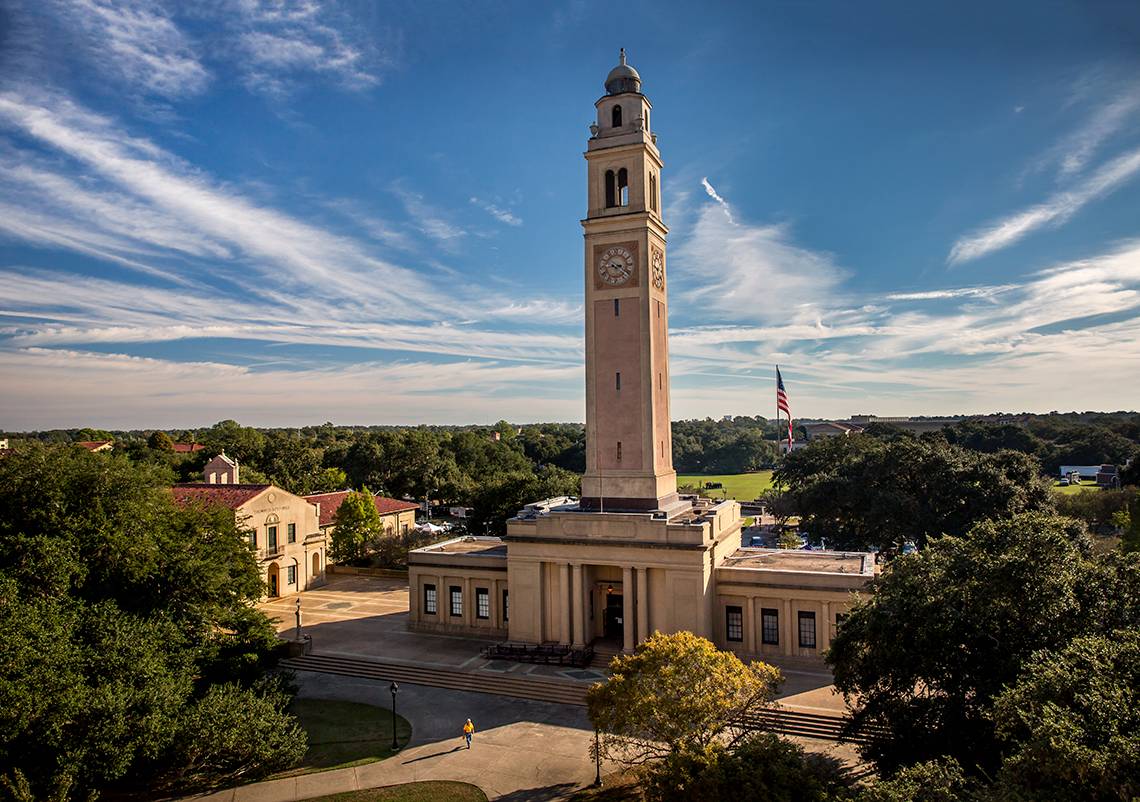
2018 Annual Physics & Astronomy Awards
2018 Annual Physics & Astronomy Awards list and gallery
Robert O'Connell 2018 College of Science Hall of Distinction Inductee
Emeritus Boyd Professor Dr. Robert O'Connell is originally from Ireland and received his undergraduate degree from the National University of Ireland Galway, which also awarded him a doctorate of science degree later on. After working four years as a telecommunications engineer, he came to the US in 1958 and got his Ph.D. in theoretical physics from the University of Notre Dame. In his 53-year career at LSU, Dr. O'Connell has made countless contributions to many areas of physics and astronomy.
Rory Bentley and Harvey Shows Named Astronaut Scholars
For more than 30 years, the Astronaut Scholarship Foundation has supported hundreds of top performing students pursuing degrees in science, technology, engineering or mathematics. This year, LSU physics majors Rory Bentley and Harvey Shows are among the top performing scholars to receive the ASF award.
Quantum Revolution - U.S. Department of Defense funds LSU physicist’s quantum sensing research
Dowling and collaborators have been awarded more than $7 million from the U.S. Army Research Office to develop quantum technologies related to sensing. Their recently received grant titled, “Quantum control based on real-time environment analysis by spectator qubits,” is funded for three years, with the possibility of a two-year extension for a total of $7.05 million. The purpose of the grant is to develop feedback and control techniques on quantum systems that will be used to improve the performance of quantum computers and sensors.
"Signature of charge migration in modulations of double ionization" by Mauger et al. Phys. Rev. A 97, 043407
We present a theoretical investigation of charge migration following strong-field ionization in a multielectron system. We study a model homonuclear molecule with two electrons, each restricted to one dimension ( 1 + 1 D ), interacting with a strong, static electric field. We show that in this system charge migration results from the interplay between multiple ionization channels that overlap in space, creating a coherent electron-hole wave packet in the cation. We also find that, in our case, charge migration following the first ionization manifests as a modulation of the subsequent double-ionization signal. We derive a parametrized semiclassical model from the full multielectron system and we discuss the importance of the choice of cation electronic-structure basis for the efficacy of the semiclassical representation. We use the ab initio solution of the full 1 + 1 D system as a reference for the qualitative and quantitative results of the parametrized semiclassical model. We discuss the extension of our model to long-wavelength time-dependent fields with full-dimension, many-electron targets.
"Non-Gaussianity in Loop Quantum Cosmology" by Agullo et al. Phys.Rev. D97 (2018) no.6, 066021
We extend the phenomenology of loop quantum cosmology (LQC) to second order in perturbations. Our motivation is twofold. On the one hand, since LQC predicts a cosmic bounce that takes place at the Planck scale, the second order contributions could be large enough to jeopardize the validity of the perturbative expansion on which previous results rest. On the other hand, the upper bounds on primordial non-Gaussianity obtained by the Planck Collaboration are expected to play a significant role on explorations of the LQC phenomenology. We find that the bounce in LQC produces an enhancement of non Gaussianity of several orders of magnitude, on length scales that were larger than the curvature radius at the bounce. Nonetheless, we find that one can still rely on the perturbative expansion to make predictions about primordial perturbations. We discuss the consequences of our results for LQC and its predictions for the cosmic microwave background.
"Low- and middle-income countries can reduce risks of subsequent neoplasms by referring pediatric craniospinal cases to centralized proton treatment centers." by Newhauser et.al
Taddei PJ, Khater N, Youssef B, Howell RM, Jalbout W, Zhang R, Geara FB, Giebeler A, Mahajan A, Mirkovic D, Newhauser WD. Low- and middle-income countries can reduce risks of subsequent neoplasms by referring pediatric craniospinal cases to centralized proton treatment centers. Biomed. Phys. Eng. Express. 4 025029 (2018).
LSU Sophomore Corey Matyas Named a 2018 Goldwater Scholar
LSU College of Science and Roger Hadfield Ogden Honors College sophomore Corey Matyas has been named a 2018 Goldwater Scholar. Matyas, a native of Dahlonega, Ga., was nominated through an internal university process earlier in the year. A list of winners was released on Friday, March 30.
SEC Selects 2018 Faculty Achievement Award Recipients: Boyd Professor Ward Plummer chosen as LSU’s honoree
The 2018 SEC Faculty Achievement Award selection from LSU is Ward Plummer, Boyd Professor of Physics. Plummer is special assistant to LSU’s vice president for research and economic development. He is a world‐renowned physicist, specializing in surfaces and interfaces phenomena
Khang Pham Awarded LSU Discover Scholar
Physics undergraduate Khang Pham, a native of Vietnam, and a McNair Research Scholar, has been named a 2018 LSU Discover Scholar awardee. Currently mentored by Professor Catherine Deibel, Pham is doing research in the nuclear physics group.
"On-orbit Operations and Offline Data Processing of CALET Onboard the ISS", Y. Asaoka, N. Cannady, M. Cherry, T.G. Guzik, J. Wefel et al., Astroparticle Phys. 100, 29 (2018)
The CALorimetric Electron Telescope (CALET), launched for installation on the International Space Station (ISS) in August, 2015, has been accumulating scientific data since October, 2015. CALET is intended to perform long-duration observations of high-energy cosmic rays onboard the ISS. CALET directly measures the cosmic-ray electron spectrum in the energy range of 1 GeV to 20 TeV with a 2% energy resolution above 30 GeV. In addition, the instrument can measure the spectrum of gamma rays well into the TeV range, and the spectra of protons and nuclei up to a PeV.
LSU Hosts International Researchers on Quantum Communication, Measurement and Computing
The International Conference on Quantum Communication, Measurement and Computing (QCMC), established in 1990 to encourage and bring together scientists and engineers working in the interdisciplinary field of quantum information science and technology, will take place March 12-16, 2018 at Louisiana State University. Organized by the LSU Quantum Science and Technologies Group (QST), the 2018 QCMC conference will highlight research areas on nano photonic quantum information and processing.
LIGO Researcher Gabriela González to be Honored as Distinguished Scientist
The Southeastern Universities Research Association, or SURA, announced that Gabriela González, professor of physics and astronomy at LSU and former spokesperson of the LIGO Scientific Collaboration, will receive the 2018 SURA Distinguished Scientist Award. The annual honor goes to a research scientist whose extraordinary work fulfills the SURA mission to “advance collaborative research and education” in the Southeast and nation.
LSU Physicist Applies New Technology to Analyze Ancient Artifacts
LSU Professor Josef Hormes will conduct this cutting-edge research on samples of prehistoric artifacts from Poverty Point at the LSU J. Bennett Johnston, Sr., Center for Advanced Microstructures and Devices, or CAMD, with support from the National Park Service.
LSU Students Receive Distinguished SPS Chapter Award
The LSU Chapter of the Society of Physics Students (SPS) received the 2016-2017 Distinguished Chapter Award from the national office of the SPS within the American Institute of Physics. SPS is an organization for students interested in the fields of physics and astronomy. Their primary purpose is to promote the appreciation and advancement of physics and astronomy in the community, as well as to further educate members in these fields. The LSU SPS group participates in multiple outreach events throughout the year, including Mini Maker Faire, NanoDays, International Astronomy Day, Earth Day, LASM Engineering Day, in addition to visits to middle and high schools for science fairs and similar events.
"Orientation dependence of temporal and spectral properties of high-order harmonics in solids" by Wu, et al.
Mengxi Wu, Yongsing You, Shambhu Ghimire, David A. Reis, Dana A. Browne, Kenneth J. Schafer, and Mette B. Gaarde Phys. Rev. A 96, 063412 – Published 18 December 2017
"Resonantly-initiated quantum trajectories and their role in the generation of near-threshold harmonics" by Camp et al.
Author: Seth Camp, Samuel Beaulieu, Kenneth J Schafer and Mette B Gaarde Published 21 February 2018 • © 2018 IOP Publishing Ltd Journal of Physics B: Atomic, Molecular and Optical Physics, Volume 51, Number 6
Graduate Student Das Published in APS Physical Review A: "Continuous-variable quantum Gaussian process regression and quantum singular value decomposition of nonsparse low-rank matrices"
Siddhartha Das, George Siopsis, and Christian Weedbrook Phys. Rev. A 97, 022315 – Published 12 February 2018
Alumni Spotlight: Leslie Austin
If anyone is a life-long learner, it's LSU Physics alumna Leslie Austin. Leslie is from Baton Rouge and always wanted to be a Tiger. After earning her B.S. in Physics in 2000, she worked for a year as a research associate for the Department of Physics & Astronomy, traveling to Antarctica as part of the Advanced Thin Ionization Calorimeter (ATIC) project. She later went to law school at the LSU Paul M. Hebert Law Center, and then began a career in human resources (HR) with a focus on labor and employment law compliance. "I thought about obtaining an MBA, but chose law school because I was always interested in the legal system, I minored in English, and I thought patent law might be a good fit with science backgrounds." Today, she is Chief Operating Officer for HR Solutions.
Small Science Wields Big Ideas - LSU celebrates NanoDays: the biggest event for the tiniest of science
For the ninth consecutive year, LSU will host NanoDays at the Highland Road Park Observatory, or HRPO, on Saturday, Feb. 24, from 2-6 p.m. followed by a presentation by David Young, a professor in the LSU Department of Physics & Astronomy, “Alternative Energy! Using nanotechnology to improve the performance of thermoelectric materials,” at 6:15 p.m.