
Prospective Students
Welcome to the LSU Department of Physics & Astronomy. We are housed in the historic Nicholson Hall at the very center of Louisiana State University's beautiful campus. Our department is one of the seven top Foundations of Excellence departments within the university and contains many world renowned physicists and astronomers who collectively bring in $8 million in federal research funding every year. This funding supports a diverse research team, including faculty, research associates, graduate students, and undergraduates. Our goal is to provide an experience of real research to every physics major at some point during their degree. Many of our students participate in research throughout their time at LSU, publish papers, and attend conferences.
Some of the department's research areas include nanotechnology, observational astronomy, experimental nuclear physics, quantum computing, medical imaging, general relativity, cosmic-ray physics, laser physics, theoretical and computational astrophysics, superconductivity, neutrino physics, quantum criticality, and gravitational-wave research. Our faculty use major national and international research facilities as well as local sites such as the Louisiana Light Source in Baton Rouge, the Laser Interferometric Gravitational wave Observatory (LIGO) about 20 miles to the east of the city, and the Mary Bird Perkins Cancer Center.
You can learn more about our active research program.
What is Physics?
Physics is about understanding how the universe around us and within us works, from the smallest scales imaginable to the entire universe. It is the most basic and fundamental of the sciences, and underpins many other sciences, such as astronomy, chemistry, oceanography, seismology, and even biology. Physics challenges our imaginations with concepts like relativity and string theory, and it leads to great discoveries, like computers and lasers, that change our lives.
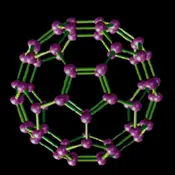
Buckeyball Physicists identify the fundamental particles of which the universe is made, and the laws, such as quantum physics and relativity that determine how they interact with each other. They study how these particles can assemble into atomic nuclei and how these nuclei combine with electrons to form atoms and molecules such as the "buckyball" shown in the picture. They explore how radiation (such as laser light) interacts with atoms and molecules and how atoms can assemble into larger structures such as crystals.
Applied physicists seek to take this knowledge and devise useful applications to society. Materials scientists develop semi-conductors, super-conductors, and nano-structures. Medical and health physicists monitor the effects of radiation on the body and develop techniques to image inside our bodies using radiation and treat cancers.
Astronomers and astrophysicists apply physics to understand how planets, stars, galaxies, and indeed the whole universe works. Observational astronomers use telescopes on the ground and on satellite to study radiation from astronomical objects: extra-solar planets, black holes, neutron stars, supernovae, gamma-ray bursts, and quasars are some of the exciting objects challenging our understanding of the universe.
What can you do with a physics degree?
A physics degree is a gateway to many opportunities. Continuing to graduate study and ultimately research in physics or astronomy is only the tip of the iceberg, although an LSU physics degree will provide an excellent foundation for such a career path. Many physicists instead seek employment outside academia in industrial physics applications or engineering. A large proportion actually end up working in computing and information technology, as the problem-solving, numerical analysis, and programming skills learned in a physics degree are very applicable there.
There are many less obvious career paths from a physics degree too. Physicists are
actively recruited by the financial sector as modeling stock markets requires many
of the same skills and techniques as modeling physical systems. A physics degree,
coupled with a pre-med track, is an excellent preparation for medical school, or a
career in medical and health physics. A physicist who continues to law school is ideally
qualified to work in patent law. Physicists can find employment in journalism, whether
for specialist scientific journals or major newspapers.
Explore Our Concentrations and Minors
The core courses for a physics major train you in critical thinking, experimental technique, technical writing and quantitative analysis. This leads you to a wide variety of opportunities in science, engineering, teaching, government and business.
The physics core begins with a three-semester survey of calculus-based physics, both classical and modern physics, along with training in experimental technique and data analysis. This is accompanied by three courses in calculus.
Each of the subjects covered in the introductory survey is then investigated in greater depth and with more sophisticated mathematics. Along with this are courses in electronics, differential equations, linear algebra, computer programming, and scientific computation.
Outside of the core, you can specialize in a particular area through one of our concentrations.
Concentrations
Physics
The Physics Concentration is for physics majors interested in traditional areas of physics. The hours in the concentration allow you to explore advanced physics topics in more detail. It is intended to provide a solid basis for graduate study in physics as well as a launching point for the many other careers available to a physics graduate.
Astronomy
The Astronomy concentration provides an excellent grounding in astronomy and astrophysics
as preparation for graduate study and is
also well suited to anyone else interested in astronomy. You will take elective courses
in stellar and galactic astrophysics, modern optics, and carry out an observational
astronomy project at the Highland Road Park Observatory.
Medical Physics
The Medical Physics concentration is designed for students interested in applying the principles of physics to medicine and human health. Along with core physics courses, you will study chemistry, biology, and specialized medical physics topics. The concentration provides strong preparation for graduate study in medical physics and related fields, leading toward careers in medical imaging, radiation therapy, and other healthcare technologies.
Physics & Second Discipline
The Physics with a Second Discipline concentration is for students who wish to combine a study of physics with another subject, either a minor or a double-major in order to tailor their degree to their interests and career goals. Common choices for the second discipline are math, some other science or engineering, but we have also had students with a second concentration in art, music, and psychology.
Secondary Education
The Physics with Secondary Education concentration is for students wishing to pursue a career in science teaching in grades 7-12, it is a part of LSU's Geaux Teach Program.
Minors
Physics Minor
Students who are not majoring in physics may opt to obtain a minor in physics. To complete a minor in physics, you first need to complete the introductory physics sequence with the labs. That would be either PHYS 1201, 1202, 1208 and 1209, or PHYS 2110, 2112, 2113, 2108 and 2109. In addition, you must complete PHYS 2221 and three additional lecture or lecture/lab courses. At least one of the courses should be at the 4000 level. The lecture courses can be chosen from PHYS 2203, 2231, 2411, 3098, or any three-credit-hour PHYS or ASTR courses numbered from 4100 to 4299. The total number of hours to obtain a physics minor is 22-23 hours, depending on which introductory physics sequence you choose.
Nuclear Science Minor
Any undergraduate student who wishes to learn more about nuclear science can earn the Nuclear Science Minor. The Minor requires an introductory physics sequence that uses calculus. This can be either PHYS 1201, 1202, 1208 and 1209, or PHYS 2110, 2112, 2113, 2108, 2109. The minor then requires 12 additional credit hours chosen from the following list: PHYS 2203, PHYS 3098, PHYS 4271; MEDP 4331, MEDP 4351/4352; NS 4352, NS 4411, NS 4570.
Physics majors who want to earn this minor must choose at least 9 of their hours from courses not being used for their physics major.
How to Apply
All undergraduate admissions are handled by the University's Office of Undergraduate Admissions. The deadline for normal Summer or Fall admission is April 15, and you can find out how to apply from the Undergraduate Admissions office.
If you wish to enter the Honors College, you must apply by November 15.
Other university information for prospective students is also available from the LSU website.
Financial Aid
The Department of Physics and Astronomy does not currently have any scholarships for incoming freshmen. There are several scholarships and awards available at a later stage to our top students. For many students paid research work takes the place of a scholarship. We endevour to provide a job to all students who are interested. We will hold a welcome meeting at the beginning of the fall semester and try to find a position for students as soon as possible. Many freshman are able to start work right away.
The university has several scholarship and financial aid packages. Typically the scholarships do require you to undertake work of some kind, and ideally this should be a research job.
The research work we offer is real research, working with professors using the same data and tools as they use. Some students undertake fieldwork as part of this experience, such as the ACES team, others may attend conferences. Most are either first-authors or co-authors on papers in major science journals. Increasingly graduate schools are looking for this kind of experience in applicants, and so we strongly encourage you to make the most of the opportunities that we can offer.