
Geology & Geophysics News
These Rocks Weren’t Supposed to Be There. They Helped Reveal How a Young Ocean Formed
Deep below the Tyrrhenian Sea offshore Italy, scientists drilled into what they thought would be dark mantle rock — and found pieces of granite that seemingly had no business being there. Those unexpected intrusions turned out to offer a rare glimpse of how a massive fault rapidly pulled deep Earth rocks toward the surface during the opening of a young ocean basin.
Louisiana needs seismic network to understand rash of earthquakes, regulators say
State regulators and LSU officials are working to create a seismic monitoring network to understand a rash of earthquakes in northwest Louisiana as questions mount over whether activity related to oil and gas production is to blame.
The Gulf will someday overwhelm coastal Louisiana. Planning should start now, study says.
A team of scientists is urging Louisiana to begin planning now for how to relocate entire communities away from the coast, warning that sea levels may eventually rise high enough to overtake New Orleans.
Earth is Splitting Open Beneath the Pacific Northwest, Scientists Say
For the first time, scientists have watched a subduction zone literally fall apart beneath the ocean floor. Using advanced seismic imaging, they found the Juan de Fuca plate splitting into fragments as it sinks beneath North America. Rather than collapsing all at once, the plate is tearing piece by piece, like a train slowly derailing. The finding helps explain ancient plate fragments and could refine how scientists understand earthquake behavior.
The Hunt for Rare Earths: LSU Minerals Analysis Could Help Secure America’s Tech Future
Only 30 of the 600 carbonatite formations worldwide contain enough rare earth elements (REEs), vital to electronics and defense systems, to make commercial production viable. Two confirmed locations lie in the United States, with exploration continuing. The U.S. must find new deposits of REE-containing minerals to secure its supply chain. LSU has developed analytical procedures to identify, describe, and define REEs’ key physical, chemical, and structural properties, positioning the university as a potential service center for researchers and companies worldwide.
Louisiana Considered Episode: Suspected Causes of Shreveport Earthquakes
Karen Luttrell in the Geology and Geophysics Dept was interviewed by Bob Pavlovich at Louisiana Considered about the recent flurry of earthquake activity in Louisiana
Is Louisiana’s Coastline Doomed? Scientists Urge a Closer Look
Louisiana’s coastline has long been recognized as vulnerable. But a high-profile 2024 study brought that reality into sharper — and more alarming — focus, warning that under continued sea-level rise, much of the state’s coastal wetlands may not survive the coming decades. Analyzing data from hundreds of monitoring sites across the state, the study found that most wetlands are not keeping pace with rising water levels. Under a moderate climate scenario, the authors projected that as much as 75% of Louisiana’s wetlands could drown by 2070. But scientists are now urging a more nuanced interpretation of what those projections mean — and how they should guide the future of coastal restoration. In a follow-up publication in Nature Communications, LSU-affiliated researchers and collaborators take a closer look at how those conclusions apply across Louisiana’s highly variable landscape. Their analysis does not dispute the scale of the threat. Instead, it asks a different question: Are all wetlands responding to rising seas in the same way? Their answer: not necessarily — and that difference matters.
LSU professor's research could help NASA's future Artemis missions
One LSU professor is researching methods that could potentially assist NASA in their goal of building a fully inhabited base on the surface of the moon. Matthew Loocke, Lab Director and Assistant Professor of Research with LSU's Department of Geology and Geophysics, studies samples from deep space meteorites.
LSU Researchers Earn Prestigious AAAS Fellow Honor for Excellence Across Disciplines
Two faculty members from the LSU College of Science, Peter Doran and Bret Elderd, and Lucio Miele, Director of the LSU LCMC Health Cancer Center, have been named Fellows of the American Association for the Advancement of Science (AAAS), joining the prestigious 2025 class.
LSU Geologists Lead at International Tourmaline Conference in Madagascar
Two faculty members from LSU’s Department of Geology and Geophysics played key leadership roles at the Fourth International Conference on Tourmaline, known as TUR2025, held July 18-23 in Antsirabe and surrounding regions of Madagascar, one of the world’s premier sources of gem-quality tourmaline.
Researchers at LSU, Tulane discuss rare Louisiana earthquake
Parts of Northwest Louisiana were shaken by an unexpected wake-up call early Thursday morning as a 4.9-magnitude earthquake struck near the town of Edgefield.
LSU scientists upgrade scanning electron microscope, expanding geological research
Two LSU researchers applied two major software upgrades to the school’s scanning electron microscope, opening the doors to further geological research and information.
LSU’s SEM Upgrade Powers Geological Discovery
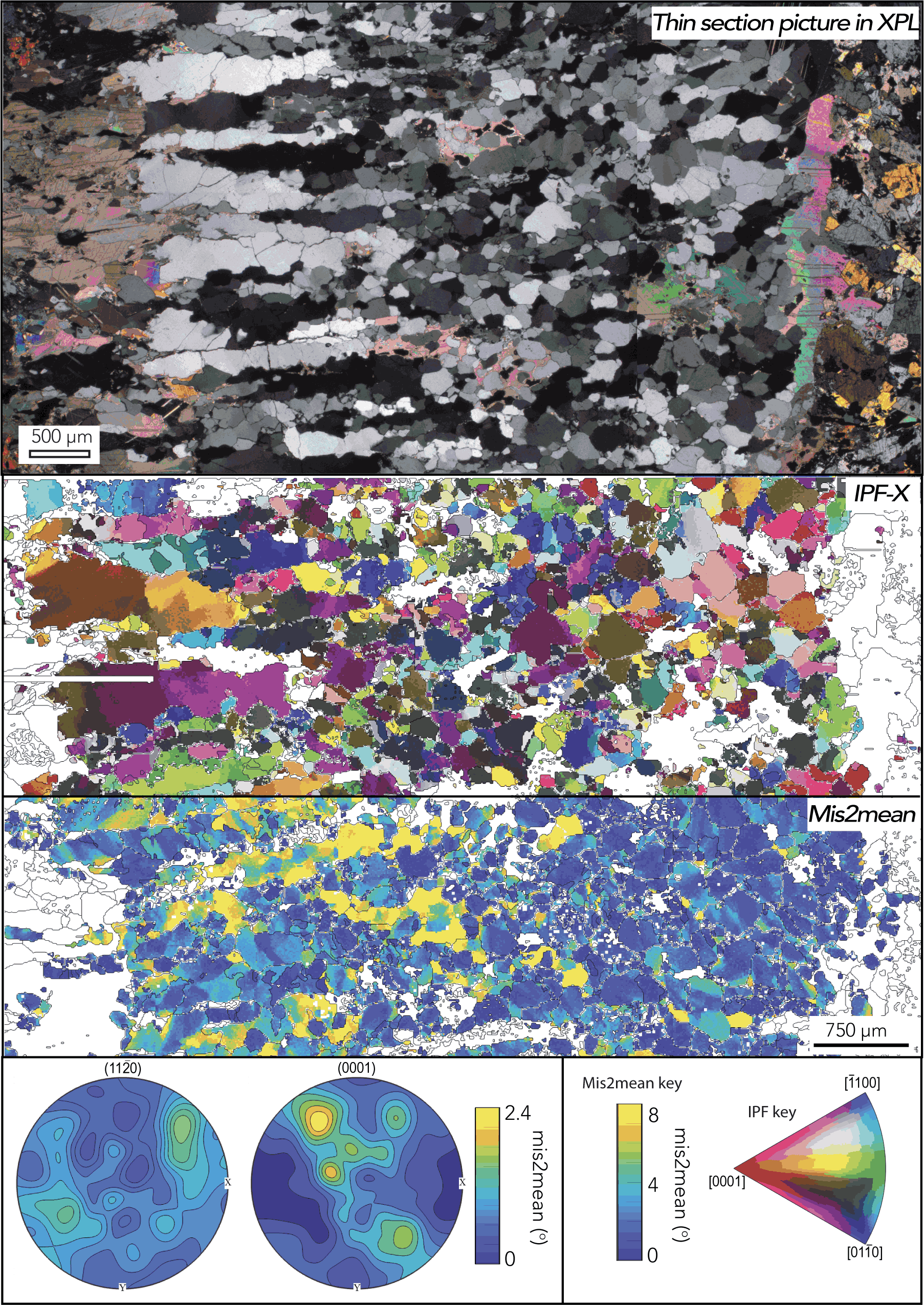
Groundbreaking research often requires tools that let scientists see beyond what the human eye can detect. At LSU, two professors in the Department of Geology and Geophysics, Assistant Professor Eirini Poulaki and Assistant Professor Brandon Shuck, are leading a transformative upgrade to the Scanning Electron Microscope (SEM) housed in the LSU Advanced Microscopy and Analytical Core (AMAC), giving researchers clearer, deeper views into the materials they study.
Discovery: Frontiers of Earth Science
A new episode of the BBC’s Discovery series explores recent Earth science research featured at the American Geophysical Union (AGU) meeting in New Orleans. The episode spotlights the Mississippi River’s Bird’s Foot Delta, where Dr. Carol Wilson, Associate Professor in LSU’s Department of Geology and Geophysics, explains how these wetlands protect coastal communities—and why they are increasingly threatened by sea level rise and reduced sediment supply.

LSU Rover to Hunt Hidden Ice on Mars and the Moon
LSU researchers are developing a rover to ‘prospect’ for ice on the Moon and Mars, in support of NASA’s Moon to Mars Program.
Earth’s Crust Is Tearing Apart Off the Pacific Northwest — and That’s Not Necessarily Bad News
With unprecedented clarity, scientists have directly observed a subduction zone—the collision point where one tectonic plate dives beneath another—actively breaking apart. The discovery, reported in Science Advances, sheds new light on how Earth’s surface evolves and raises fresh questions about future earthquake risks in the Pacific Northwest.
Selenium’s Toxic Trait: From Essential Nutrient to Coastal Threat for Louisiana’s Shellfish and Economy
Selenium is essential to human health but has a narrow margin between benefit and toxicity, making its accumulation in the environment a concern for both ecosystems and public health. This balance is the focus of Associate Professor Achim Herrmann’s research, which bridges geology, biology, and chemistry to examine how changes in oceanic and atmospheric oxygen affect trace elements like selenium, tracking their movement through sediments, organisms, and the food chain.
LSU Professors Join Historic Effort to Drill Earth's Mantle and Retrieve Rare Deep-Earth Samples
Beneath our feet lies a hidden world of searing rock, constantly churning and shifting, driving the slow yet relentless movement of Earth’s tectonic plates. The mantle, positioned between the crust and the core, powers volcanoes, can flow like honey or break in earthquakes, and even forms diamonds. Despite comprising 84% of the planet's volume, this vast layer remains largely a mystery. Now, a groundbreaking expedition—including two LSU professors—has successfully drilled into the mantle, recovering rocks never before observed. Their discoveries could transform our understanding of plate tectonic processes, natural hazards and uncover potential new energy resources.
“Core on Deck!” LSU Graduate Student Digs Deep into Mediterranean Seabed Secrets
LSU Geology and Geophysics PhD student Danielle Noto joined the NSF-funded IODP Expedition 401 aboard the JOIDES Resolution. The 60-day mission studied ancient water exchanges between the Mediterranean and Atlantic, aiming to understand their impact on local and global climate. Noto's work continues at LSU, focusing on palynology to uncover more about Earth's climatic history.
Saving the Mississippi Delta
The day after stepping down as Vice President for Research and Economic Development at LSU, Bentley received a substantial $3.8 million grant from the Bureau of Ocean Energy Management. Just over a year later, he now co-leads a 15-member consortium known as The Mississippi River Delta Transition Initiative. This impressive $22 million initiative, funded by the Gulf Research Program (GRP) of the National Academies of Sciences, Engineering, and Medicine, aims to safeguard the Lower Mississippi River Delta.