
New Theory Shows How Altermagnets Could Guide Electron Spins
September 18, 2026
As electronic devices become smaller and more powerful, engineers need to pack more information-processing components into increasingly tiny spaces. For technologies that rely on magnetism, that creates a fundamental problem: magnetic fields spread. Put magnetic components too close together on a chip, and the field from one can interfere with its neighbors.
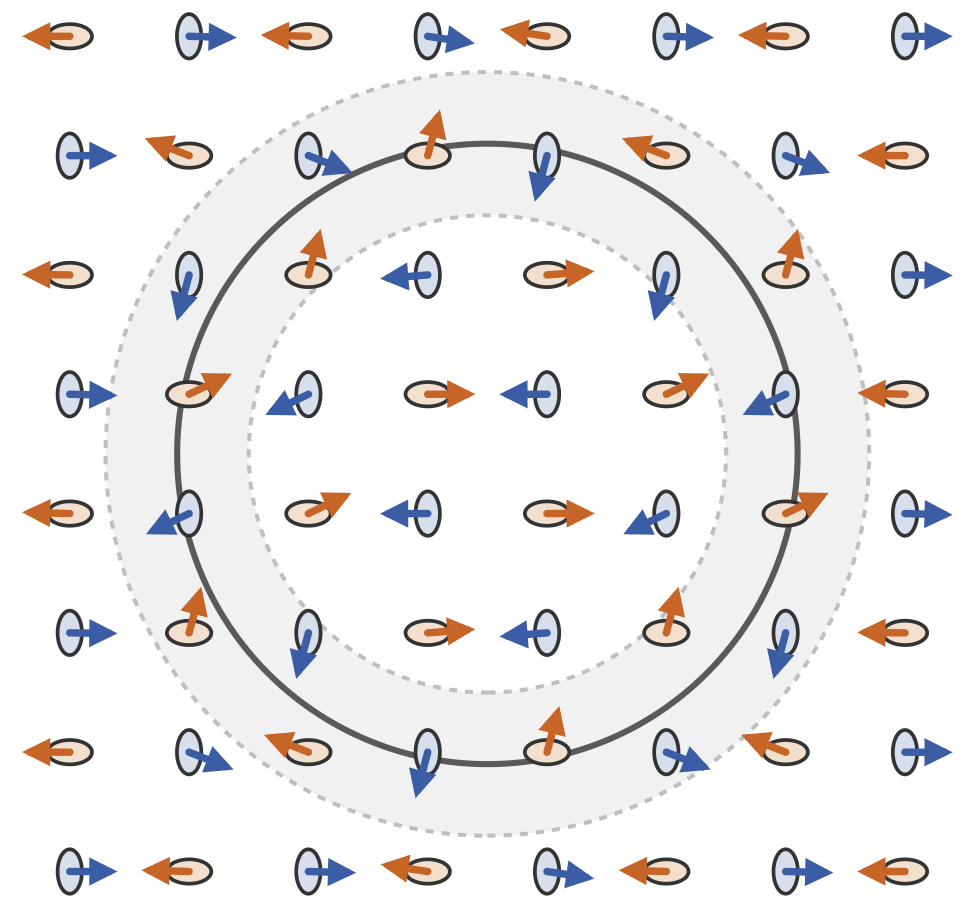
Illustration of a circular domain wall in an altermagnet. The orange and blue arrows show alternating magnetic moments gradually changing direction across the shaded ring, creating a texture that can steer electrons differently depending on their spin.
That is one reason physicists are interested in a newly recognized class of materials called altermagnets. Inside these materials, tiny magnetic moments point in alternating directions — one up, the next down — so their magnetizations cancel each other out. The material as a whole has no net magnetization.
But the cancellation does not make the two directions equivalent. Because of the way atoms are arranged in an altermagnet’s crystal structure, electrons with opposite spins can have different energies and behave differently as they move through the material. Altermagnets can therefore interact differently with spin-up and spin-down electrons without producing the overall magnetic field of a conventional magnet.
That unusual combination could be useful for spintronics, an approach to electronics that uses an electron’s spin to carry and process information. Just as electric charge can represent the 1s and 0s of conventional electronics, two spin orientations — often called spin-up and spin-down — can encode different information states.
That makes altermagnets promising candidates for spintronics. But another challenge remains: researchers need a way to control where spin information goes.
In a new study published in Science Advances, LSU theoretical physicist Constantin Schrade and collaborator Mathias S. Scheurer of the University of Stuttgart show how the magnetic patterns inside altermagnets could provide that control. Their theory predicts that gradual twists in the material’s magnetic order can steer electrons with opposite spins along different paths.
These gradual changes in the microscopic magnetic pattern are known as altermagnetic textures. Instead of the alternating magnetic moments maintaining the same orientation throughout the material, their direction slowly rotates from one region to another. One example is a domain wall, a boundary between regions with different orientations of magnetic order.
Their calculations show that these spatial variations change how electrons move through the material. Electrons with opposite spins effectively experience distinct curved geometries.
Shaping the landscape
Schrade compares the effect to sending two balls across two different landscapes. Give both balls the same push, but place a hill in the path of one and a valley in the path of the other, and they will follow different routes.
In an altermagnet, the magnetic texture shapes those effective landscapes. Change the texture, and the paths taken by spin-up and spin-down electrons change with it.
“If we can engineer the texture, we engineer the landscape,” Schrade said. “Then we can determine where spin-up goes and where spin-down goes.”
The underlying physics involves quantum geometry. Near a domain wall, Schrade and Scheurer found that the spatial change of the electron’s spin state can be described using a quantity called the quantum metric. In an altermagnet, this metric combines with the material’s spin-dependent electronic structure to give opposite spins different effective geometries.
One consequence is electronic lensing. The theory predicts that an altermagnetic domain wall can bend, focus or defocus electron trajectories, much as a glass lens bends light. The amount and direction of the bending depend on the electron’s spin and on the orientation of the magnetic texture relative to the crystal.
A fingerprint for altermagnetism
The work also offers a possible way to identify altermagnetic order, which remains experimentally challenging.
Schrade and Scheurer predict a characteristic multi-lobed pattern of spin polarization around certain magnetic textures. The shape of this pattern acts like a fingerprint of the underlying altermagnetic order and could be imaged using techniques such as scanning SQUID or nitrogen-vacancy magnetometry.
The study is theoretical, and altermagnets remain a young area of fundamental research. But it gives experimentalists concrete predictions to test while pointing toward a longer-term possibility: using magnetic textures to route spin information without the net magnetization of conventional magnets.