
Near-Peer Mentoring Helps Graduate Students Turn Coursework into Published Science
October 28, 2026
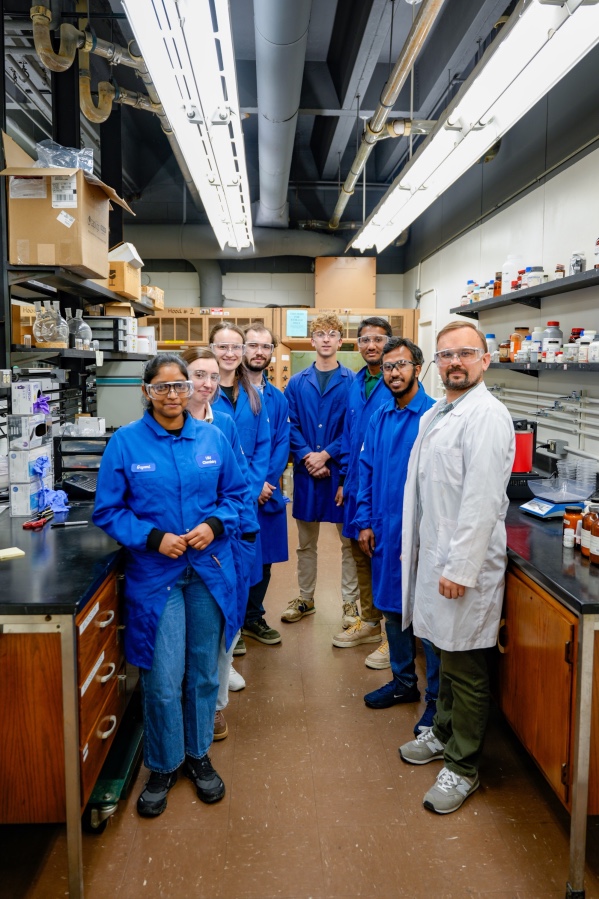
left to right, Gayomi Samarakoon, Spencer Watts, Olha Pokhvata, Riley Patterson, Matthew Awbrey, Thimira Kandabadage, Md. Rashed Alam, Sviatoslav Baranets.
– Photo by Olivia Crowell
For undergraduate and graduate students from four departments at LSU, a course assignment became an introduction to scientific publishing, with fellow graduate researchers helping guide the way.
Thimira Kandabadage, Gayomi Samarakoon, Spencer Watts, Olha Pokhvata, and Md. Rashed Alam led research projects and mentored students enrolled in an X-ray crystallography course offered by the Department of Chemistry. The work resulted in seven papers published in Acta Crystallographica Section C as part of a special issue highlighting early-career scientists in structural science.
The project grew from a course revived in spring 2024 by Dr. Sviatoslav Baranets, an assistant professor in the LSU Department of Chemistry. The course was offered again in spring 2026, with nine students enrolled. Through near-peer mentoring, students further along in their research helped course participants analyze newly discovered compounds and develop their findings into scientific papers.
Turning classroom work into published research
Baranets designed the final project in CHEM 7770, a graduate X-ray crystallography course, around unpublished compounds discovered mostly by the Baranets research group. Students interpreted single-crystal diffraction data and refined structural models. They also examined chemical structures and prepared reports in the format expected for scientific publication.
“Unlike your typical class assignment, all of these structures were unpublished structures from our lab,” said Spencer Watts, one of the graduate mentors. “This allowed for the new students to get hands-on experience with the process of crystallographic analysis, data curation, and manuscript drafting.”
Working with the graduate researchers who had discovered the compounds, students connected their structural analyses to broader questions about the materials’ chemistry. The teams incorporated additional research and electronic structure calculations to explain how atomic structures influence bonding, continuing after the semester to verify results and revise manuscripts.
The collaboration brought together undergraduate, master’s, and doctoral students from chemistry, chemical engineering, physics, and biological sciences. Baranets provided scientific feedback and final edits as the teams prepared their work for publication.
Learning to lead through near-peer mentoring
For the five graduate researchers, the project offered an opportunity to develop as mentors and leaders while taking greater responsibility for their research. They also served as corresponding authors, managing communication with the journal editors throughout the submission and review process, taking responsibilities usually reserved for principal investigators.
Samarakoon focused on helping students interpret their results and communicate their findings. “One of the biggest lessons I learned was how to become a better mentor and guide students through the research process,” Samarakoon said.
She also emphasized the work required to move from a structural analysis to a complete scientific paper. “Understanding the chemistry, interpreting the results, and turning those findings into a publication require much more effort and collaboration,” she said.
Pokhvata also carried lessons from the course to her own research, leading a study of EuSnAs and its crystallographic and electronic structure. “I learned how to look more deeply into crystal structure data and understand the details behind the structures, starting with the basics from class and applying them to more complex systems in my own research,” Pokhvata said.
The other graduate researchers led projects spanning several areas of inorganic chemistry. Kandabadage worked on a praseodymium chlorosilicate with undergraduate and high school students, and a molybdenum-containing compound, while Samarakoon led a study of bismuth clusters and contributed to a hybrid halide project led by Riley Patterson, a first-year graduate student enrolled in the course. Watts led research on two mixed-metal oxides, and Alam studied new europium-gallium-arsenic and barium-indium-arsenic compounds.
Building on LSU’s crystallography tradition
The course renewed LSU's longstanding tradition of crystallography education.
Baranets brought back the X-ray crystallography course after it had been dormant for a decade or more. He drew inspiration from earlier LSU instructors, including Dr. Frank Fronczek and Professor Steve Watkins, who taught the course and published short structural reports with students in Acta Crystallographica Section E.
Baranets wanted to preserve that connection between classroom instruction and scientific publication while taking the research further.
"Publication was part of the plan from the beginning, since my group produces dozens of new compounds every year and all of them can and should be published” Baranets said. “I wanted to implement a multi-layered mentorship approach and to show course participants how their structural reports from the coursework could develop into complete scientific papers, while allowing graduate researchers to mentor others, take leadership responsibilities, and guide a project through publication. This created an incredible collaborative research culture.”
With nearly 50 years of service to LSU, the X-ray crystallography facility continues to support research and student training, providing the equipment and diffraction data used in the seven papers submitted in only a few months. Students also gained practical crystallography experience and learned how data quality shapes the conclusions they can draw.
Expanding opportunities for future students
The project showed how a classroom course can become a starting point for scientific discovery, collaborative research, and scientific publishing, and Baranets wants to expand these opportunities to more students.
“In the future, we plan to transform this 7000-level course into a 4000-level course, making it more accessible for a broader body of interested students, including undergraduate students,” he said. “We also want to further leverage the excellent capabilities of the X-ray facility at LSU toward educational goals.”
He hopes the proposed change will give future Tigers the opportunity to discover that their first published paper might begin with a class assignment.
Explore the research
Read the papers published in Acta Crystallographica Section C: Structural Chemistry:
- Patterson, R. B., Samarakoon, S. M. G. K., Watts, S. R., and Baranets, S. (2026). Ionic liquid-assisted synthesis, crystal structures, and electronic structure characterization of novel hybrid organic–inorganic chloride compounds [BMIm]ₘ[MClₙ] (M = Cd, Se, Sn, Bi; n = 4, 6; m = 2, 3).
- Alam, Md. R., Lane, R., Khajkini, M. P., and Baranets, S. (2026). Eu₅Ga₂As₆ and Ba₅In₂As₆₋ₓSbₓ: new As-containing members of the Sr₅Al₂Sb₆ structure type.
- Pokhvata, O., Butler, G. Q., and Baranets, S. (2026). EuSnAs: the first arsenide adopting the NbCrN structure type.
- Watts, S. R., Ante, D. A., and Baranets, S. (2026). When the crucible contributes: serendipitous formation, flux reactivity, and crystal and electronic structures of two aluminium-bearing mixed-metal oxides, Ba₂.₁Pb₀.₉Al₈.₈In₂.₂O₂₀ and BaAl₁.₆Ga₀.₄O₄.
- Kandabadage, T., Ibrahim, S. M., and Baranets, S. (2026). Synthesis, structural characterization, and electronic structure of monoclinic α-[SeCl₃][MoOCl₄].
- Madura, E., Weng, D., Kandabadage, T., and Baranets, S. (2026). Crystal and electronic structure of heteroanionic praseodymium chlorosilicate Pr₃Cl₅[SiO₄].
- Samarakoon, S. M. G. K., Estrella, C. N., and Baranets, S. (2026). Homopolyatomic bismuth cluster compound Bi₈[AlBr₄]₂: synthesis, structural characterization, and electronic structure.