
Frank Fronczek and a Half Century of Crystallography at LSU
September 23, 2026
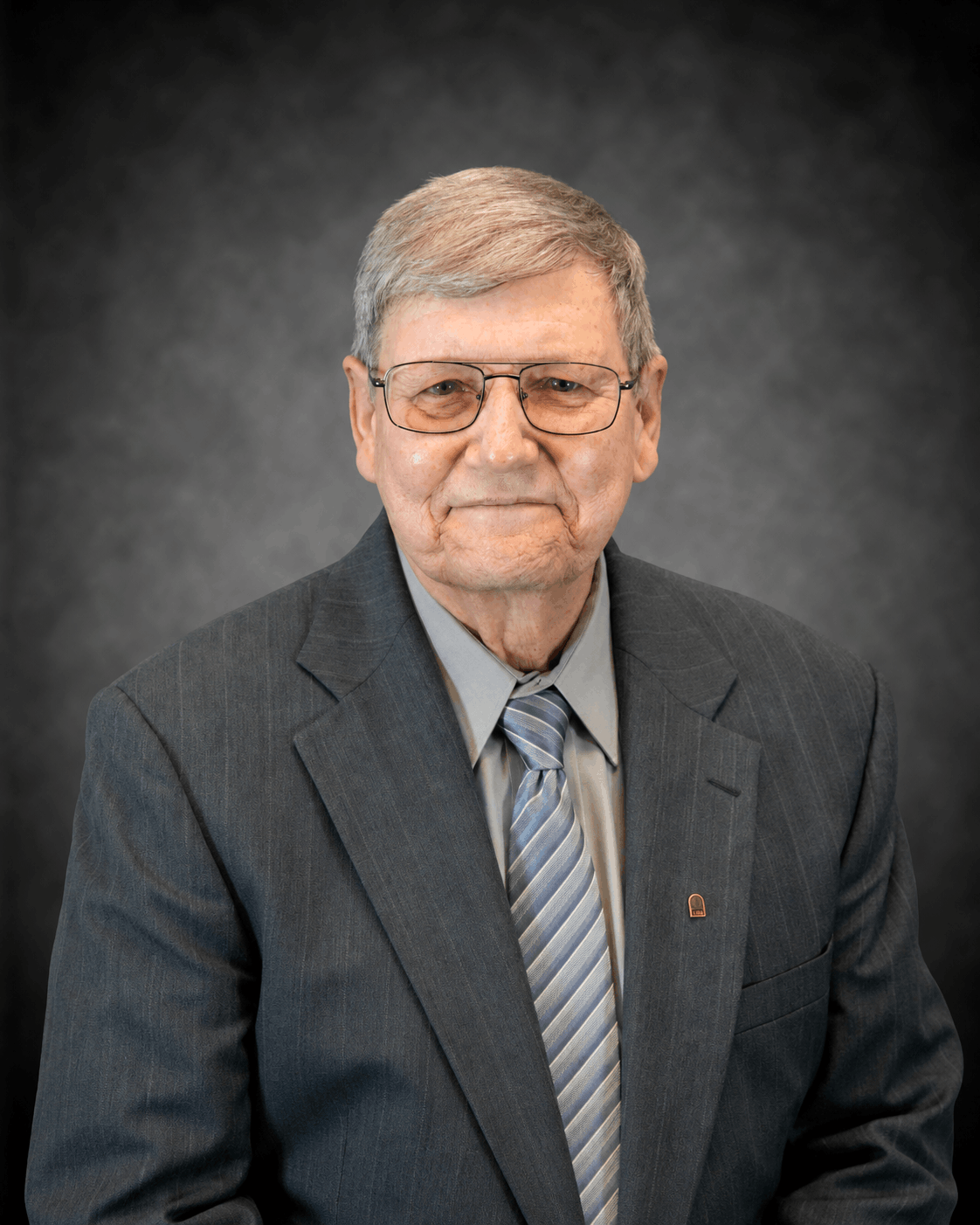
Dr. Frank Fronczek, Crystallographer, LSU Department of Chemistry
For 50 years, when LSU chemists grew a crystal and needed to know exactly what they had created, the answer often began with Dr. Frank Fronczek. From natural products and metal complexes to molecular materials, dyes and compounds destined for biomedical research, thousands of samples have made their way to LSU’s X-ray Crystallography Facility.
There, Frank spent his career as a crystallographer using X-rays to reveal how atoms are arranged in three dimensions, often providing the structural evidence researchers need to understand a new molecule, explain an unexpected result or confirm that a synthesis worked.
At a September 4 colloquium recognizing Frank’s 50 years at LSU, the Department of Chemistry community reflected on the role he has played in advancing research across generations of chemists. He has helped answer one essential question: “What exactly did we make?”
The scale of those answers is remarkable. According to the Cambridge Structural Database’s (CSD) 2026 author statistics, Frank is associated with 4,387 crystal structures, ranking him ninth in the world among all CSD authors. He ranks second worldwide for CSD Communications, with 2,165 structures shared directly through the database. The CSD, maintained by the Cambridge Crystallographic Data Centre, is considered the definitive repository for experimentally determined small-molecule organic and metal-organic crystal structures.
Those numbers, however, tell only part of Frank's story.
An LSU story that started early
Frank's relationship with LSU predates his career, and even his time as a student.
Growing up in the piney woods near Lake Charles with a Polish-American father and a Texan mother, Frank and his brother, later an LSU Physics graduate, raised sheep. Some of his earliest trips to LSU were for livestock shows. Later came high school literary rallies, science fairs and marching band competitions. By the time he graduated from high school, an influential science teacher had helped convince him that chemistry was his path and LSU was where he wanted to study it.

Frank Fronczek (left) with his older brother at an LSU livestock show (1956).
He arrived at LSU as an undergraduate in 1966 and graduated in 1970. Along the way, he met fellow chemistry major Rosalind (Roz) Segesta, who would become his wife, a milestone he ranked as the greatest achievement of his undergraduate years.
Frank and his classmates often studied together in the chemistry library on the second floor of Coates Hall. On the shelves behind their usual table sat copies of Acta Crystallographica. Curious about the unfamiliar journal, he would occasionally pull down a volume and look through its images of crystal structures.
“I said, ‘Hey, that’s kind of neat,’” Frank recalled. At the time, he could not have imagined that crystallography would become his career, or that he would later spend nine years as a co-editor of that journal.
Graduate school took him west to the California Institute of Technology, where crystallography captured his attention again. His 1975 Caltech dissertation, “Structural Studies of Binuclear Cobalt(III) Cyano Complexes,” placed him squarely in a field that would define the rest of his career. He conducted postdoctoral research at the University of California, Berkeley, doing actinide research, before returning to LSU in 1976.
“I thought I would be here for one year when I came,” Frank said. “Turned out to be a little bit longer than that.”
A little bit longer became half a century.
The thrill of seeing something first
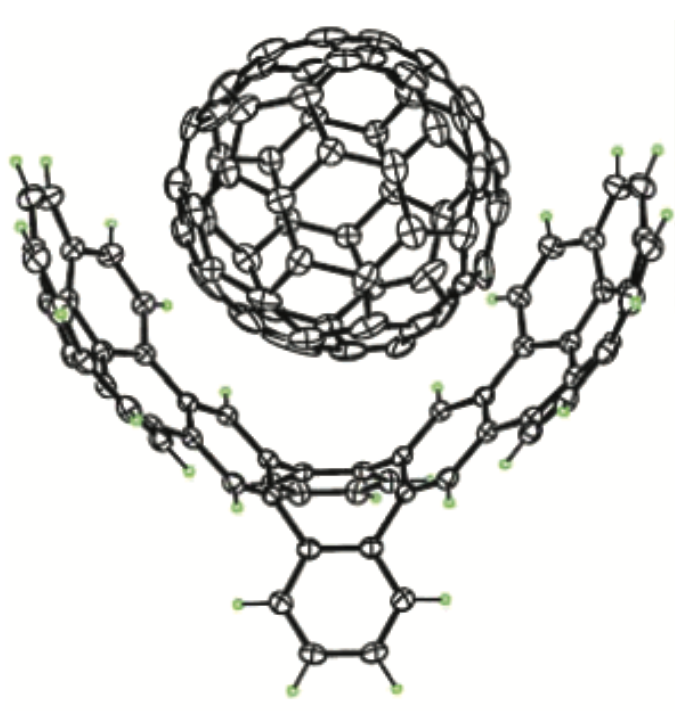
A molecular embrace: The “buckycatcher” holds a soccer-ball-shaped carbon molecule between its two curved arms. Frank Fronczek helped determine the crystal structure, which was reported in 2007.
For Frank, the enduring appeal of crystallography lies in the moment an unknown molecular structure comes into view.
Synthetic chemists sometimes bring him the only existing sample of a newly created compound, the entire known supply held in a few tiny crystals. When its structure appears on the screen, Frank may become the first person to know exactly how its atoms are arranged.
“I’m looking at that picture that pops up on the screen, and I’m the first person ever to see that, to know that,” he said. “There’s a bit of a thrill in that as well.”
That excitement connects him to his scientific lineage. Frank considers Nobel laureate Linus Pauling his “scientific grandfather.” Pauling mentored Richard Marsh, who later mentored Frank at Caltech, and once described the same pleasure of knowing a molecular structure before sharing it with the world.
Asked which structures stood out from his career, Frank recalled mannitol, a small sugar alcohol once believed to exist in five or six crystalline forms, known as polymorphs. His work showed that several reported forms were incorrect and that only three were known at the time. Roughly two decades later, that conclusion remains widely cited.
Another favorite was a “buckycatcher,” a molecule with two bowl-shaped sections that embrace a soccer-ball-shaped carbon molecule C60, known as a buckyball. Reported in the Journal of the American Chemical Society in 2007, the crystal structure revealed how these molecular “nanotongs” held their tiny guest.
The project also had strong LSU ties. Coauthor Peter W. Rabideau was a former dean of the College of Science, and two other coauthors had been his LSU students. Solving the structure, however, required Frank to become a student himself. When he encountered an unfamiliar crystallographic problem, coauthor Marilyn M. Olmstead of the University of California, Davis, taught him how to handle it. “Never too old to learn,” he said.
From punch cards to structures in minutes
Frank’s career also provides a window into the advancement of crystallography itself. When he began graduate school, determining a single crystal structure could take weeks or even a month. Early in his LSU career, before the department had working instrumentation of its own, Frank gathered crystals and drove to Tuscaloosa or Houston to collect data. He returned to Baton Rouge with boxes of punch cards for calculations on LSU’s mainframe computer, a routine he jokingly called “freeway crystallography.”
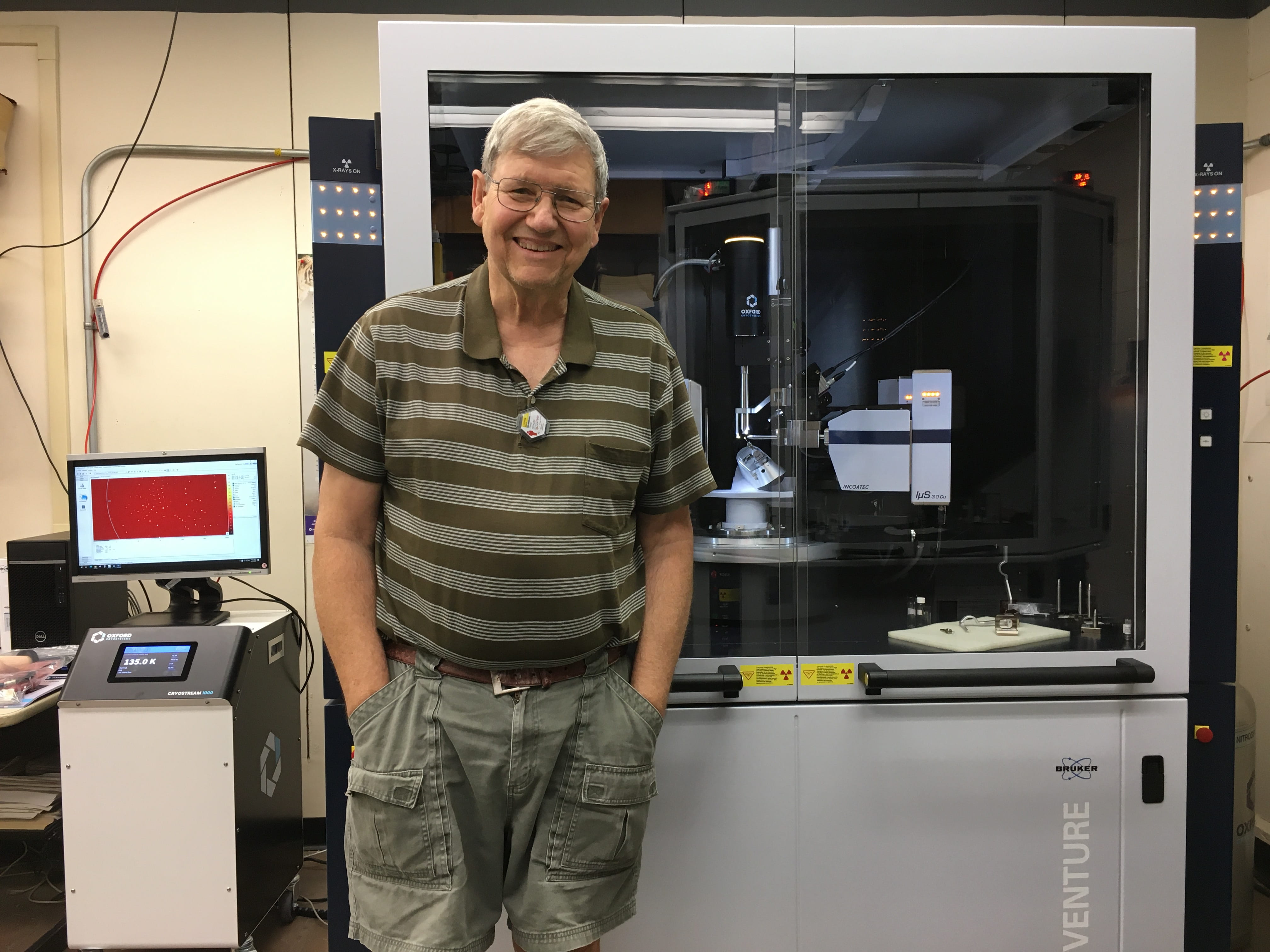
Frank Fronczek beside the D8 Venture X-ray diffractometer, used to determine the atomic structures of crystalline materials.
That experience helped build the case for LSU to invest in its own instrumentation. In 1980, the department established the X-ray facility, with its first diffractometer through National Science Foundation support. Subsequent instruments and upgrades were funded by NSF, the Louisiana Board of Regents and the LSU College of Science.
LSU Chemistry Professor Les Butler played an essential role in securing the facility’s newest instrument, Frank recalled, helping initiate and develop the proposal that made the acquisition possible. Today, LSU’s facility includes advanced Bruker diffractometers capable of studying small, weakly scattering crystals and collecting data at controlled low temperatures. What once required weeks can now happen in hours, or sometimes minutes.
“Crystallography has changed a lot,” Frank said. With modern instruments, software and computing power, “nowadays we can get a publishable structure in maybe two or three hours, or a picture of a molecule in minutes.”
The speed, however, introduces a different challenge. Automated software can create the impression that crystallography is simply a matter of pushing a button and waiting for an answer. “It falls out the bottom, but it may or may not be right,” he said.
That is why he has emphasized theory and scientific judgment when training students. He wants them to understand why crystallography works well enough to recognize when an automated result is wrong. Even selecting a crystal remains deeply human work. Under a microscope, a researcher must search through a sample and identify the single best crystal for analysis.
As the technology evolved, he built expertise in difficult cases involving disordered structures, twinned crystals, air-sensitive materials and molecules that refused to behave as expected. That ability to work through challenging problems made him a valued collaborator across a wide range of research.
A facility built through collaboration
Over five decades, Frank’s expertise carried him well beyond the traditional boundaries of chemistry. His collaborators included researchers across LSU, universities throughout Louisiana and the nation, government laboratories and institutions abroad. His work even extended into forensic anthropology through a collaboration with LSU FACES Laboratory founder and retired forensic anthropologist Mary Manhein, widely known as “The Bone Lady.”
Long-running LSU collaborations included Professors Emeriti Andrew Maverick and George Stanley in inorganic chemistry; Boyd Professor Graça Vicente in porphyrins, BODIPY dyes and compounds with biomedical applications; and Professor Julia Chan, now at Baylor University, solid-state and materials chemistry. More recent work has included research connected with Assistant Professors Sviatoslav Baranets and Clifton Wagner.
That wide-ranging impact is reflected in a career encompassing more than 1,200 publications across 135 journals and nearly 1,800 co-authors. The Cambridge Crystallographic Data Centre recognized that extraordinary reach by including Frank among its “CSD Heroes” as the database celebrated its one-millionth structure in 2019. At the time, his deposited structures contained 67 different elements from the periodic table.
The combination of instrumentation and expertise also helped bring new faculty to LSU. Frank learned that access to the facility had influenced several researchers’ decisions to join the university. “I take some pride in that,” he said.
“Crystallography is the bread and butter of my research program at LSU, so LSU's excellent crystallography facility and Frank's expertise were an important part of my decision to come here. Because of our facility, LSU belongs to a select group of universities worldwide,” said Baranets. “I have learned a great deal from Frank about complex crystallographic aspects and, even more importantly, received an enormous amount of support in reviving our crystallography course after over a decade of dormancy.”
A legacy measured in people, too
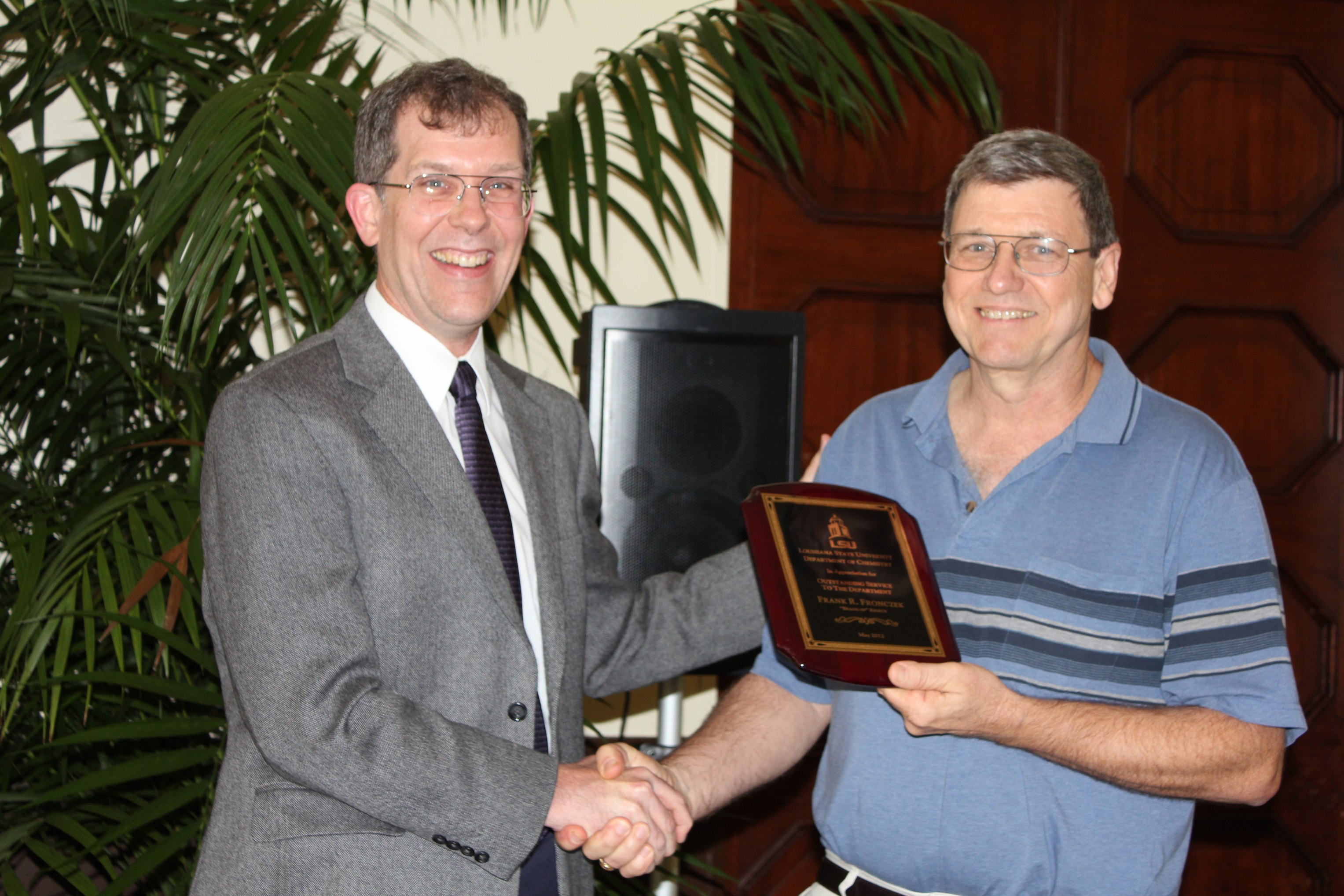
Andrew Maverick (left) presenting Frank Fronczek with the Outstanding Service Award in Chemistry (2012).
For all the structures solved and papers published, Frank's impact is equally visible in the students who learned beside him.
He estimates that hundreds of students have passed through the X-ray laboratory during his career. Some went on to careers in crystallography; many more took the experience into chemistry, materials science and other fields. His goal was not merely to teach them how to use the instruments, but to give them enough theoretical grounding to question an answer and recognize when something was wrong.
Asked what he hopes students and colleagues remember most about working with him, Frank's answer was characteristically modest: “He was a nice guy.” He added that he hopes they remember he worked well with students and enjoyed working with them.
“For Frank, the science is top-notch, but it is also about the people,” said Andrew Maverick, LSU professor emeritus of chemistry and a longtime collaborator. “Whether showing a student crystals under a microscope or buying Girl Scout cookies from a colleague’s daughter who made her own sales pitch, Frank found ways to connect with those around him. I watched these events build lasting friendships.”
The curiosity and humor that shaped those relationships also found an audience beyond LSU. Beginning in 2011, Frank served as puzzle editor for the American Crystallographic Association, creating word games, logic problems and his crystallography-inspired “DISORDERED” puzzles. In May, the ACA formally thanked him for 15 years of puzzles that blended science, wordplay and curiosity and became a familiar feature to the crystallography community.
Still bleeding purple and gold
“Frank is one of LSU’s most productive and best recognized researchers ever, but he might prefer to be known for all the people he won over to the side of the Purple & Gold!” Maverick shared.
That devotion to LSU gave Frank’s final colloquium seminar its title: “A Half Century of Crystallography and Bleeding Purple and Gold.” And while retirement closes a 50-year chapter, he does not intend to disappear entirely.
He still has roughly 1,000 crystal structures waiting to be deposited in the Cambridge Structural Database, work he plans to continue in retirement. Adding those structures would bring his total to approximately 5,400 CSD entries and should move him further up the worldwide rankings. He will also continue to collaborate with Chemistry faculty in publishing papers containing past crystal structure determinations.
Even with more work ahead, retirement offered a moment to look back. Asked what he would tell the LSU undergraduate who first arrived in 1966, Frank thought of the student thumbing through Acta Crystallographica, unaware of where that curiosity would lead.
“You have no idea what the future is going to hold for you,” he said.
Near the close of his talk, he reflected on a verse once printed in an early LSU catalog about standing on “holy ground.” Whether LSU qualifies in the biblical sense, he joked, he could not say. But he knew what the campus had become to him.
“It's home to me. It's been home for most of my life, and I love it here.”


