
Building the Human Infrastructure: Inside AI In Action 2026
April 01, 2026
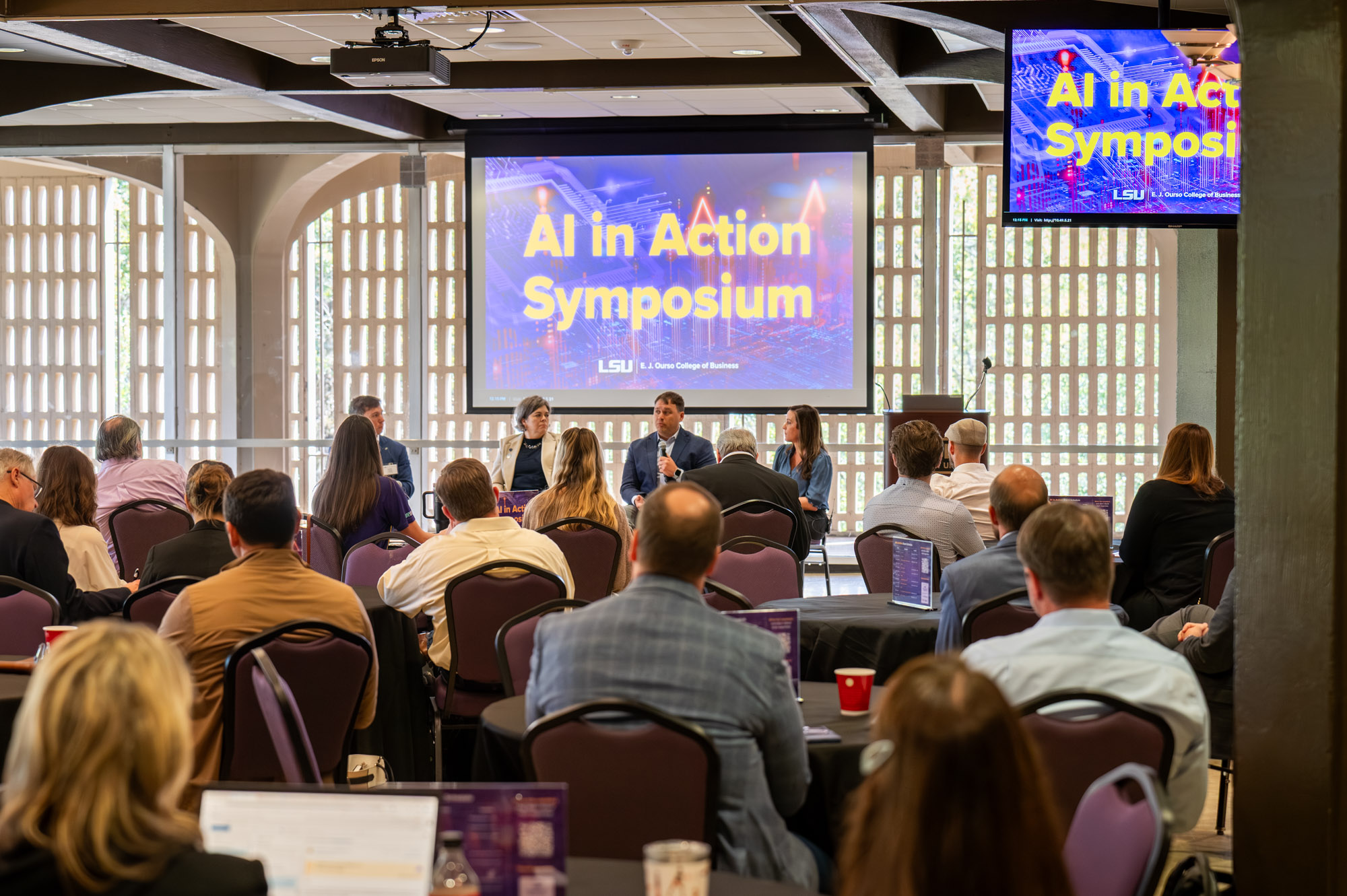
On March 20, the LSU E. J. Ourso College of Business hosted its second AI in Action Symposium, bringing together Louisiana leaders to discuss what comes after AI experimentation. With $22 billion in data center infrastructure commitments, including investments from tech giants Meta and Amazon, Louisiana is rapidly becoming a physical node in the global AI supply chain. Within organizations, the real opportunity lies in empowering the workforce to use it responsibly and effectively.
Keeping a Human Touch
Despite fears that AI will replace workers, panelists agreed that success increasingly depends on soft skills and human interaction. Sean Mulligan of The Idea Village argued that as AI makes technical work easier, the real edge belongs to those who understand people.
Henry Hays, an AI consultant and adjunct instructor in the LSU College of Engineering, reframed the conversation around "human infrastructure." Hays envisions hybrid roles designed to integrate technology with human judgment.
That shift requires active protection of critical thinking. Dulany Phillips of Breakout Learning cited research showing that students who rely too much on AI for preparation score 20 percent lower on exams. The goal, she said, isn’t to block AI but to build systems that preserve creativity and original thought.
I know companies with $10 million in annual recurring revenue who still take five customer calls a day to understand how people are using their product. That relationship is something that AI is never going to replace.
Sean Mulligan, The Idea Village
Guardrails and Governance
As AI adoption accelerates, governance gaps are becoming more visible. Hunter Thevis, president of S1 Technology, emphasized the need for clear policies and a shared model; without them, employees may default to the tools that are easiest to access, creating data security and compliance risks.
In the public sector, those challenges are further complicated by what Bruce Greenstein, secretary of the Louisiana Department of Health, described as “sludge” — outdated procurement processes and limited AI literacy.
Mike Ardoline of the LSU Ethics Institute noted that while AI may be new, the ethical questions it raises are not. “We’ve been debating accountability and justice for centuries,” he said. Rudy DeFelice, the global head of Harbor Labs, offered a different perspective by reframing the idea of responsibility itself.
There is a responsibility to control how we use any technology, but there is also a responsibility to use it, to the extent it creates a public good.
Rudy DeFelice, Harbor Labs
Rethinking Talent
What does AI mean for hiring? Justin Obney of Obney.ai and Tonya Jagneaux of Franciscan Missionaries of Our Lady Health System argued that the best candidates are adaptable thinkers who can explain their reasoning and pivot when a prompt fails.
Culture, however, can be a bigger barrier. Jagneaux said that in complex or long‑established organizations, leaders must model curiosity rather than fear. “If top leaders are dismissive or overly cautious,” she said, “that attitude quickly becomes the company’s default.” April Wiley of Community Coffee echoed that sentiment, describing the challenge of introducing AI into a 106‑year‑old business rooted in personal relationships.
What the Ourso College is Building
The symposium highlighted the need for human infrastructure to support the AI transition. The Ourso College is meeting the moment by embedding AI across its programs:
- Degrees: We are transforming the Master of Science in Analytics (MSA) curriculum to create the Master of Science in Analytics and Artificial Intelligence (MSAAI) placing LSU among a select group of programs nationally to take this step.
- Upskilling: We are partnering with the LSU College of Engineering to offer micro-credentials designed specifically for Louisiana's workforce. LSU Online and LSU Executive Education also offer targeted programming.
- Pipelines: A new dual-enrollment AI and Cloud program will pilot this fall, bringing this critical curriculum directly to high school students.
These initiatives build on a strong foundation of early adoption, including an AI for Business course that has already been part of the curriculum for more than seven years.
"The way that we advance AI in this state is not by silos, it's by an integrated approach," Andrew Schwarz, professor in the LSU Stephenson Department of Entrepreneurship & Information Systems, told attendees. "We are trying to push the boundaries of AI, but we can't do it without you."