
Community Resilience in Louisiana Gets a Boost from LSU’s Two GRP Early-Career Research Fellows
November 03, 2026
BATON ROUGE – Researchers from LSU College of the Coast & Environment and LSU E. J. Ourso College of Business have been named members of the 2026-2028 cohort of Gulf Research Program Early-Career Research Fellows in the Community Resilience track, the National Academies has announced.
Nazla Bushra, assistant professor (research) in the Department of Oceanography & Coastal Sciences, and Holly Peterson, assistant professor in the Department of Public Administration, will each receive a $76,000 financial award and mentoring support towards research identifying how climate-related stressors, such as heat, flooding and pollution, affect human health, community resilience and regional economies.
Out of seven universities represented in the cohort, LSU is the only institution where multiple faculty members were named fellows.
“The challenges facing Louisiana’s coastal communities demand research that leads to real-world solutions. Drs. Bushra and Peterson are advancing the kind of work that makes a difference in people’s lives, helping communities better understand their risks, prepare for future disasters and build long-term resilience.”
LSU Chancellor Jim Dalton
Meet the Fellows
Nazla Bushra
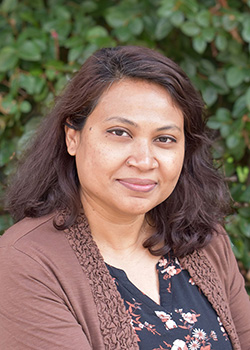
Nazla Bushra
As a research faculty member with Louisiana Office of State Climatology in the Department of Oceanography & Coastal Sciences (DOCS), Nazla Bushra works to help communities in Louisiana and around the Gulf become more resilient in the face of natural disasters and extreme weather. In just two years at DOCS, she has already headed a number of resiliency-focused projects, including the creation of a Community Well-Being Index, a Louisiana Board of Regents project on Louisiana's future climate hazards and an NSF/UCAR grant for community hazard partnerships. She also leads climate risk modeling for a multi-institution NSF EPSCoR project on hydroclimatic extremes.
Bushra’s GRP funded project, the Gulf Coast Community Climate-Health Vulnerability Index (GC-CHVI), will confront an unexpected challenge in disaster-prone South Louisiana: the spike in hospitalizations for chronic conditions that research has shown happens after a disaster. Bushra’s Index will provide a neighborhood-level map of areas where extreme heat and flooding are most likely to create compound stress in residents already living with conditions like diabetes or COPD. A Community Advisory Council, comprised of residents and officials from South Louisiana, will provide input throughout the process, and the result will be a publicly available tool communities can use to find ways to protect the health of their residents before disaster strikes.
"Every storm leaves damage we can see and damage we can’t. I’ve spent years studying the first kind,” Bushra said. “Louisiana’s hospital records showed me the second: people whose health quietly breaks down after the water goes down. This fellowship is my promise to those communities. We’ll build this together, and if we earn their trust, it will outlast any grant."
Holly Peterson
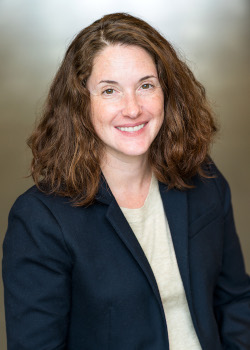
Holly Peterson
Peterson’s research focuses on public policy processes, technology, and environmental and natural resources policy. She serves as an associate editor for Policy Studies Journal and has held a faculty fellowship with Louisiana Sea Grant’s Discovery, Integration and Application Program (LaDIA). Her previous funders include the Louisiana Department of Administration.
Her Gulf Research Program fellowship supports a study of policy entrepreneurs, the residents, community leaders, government officials, scientists and philanthropic actors who champion policy ideas. The project asks how these actors drive change in coastal Louisiana, both in the wake of acute disasters like Deepwater Horizon and hurricanes Katrina, Rita and Ida and amid chronic ones like land loss and sea level rise. From this research, Peterson will develop concrete strategies to help community leaders, practitioners and residents communicate across audiences and build coalitions. The project will also strengthen public affairs and policy instruction at LSU by grounding courses in Louisiana examples that show students how policy change actually unfolds.
“Coastal Louisiana faces two kinds of crisis at once,” Peterson said. “Some are sudden, like hurricanes and oil spills. Others build slowly, like land loss, saltwater intrusion and sea level rise. The slow-moving ones are harder to address politically, and the communities carrying the heaviest burden tend to have the least access to recovery and adaptation resources. Disasters don’t automatically lead to better policy. Whether they do depends on whether the right people are positioned to act.”
About the Gulf Research Program
The National Academies’ Gulf Research Program was established in 2013 following the 2010 Deepwater Horizon disaster. The program’s mission is to develop, translate and apply science to enhance the safety of offshore energy, the environment and the well-being of the people of the Gulf region for generations to come.
More information is available from the National Academies.
About the LSU College of the Coast & Environment
LSU’s College of the Coast & Environment (CC&E) stands out for its world-class research and academic programs. Our faculty and students work at the epicenter of one of the world’s most dynamic and environmentally significant regions, confronting pressing challenges such as coastal erosion, pollution, and extreme weather events. Research and education at CC&E are closely aligned with the needs of Louisiana and its people, providing our work with a strong sense of purpose that empowers students and scientists to make a real, lasting impact.
Visit lsu.edu/cce for more information.
About the LSU E. J. Ourso College of Business
Since 1928, the LSU E. J. Ourso College of Business has served as Louisiana's flagship business college. Through its undergraduate, master's, doctoral and professional programs, the college prepares students for immediate success and long-term leadership. Its faculty produce research that influences business, policy and the Louisiana economy. Guided by its 2026–2031 strategic plan, the E. J. Ourso College aims to maximize its return on investment and position itself among the nation's leading public business schools.
Learn more at lsu.edu/business.