
Interning with Impact: Invasive Species and Intelligent Systems
July 30, 2025
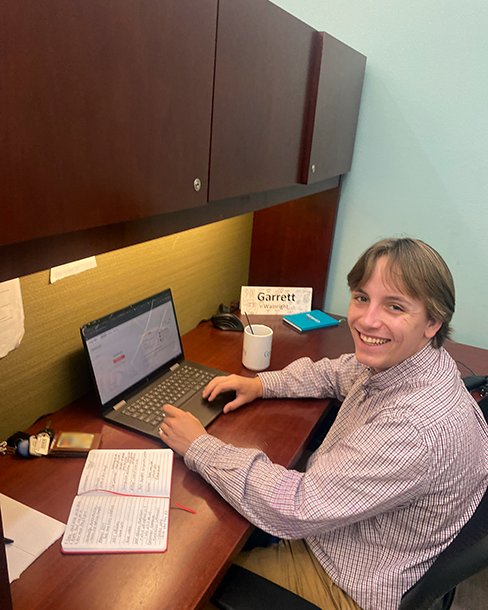
Through two summer internships, economics major Garrett Wainright is advancing his career path while making contributions to our state and local businesses.
BATON ROUGE - Through two summer internships, LSU economics major Garrett Wainright
is applying classroom knowledge to real-world challenges, from helping combat invasive
species in Louisiana's waterways to advancing artificial intelligence (AI) solutions
in business strategy. This work added more than a line to his résumé. It gave him
a real opportunity to contribute to something that matters to him on a personal level.
Turning Data into Solutions for Louisiana
Giant salvinia is one of the worst aquatic weeds in Louisiana. It chokes waterways and harms wildlife habitats, threatening the state's ecological and economic stability. Research from the LSU College of Agriculture is essential in understanding and managing this and other invasive species.
When Wainright, a native of Franklinton, Louisiana, had the opportunity to apply his research skills to study the economic impact of giant salvinia, he seized the chance to contribute to a solution as a summer research intern.
"I love the outdoors and I know I have a skill that allows me to structure the immeasurable value we gain from these resources in a way that policy makers can understand and compare," said Wainright. "This research lets me put economic numbers behind what we all know - that healthy ecosystems are worth protecting."
As a summer research intern, Wainright is using a hedonic analysis to estimate how infestations of giant salvinia influence property values in lakefront communities across Louisiana.
Using R and geospatial data, he is building spatial econometric models that examine how proximity to infestations impacts housing markets. His duties involve processing large-scale property transaction datasets, applying panel data methods to uncover value shifts, and integrating machine learning techniques to refine results.
His work will contribute to a policy brief for the Louisiana Department of Wildlife and Fisheries and will lead to a peer-reviewed publication. The project not only helps to inform the state's more than $5 million annual investment in aquatic invasive species control but also creates a replicable framework for analyzing the economic costs of environmental issues more broadly.
Embracing AI From the Classroom to the Career Path
Through HNRS 3025: Advanced AI Seminar, Wainright joined an interdisciplinary team of business and computer science students tasked with solving real-world problems for major organizations. His group, "Shell Yeah," developed an AI model for Shell that classified railcar seals based on compliance, collaborating with professionals across Shell's global network.
Co-taught by Assistant Professor James Ghawaly and entrepreneur and DisruptReady co-founder Henry Hays, the course offered lessons that went far beyond the classroom. Hays, who served as a mentor during the course, offered Wainright an internship on the spot; no interview required.
During his time with DisruptReady, Wainright's role has combined AI, business strategy, and consulting. He helps assess new partnerships, guides conversations with clients on the challenges and opportunities of AI, and builds automation tools to streamline internal processes.
"The work forced me into a role I was incredibly unfamiliar with and forced me to grow as a business professional," Wainright said. "Real teams driving real change relied on me heavily for growth, and it was very challenging to face that kind of dependence for the first time."
The internship taught him more than just technical skills. "I learned a lot about the true value of organizational data and data security," Wainright explained. "I feel significantly smarter knowing how AI and automation can genuinely impact and interact with real business-driving action."
What surprised Wainright most was the respect his specialized skill set commanded. "Being a thought leader in applied automation is so much more exciting than I thought," he said. "These companies rely on my skills and abilities to make them better. I effectively become more than a consultant but a driver of inter-organizational change."
The role has given him exposure to the technical realities of business transformation. "I was challenged with learning the technical side of what most businesses are and have become," Wainright noted. "I've learned a ton about applied AI and the actual nuts, bolts, and tacit information that a real AI engineer would learn and go through."
With talks already underway about a fall return, this hands-on role continues to shape
his professional path. This experience is proof that emerging technologies can create
genuine value when applied strategically.
Looking Forward
Whether analyzing the economic toll of invasive species or guiding businesses through the complexities of AI, Wainright's internships reflect a commitment to using data for good. These experiences helped him develop stronger analytical skills and provided him with a clearer understanding of how economics can be applied to solve real-world problems. As he looks ahead, Wainright is not just preparing for a career; he's already shaping it.
About the LSU E. J. Ourso College of Business
Since its establishment in 1928, the E. J. Ourso College of Business has served as the flagship business college of Louisiana, playing an essential role
in uplifting the economy of the state and the well-being of its citizens. Each year,
the college graduates more than 1,000 exceptional men and women who are the business
leaders and entrepreneurs of the future.