


Nanobubbles, Virtual Reality Could Unlock the Hydrogen Economy
May 11, 2026
Hydrogen as a fuel source could revolutionize the energy economy but there’s a big problem: transportation. Most existing pipelines can’t handle the high pressures needed to move hydrogen, its destructive effects on their components, or prevent the small-molecule gas from escaping.
One LSU researcher is working on a solution that involves storing and transporting hydrogen in nanobubbles, which are so small 250 can fit inside a grain of rice.
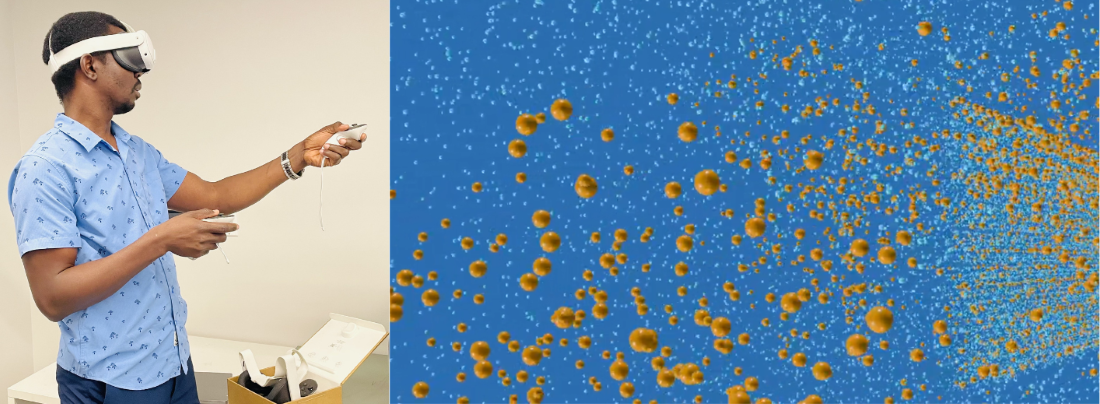
The key to unlocking the hydrogen economy may lie in virtual reality. Associate Professor of Petroleum Engineering Olufemi "Femi" Olorode is using VR to find a way to make transporting hydrogen as simple as shipping frozen food.
“Shipping hydrogen without pressure requires a medium: a frozen hydrate, like ice, except with hydrogen molecules embedded inside,” Associate Professor of Petroleum Engineering Olufemi “Femi” Olorode said. “With hydrates, hydrogen could be moved as easily and safely as refrigerated goods and stored with minimal cooling. But hydrates don’t naturally contain enough hydrogen to make the gas a practical energy source.”
Hydrates normally hold a certain amount of hydrogen, around 4.8% of the total weight. However, to make the economics work, hydrogen must make up at least 5.5% of the total weight.
“By trapping nanobubbles inside the hydrate, we can increase the hydrogen to 7-7.5% of the total weight,” Olorode said.
The key to stuffing enough nanobubbles into the hydrate may lie in combining computer simulations of how the hydrogen and water molecules move with virtual reality (VR). While VR has been used to visualize and manipulate proteins and drug candidates, Olorode is the first to use the technology to study the internal structure of hydrates. One key finding of his research: the presence of gas nanobubbles accelerates hydrate formation. This could make hydrogen storage and transportation even more efficient.
Hydrogen has long been considered an ideal fuel source.

Associate Professor of Petroleum Engineering Olufemi “Femi” Olorode
It packs more energy into each pound than any other fuel and its only byproduct when burned is water vapor. There are no pollutants or carbon dioxide. Hydrogen can also be used to store renewable energy. Extra electricity produced by wind and solar power can be redirected to make hydrogen from water.
In hydrates, water molecules are arranged in a 3D framework that resembles a trellis. Without VR, Olorode’s ability to examine the nanobubbles was limited to two-dimensional slices or screenshots of the hydrate. The process was tedious, and it was hard to see where the hydrogen molecules were stored in the hydrate structure, There was no way to tell exactly what section of the nanobubble the slice captured. Even if Olorode took hundreds of images, there was no way to determine the nanobubble’s shape or measure it directly, which meant he couldn’t calculate exactly how much hydrogen the nanobubbles contained or how much hydrogen they added to the hydrate.
Olorode also couldn’t see what lay on the other side of the nanobubble. He had to guess what was happening inside the molecular structure.
“Less than ideal,” Olorode said.
Enter virtual reality. Olorode became familiar with the technology during the COVID-19 pandemic when he bought a VR headset to play ping-pong. Later, he used the headset as part of LSU student outreach, so middle and high schoolers touring LSU’s campus could visualize molecules. While looking at the molecules with students, Olorode realized he could apply VR to his nanobubble research.
License this Invention
LSU, through its Office of Innovation & Technology Commercialization (ITC), is seeking partners to help bring the discovery to market. For licensing inquiries, contact techlicensing@lsu.edu
Olorode's hydrogen nanobubble research builds on his earlier VR work, which focused on trapping methane and carbon dioxide nanobubbles in hydrates. He is working with LSU’s Office of Innovation Technology & Commercialization (ITC) to protect, market and license his discovery.
“While this research is still in the early stages of development, we are now excited about the possibilities and actively seeking partners to help bring this invention to market,” said Grace Meyers, a commercialization officer with ITC.
“This project could bring hydrogen from the realm of wishful thinking to a reliable source of everyday energy,” said Robert Twilley, vice president of research and economic development. “LSU doesn’t just study the energy future, we deliver it.”