


9 Stunning Images to Celebrate World Microscope Day
April 13, 2026
LSU’s Advanced Microscopy and Analytical Core (AMAC) facility enables material characterization and elemental analysis to solve complex problems across a wide variety of scientific and engineering disciplines.
Explore nine images LSU researchers have captured using AMAC microscopy.
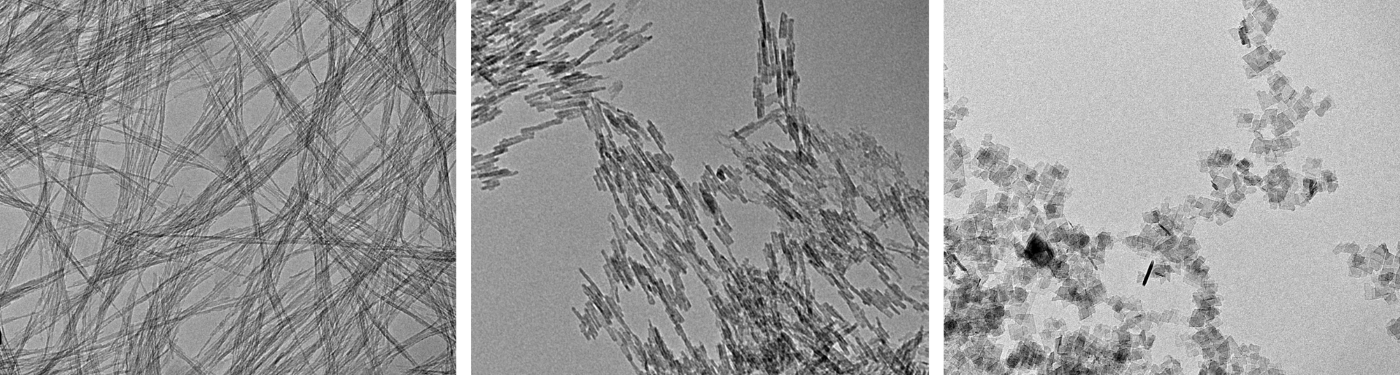
A pH-controlled solution regulates the growth pathways of aluminum hydroxide nanoparticles, some of the most widely used adjuvants in vaccine formulations. LSU research provided a rational design principle for engineering these adjuvants to keep them stable and effective. Images courtesy of Assistant Professor of Chemistry Amy Xu and PhD student Khaleda Rinee.
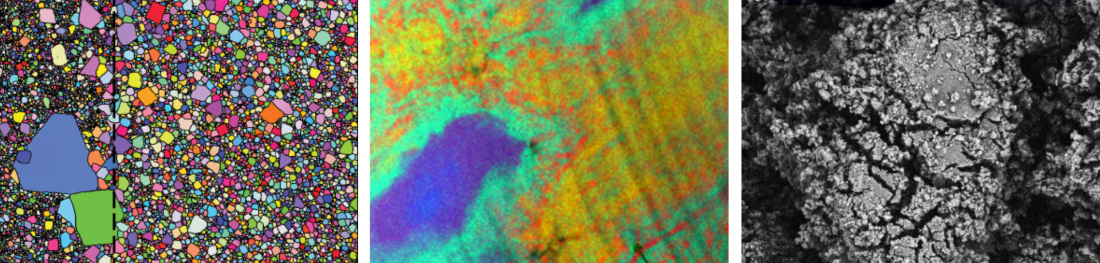
At left, spark plasma sintering densifies rare-earth-modified magnesium aluminate ceramics for grain growth studies. The dotted black line shows a clear difference after modification. The middle image shows pure nickel phases resulting from cryogenic high-energy ball milling, a reaction driven by mechanical force. At right, a backscatter electron micrograph shows the structural modification of regolith—a layer of lunar, dust, soil, and broken rock—following high-energy milling with lithium hydride additives. Images courtesy of Assistant Professor of Mechanical and Industrial Engineering Christopher Marvel.
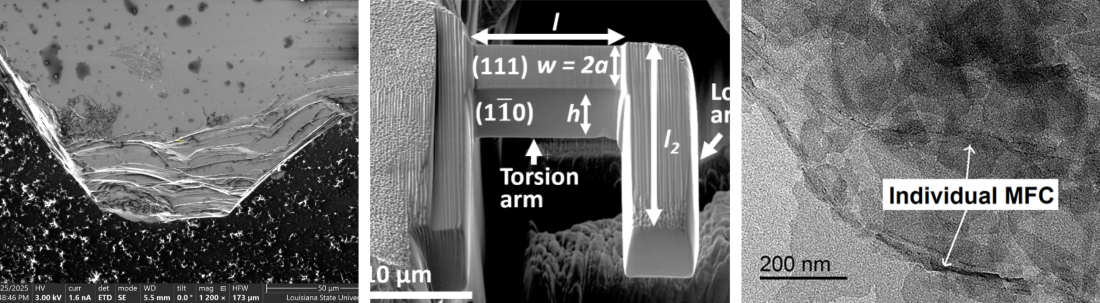
At left, Ba2Zn2Sb2O, a quaternary Zintl pnictide oxide. The thermoelectric materials, which can convert waste heat into usable electricity, stand out as particularly promising to address global energy issues. Image courtesy of Assistant Professor of Chemistry Sviatoslav Baranets. The center photo shows the micron-scale “L-beam” torsion/bending test, conceived and first executed at LSU, which enables torsional deformation data to be obtained from single crystals down to a length scale of 2 microns. Image courtesy of Professor of Mechanical and Industrial Engineering Wen Jin Meng. At right, Transmission Electron Microscopy micrograph showing individual microfibrillated cellulose fiber dispersed within the exfoliated bentonite layers in drilling fluids. Image courtesy of Cain Chair and Roy O. Martin Sr. Professor of Renewable Natural Resources Qinglin Wu.