

Breaking Barriers: Lurline Hamilton’s Legacy in Women’s Athletics
March 17, 2026
LSU graduate Lurline Hamilton’s impact on sports started before Title IX. The federal law passed in 1972 required schools receiving federal funding to provide equal opportunities for women and men in education and athletics. Hamilton paved her own path through her athletic talents, becoming the first woman to receive an athletic scholarship to LSU in 1964.
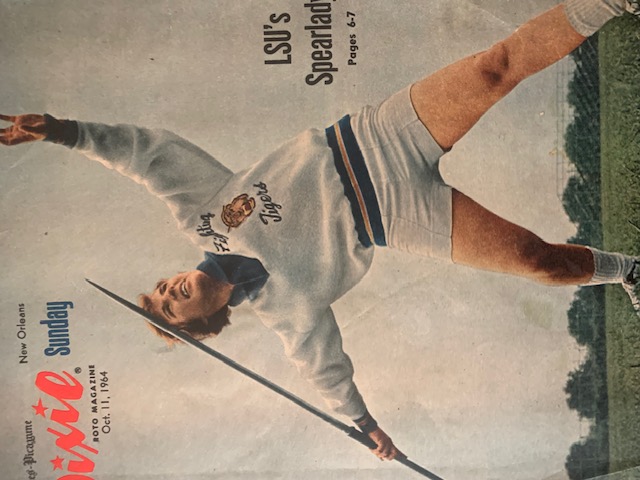
Lurline Hamilton on the cover of the Dixie Roto Magazine in 1964. Hamilton threw the javelin while competing for LSU Track and Field.
– Photos Courtesy of Lurline Hamilton
Hamilton’s love for sports started from an early age, growing up in Baton Rouge. She spent a lot of time on sandlots, playgrounds, and neighborhood fields with her siblings: five brothers and one sister. Her childhood consisted of playing baseball, basketball, and football with her siblings and friends in her neighborhood. She was one of the few girls playing alongside mostly boys.
“The thing I remember most, besides the fun, is that the boys accepted and welcomed girls to play. That inspired me most,” Hamilton said.
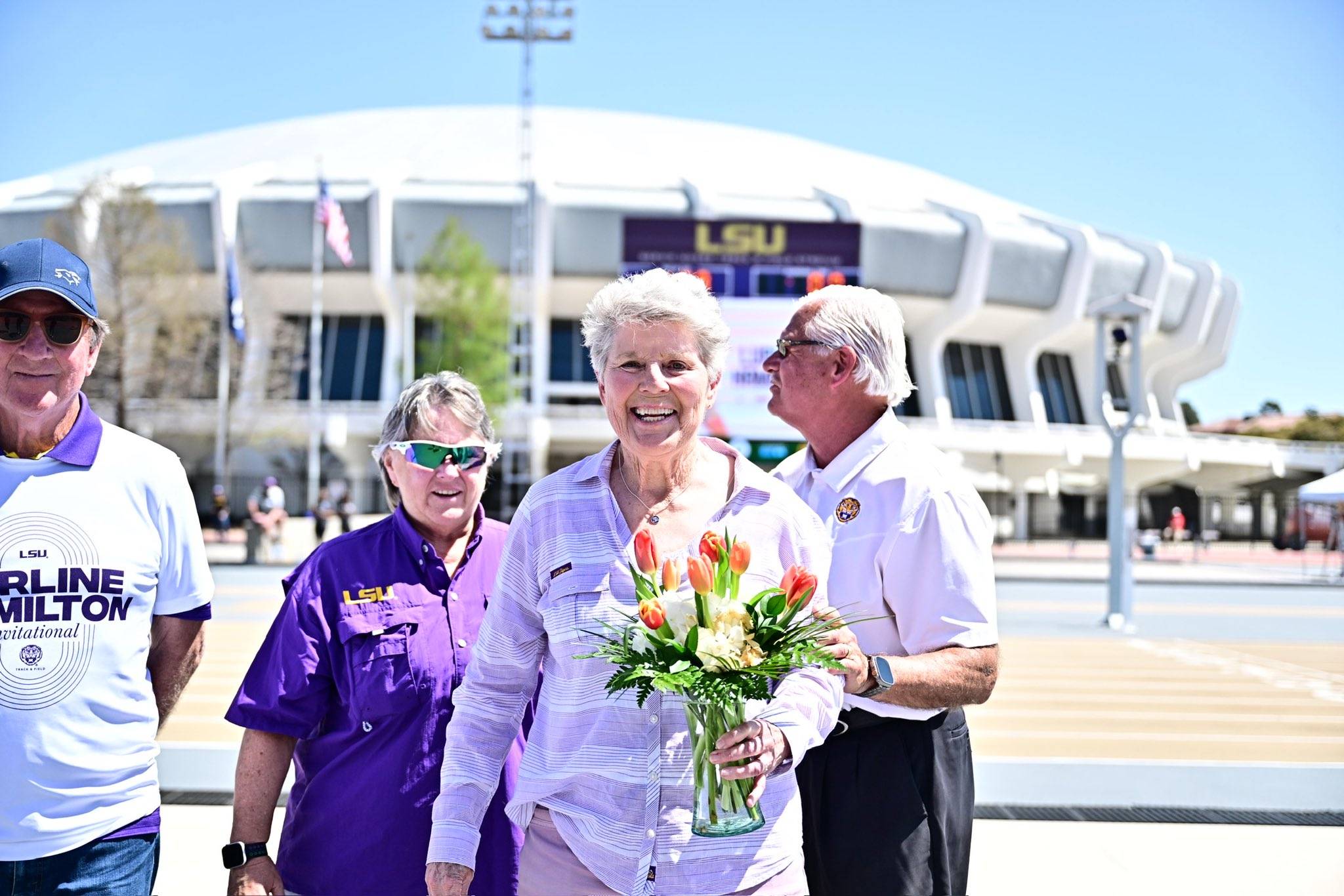
Hamilton at the Lurline Hamilton Invitational, hosted at LSU's Bernie Moore Track Stadium in March 2025.
– Photo Courtesy of LSU Athletics
Lurline Hamilton began developing her athletic career while attending St. Joseph’s Academy in Baton Rouge. At the time, opportunities for girls in track and field were limited, and there were no organized track programs for girls in Louisiana high schools. Instead, Hamilton competed through Amateur Athletic Union (AAU) meets, which provided one of the few avenues for female athletes to compete.
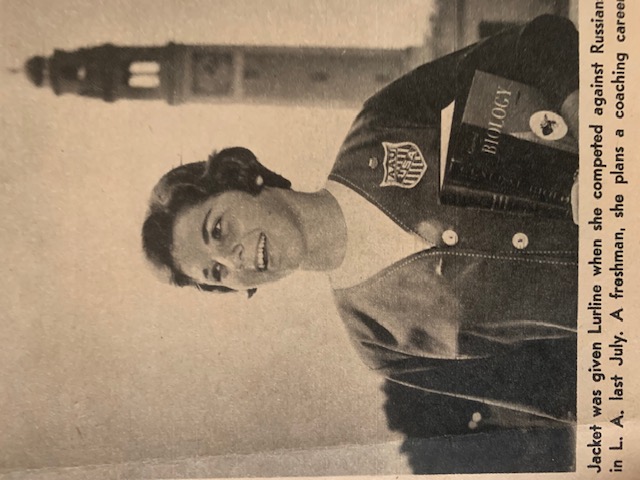
Hamilton, her freshman year at LSU.
Coach Arnold “Smo” DiDomenica was the first to recognize Hamilton’s talent and enthusiasm, encouraging her to begin training seriously in the javelin. DiDomenica helped her develop technique and connected her with experts such as Dr. Bill Bankhead and LSU track coach Joe May to refine her skills.
Bankhead graduated from LSU and started the university’s men’s gymnastics program in 1960, serving as head coach for eight years. He also revived the LSU swimming program in 1960, and in the 1970s was one of the first administrators to coordinate women’s sports and Title IX compliance at LSU.
Hamilton quickly rose to the top, making a name for herself at national competitions, including the 1963 AAU National Championships in Dayton, Ohio, where she placed first in the girls’ 18-and-under division and sixth in the women’s division. Competing against some of the nation’s top athletes helped build her confidence and set the stage for her record-breaking performances the following year.
“Support from my parents, my siblings, Smo, Dr. Bankhead and Coach May gave me the confidence to get to another level,” Hamilton said.
After graduating from St. Joseph’s Academy the following year, her athletic career began to rise rapidly in the summer of 1964. Hamilton set a national record in the javelin at the Southern AAU meet and later won gold in the 18-and-under division at the National AAU competition in California. She went on to compete in the Olympic Trials in New York, placing third. Shortly thereafter, she was offered a partial scholarship from LSU track and field, making history as the university’s first female athletic scholarship recipient. She wasn’t just breaking records. She was helping create a place for women to pursue the sport they love.
Hamilton later recalled the moment as happening almost overnight. After her success at national competitions and the Olympic Trials, she met with LSU Athletic Director Jim Corbett alongside track head coach Joe May. She said the meeting came with significant attention and she quickly transitioned from competing on the national stage to preparing to begin classes at LSU that fall.

Lurline Hamilton stands among a group of athletes during a USA–USSR Track and Field event in Moscow in 1965.
“This was all incredibly overwhelming. They took lots of pictures and did lots of publicity. It was all a bit of a whirlwind,” Hamilton said.
While her journey may have appeared easy, it did not come without difficulties and
more barriers to break. Unlike today, girls’ track and field teams were scarce in
Louisiana and were not accepted in some communities. She also faced problems with
limited equipment and training opportunities.
After her time competing, Hamilton’s influence continued well beyond her athletic
career, through education and leadership. She began her career teaching health and
physical education, where she worked to create more opportunities for young female
athletes by starting girls’ basketball and track teams at Istrouma Junior High. Hamilton
later spent many years teaching elementary physical education, mentoring students,
and encouraging participation in sports.
Her leadership also extended into officiating, where she founded the Baton Rouge Fast-Pitch Softball Umpires Association and worked as an official in several sports. Over time, she coordinated softball officials across multiple NCAA conferences, overseeing the training and development of hundreds of umpires throughout her career. Through these roles, Hamilton continued to open doors for others and contribute to the growth of athletics long after her competitive career ended.
While Hamilton said women in sports have come far and continue to pave the way for future athletes to feel accepted and equal to their male counterparts, the job is not done yet.
“To see these girls have opportunities for scholarships and the chance to play at the collegiate level and beyond is incredibly satisfying,” Hamilton said.
Looking back on her career, Hamilton encourages young women who want to pursue sports or leadership to work hard and continue learning. She believes success comes from studying the game, developing skills, and learning from strong examples of leadership. Hamilton also says she dedicated her life as an athlete, coach, teacher, and leader to those who believed in her and supported her along the way. By giving back and helping others grow, she hopes to make the same difference in someone else’s life that her mentors made in hers.
“ So, you want to be an athlete? So, you want to be a leader? So, you want to be a coach? Grow, learn, listen, study, and train hard. Find strong examples of leadership and follow them. Develop your skills and practice as much as you can. There are many opportunities for women in sports and leadership today, and you can take them if you work hard. ”