


Keeping Talent at Home: How LSU Helped Inspire Subterra, a Louisiana-Grown AI Company
December 22, 2025
For decades, Louisiana has faced a familiar challenge: Many of the country’s brightest students were educated here, only to leave the state in search of opportunities elsewhere.
“We wanted to take the opposite path—to stay, build here, and create high-level opportunities.”
Noah Deshotel, Subterra CEO
LSU has long worked to change that narrative, building success by preparing students not just to compete nationally, but to lead locally.
For young entrepreneur Noah Deshotel, a third-generation LSU alum, that mission became personal. As an LSU-trained engineer and MBA, he saw firsthand how much talent Louisiana was exporting—and how much potential was being left behind.
Rather than follow that path himself, Deshotel chose a different one. He stayed. He built. And through Subterra, an AI company headquartered in rural Louisiana, he set out to prove that advanced technology, world-class problem-solving, and LSU-grown innovation can not only survive in Louisiana—but thrive.
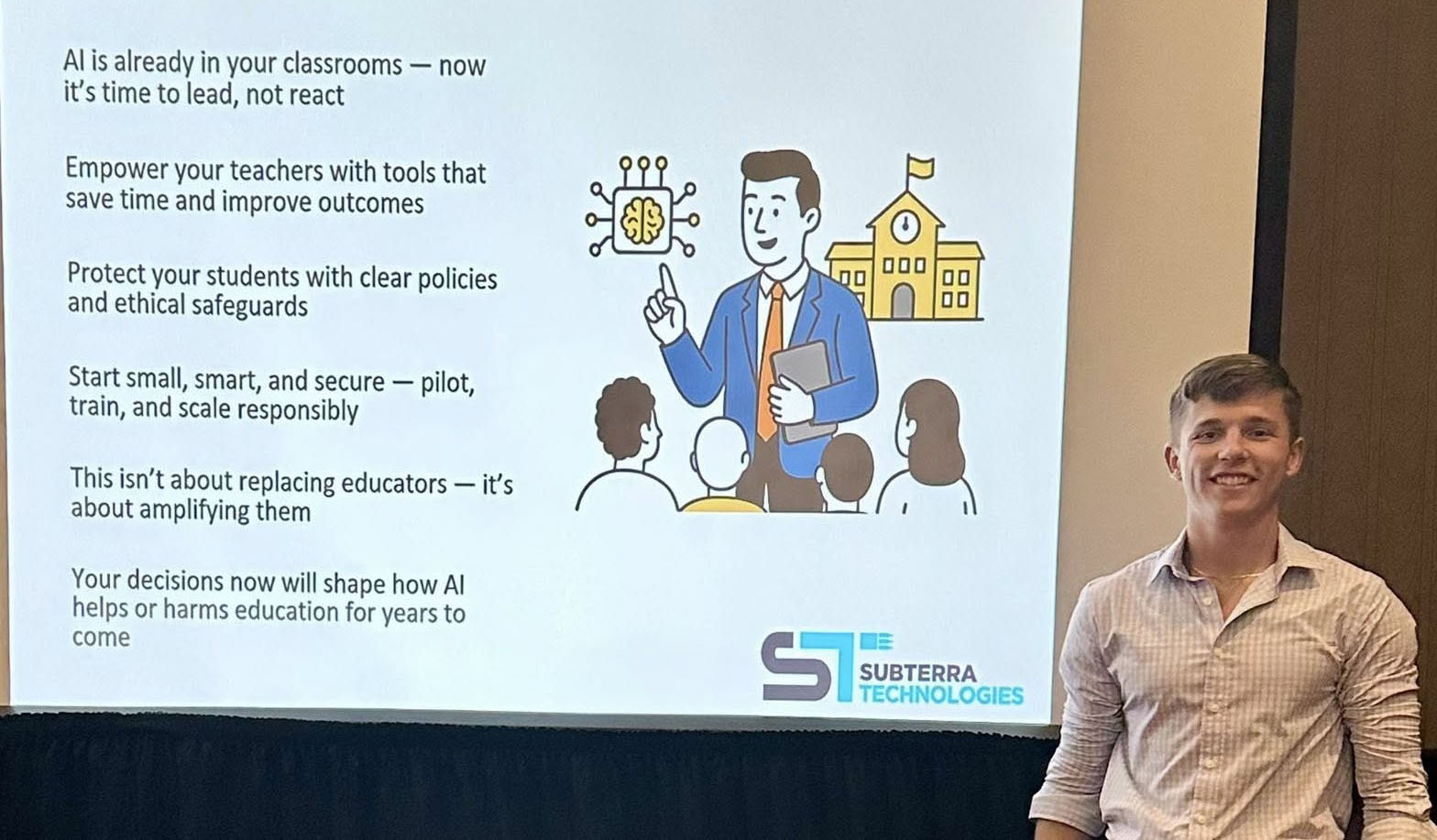
Noah Deshotel and other Subterra team members often speak to community groups in Louisiana to educate them on artificial intelligence.
The Origin of Subterra
As an undergraduate, Deshotel participated in an engineering capstone project where a small team built complex systems. It was an eye-opener, he said.
A tinkerer and problem-solver by nature, he was inspired to delve deeply into electronics, creating solutions such as a water-level indicator for his family’s duck camp and a Real-Time Kinematic (RTK) network to provide real-time GPS corrections for his personal drone.
Around the same time, he became deeply interested in artificial intelligence—and in why so many companies were hesitant to use it to its full potential.
While organizations saw AI’s promise, concerns about data security often kept them from fully adopting it. Sensitive information, proprietary processes, and internal data were typically sent to third-party cloud platforms, raising fears that the data could be exposed, misused, or accessed by competitors or hackers.
“I started thinking, AI is super useful,” Deshotel said. “It’s kind of pointless that some of the largest corporations in the United States or in the world can’t utilize it to the full capacity.
“And so, I really went down a pretty deep rabbit hole on localized and privatized AI, and I started building out systems.”
Instead of relying on public, cloud-based tools, Deshotel focused on creating private, locally hosted AI systems that enable organizations to utilize AI while maintaining full control over their data.
Offering AI Solutions
Deshotel’s growing expertise soon caught the attention of individuals and organizations struggling to adopt AI safely.
“They just asked me straight-up, ‘Hey, are you in the AI space? Could you help me with this?’”
The answer, he realized, was yes—and that realization sparked the creation of Subterra, which Deshotel founded while still an undergraduate at LSU.
In addition to AI systems, the company developed Subterra Networking AI, a platform that offers real-time anomaly detection and analysis, a revolutionary approach that surpasses traditional monitoring.
“For many organizations, this is the first time they’ve been able to see and understand their network activity in a truly accessible, AI-driven way,” Deshotel said.
His roommate and best friend, Jacob Voiselle, came on board right away and serves as the company’s business development manager. He holds a degree in construction management from LSU.
Subterra’s Microsites Offer a New Way to See Data
The Subterra team is excited about the upcoming release of a patent-pending AI pipeline powering a new product called Microsites. Deshotel said the system ingests large volumes of unstructured documents and automatically generates interactive, visual, and easy-to-understand microsites built around an organization’s content.
“We are releasing Microsites out of beta soon, and early adopters have already used it to turn extremely technical or time-consuming information into clean, actionable insights within seconds,” he said. “It represents a completely new way for organizations to consume their own data. We believe this solution is a pivotal turning point in deliverables and will replace PDFs in the near future.”
LSU alumnus Michael Chustz joined the duo later, bringing experience and connections in the construction space, where the startup company was trying to get a foothold. He graduated from LSU in 2003 with a construction management degree.
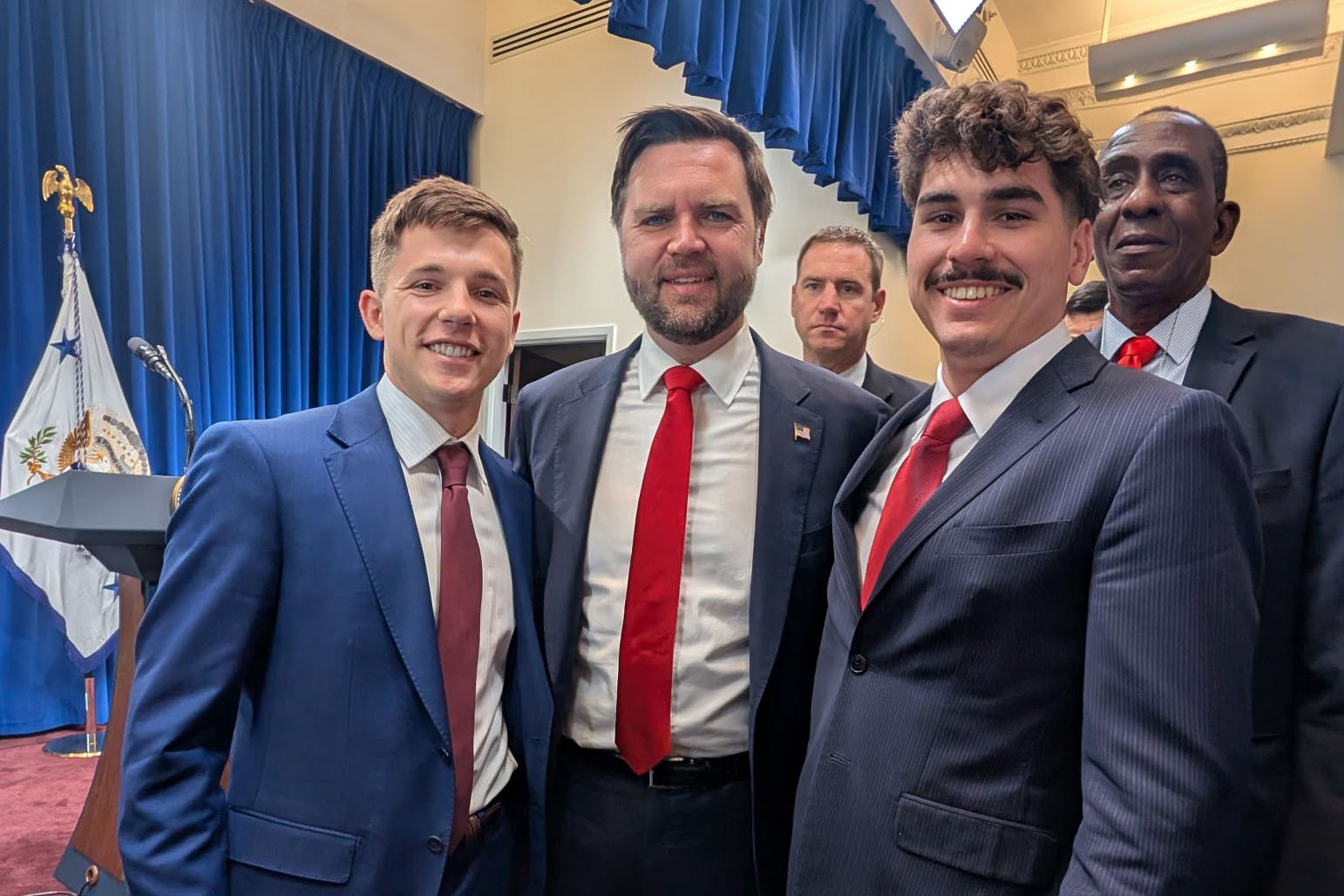
In November, the Subterra team had the honor of discussing the future of AI directly with Vice President JD Vance and tribal leaders from across the country at the Native American Coalition for Economic Prosperity’s Government-to-Government Roundtable Series in Washington, D.C., the result of an invitation from the Tunica-Biloxi Tribe of Louisiana.
National Recognition
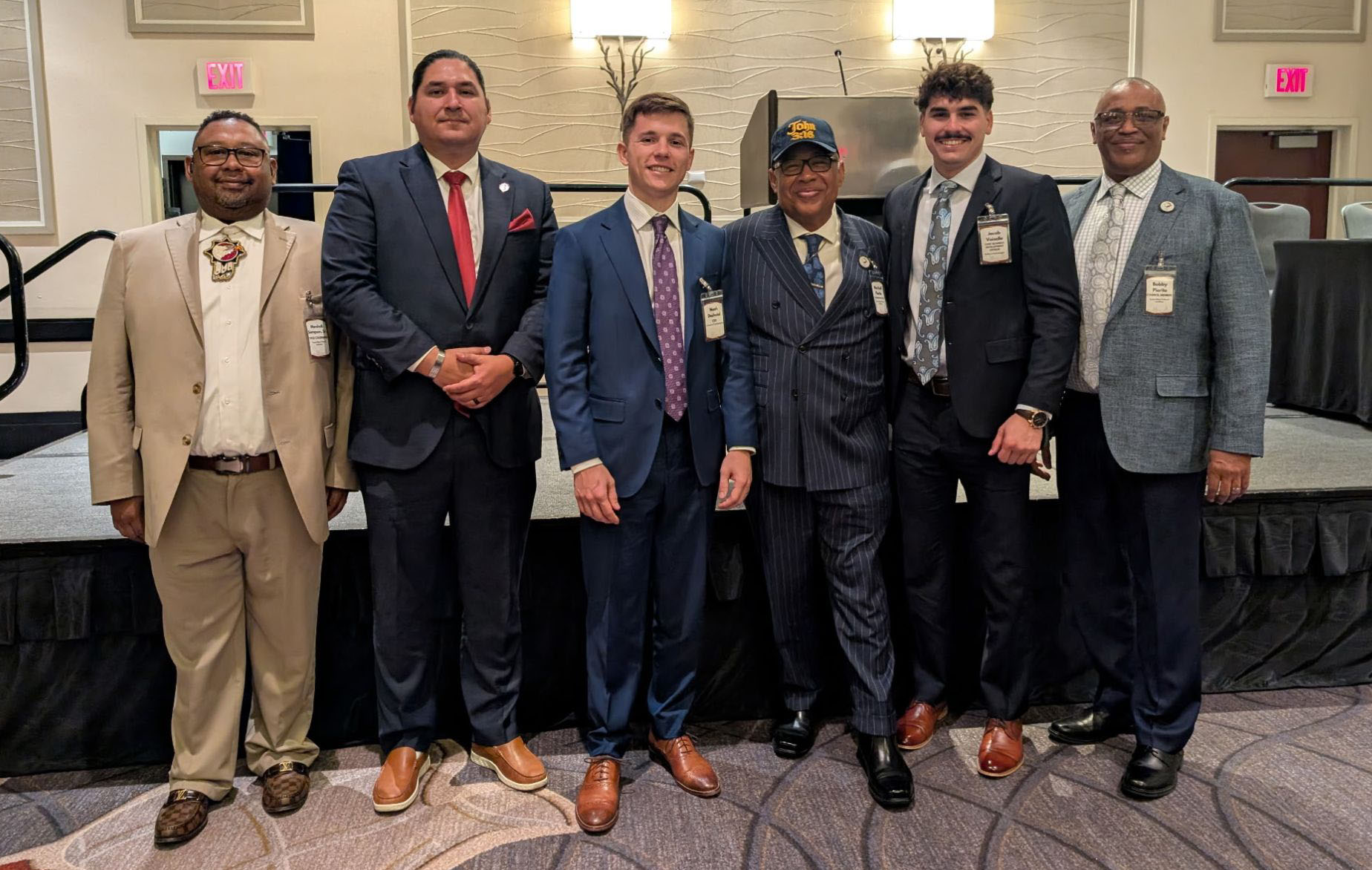
Deshotel and Voiselle with participants in a Native American Coalition event in Washington, D.C., including coalition president Marshall Pierite, center, wearing hat, of the Tunica-Biloxi Tribe of Louisiana.
In November, Deshotel and members of his team were invited by the Tunica-Biloxi Tribe of Louisiana to serve as the AI experts for the Native American Coalition for Economic Prosperity’s Government-to-Government Roundtable Series in Washington, D.C.
The event included many of the nation’s leading tribes, and the team had the opportunity to discuss the future of AI directly with Vice President JD Vance and tribal leaders from across the country.
He said that tribal communities shared the same concerns surrounding AI as other organizations and companies, and their leaders were interested in learning how AI and innovation can strengthen tribal economies, enhance infrastructure, and create sustainable opportunities for communities nationwide.
“It was a major moment of national recognition for Subterra, and a proud opportunity to represent Louisiana and LSU-grown innovation on a national stage,” he said.
Louisiana ‘Born and Raised’
For now, Subterra is nearly exclusively in Louisiana, which Deshotel said has historically been a “slow adopter” of new technology. He said efforts at LSU and companies like Subterra are now propelling the state forward in the technology fields.
“I'm born and raised in Louisiana, and so I definitely want to help out and bring technology here,” he said. Otherwise, “there's going to be larger companies from other states coming in and starting to poach Louisiana jobs—Louisiana opportunities.”
That dedication to the state shows up in the company’s community outreach efforts. Deshotel and team members often appear at local Rotary Club and Chamber of Commerce gatherings, explaining not only the benefits of AI but also the importance of understanding how to use the systems correctly.
The Subterra team is also committed to retaining Louisiana talent within the state.
“A major inspiration for Subterra came from watching so much of Louisiana’s top technical talent leave the state to find opportunity elsewhere,” he said. “We wanted to take the opposite path—to stay, build here, and create high-level opportunities so future LSU graduates don’t feel like they have to move to Austin or the coasts to work in advanced technology.”
According to Deshotel, LSU graduates bring not only technical ability but also the mindset that fits perfectly with Subterra.
“The university’s culture of innovation and real-world problem solving is deeply woven into Subterra’s identity. The company is a direct product of LSU shaping both who we are and why we exist.”
Next Steps
Let LSU put you on a path to success! With 330+ undergraduate programs, 70 master's programs, and over 50 doctoral programs, we have a degree for you.