



LSU Astrophysicist Shares Insight into the Record-Breaking Cosmic Burst He Helped Detect
December 09, 2025
LSU astrophysicist Eric Burns is among scientists poring over data from NASA satellites and other facilities as they try to determine what caused an extraordinary cosmic outburst discovered on July 2.
Burns, associate professor of Physics & Astronomy in LSU’s College of Science, leads a consortium that studies gamma-ray bursts (GRBs), including the July event that, because of its long duration, stands in a class by itself. Because opportunities to study such events are so rare, and because they may reveal new ways to create GRBs, astronomers are particularly excited about the July burst.
Burns discussed the discovery and the significance of this area of research.
Q&A
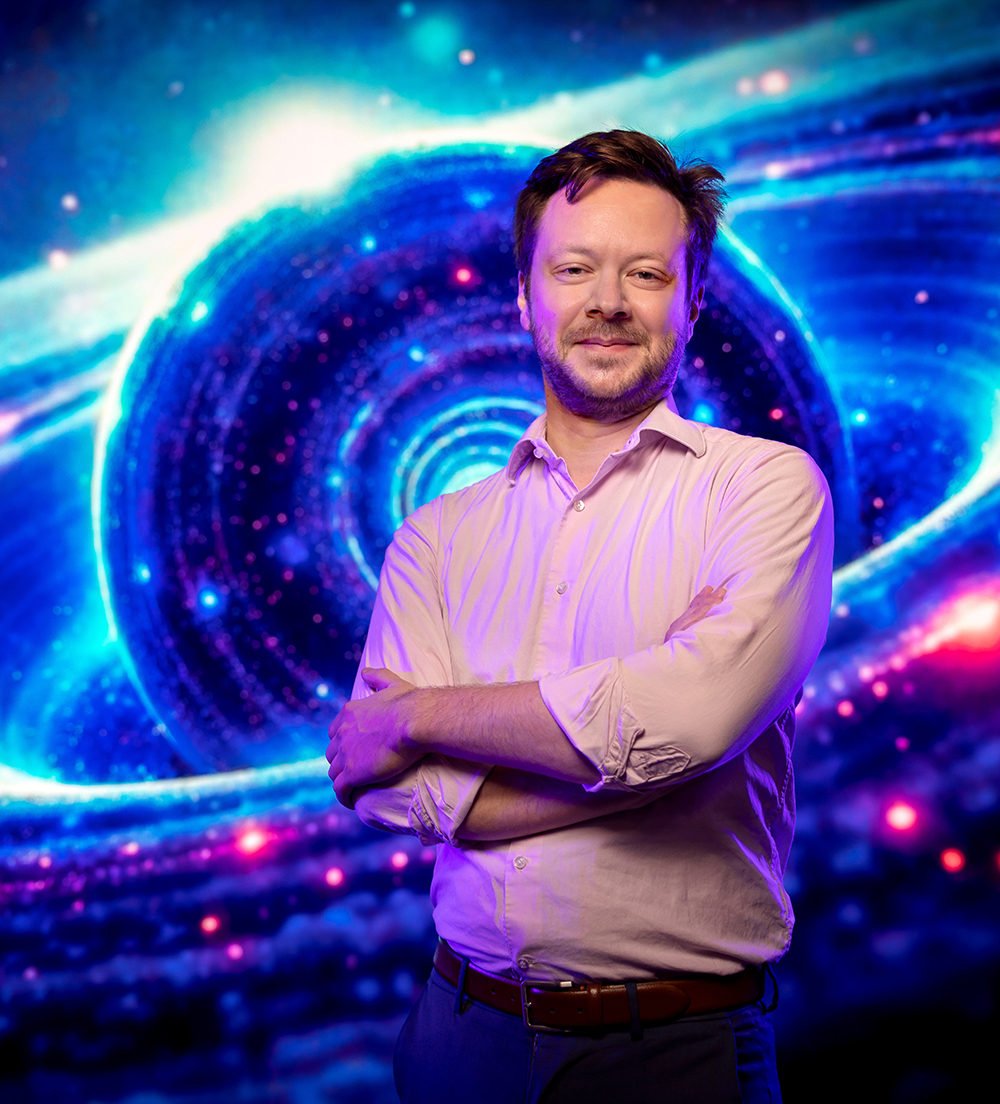
Eric Burns
Can you explain your interest in gamma-ray bursts, why they matter, and how they play into these new discoveries?
I run a consortium that studies gamma-ray bursts. These are the most luminous explosions in the universe, other than the Big Bang itself.
The consortium's been operating for almost 50 years. We've seen 15,000 gamma-ray bursts. We've used these sightings to understand the speed of gravity, where gold is created, and fundamental properties in the universe.
In July, we detected a gamma-ray burst that was longer than we've ever seen before. They're normally like 30 seconds long. This one was 8 hours. It was so long that we didn't believe it was a gamma-ray burst for a while.
What was your role in investigating this phenomenon?
The consortium I run helped find it and helped figure out where it was coming from. We put a bunch of telescopes on it to try and figure out what was happening and to understand what caused this event.
Normal gamma-ray bursts come from a massive star near the end of its life. The interior of the star collapses, and it forms a black hole. That black hole eats it from the inside out, and it launches this matter that's moving at basically the speed of light, and that produces your gamma-ray burst.
By chance, a colleague and I had written a paper earlier this year on what is the longest gamma-ray burst you could produce with this scenario. And the answer is 1,000 seconds. So we're pretty sure that what happened here was this: You have that massive star, but instead of its core becoming the black hole, instead you have a black hole that falls into it. Or they sort of fall into each other.
How was this long gamma-ray burst discovered? And what led to your involvement in studying it?
We have what’s called gamma-ray burst monitors. They're a version of a telescope, but they're not like a long tube that you use to see visible light with your eyes. They're actually crystals that detect when they are hit by a gamma ray by fluorescing and sending out light. And so we could detect them that way.
In the consortium I run, there are about a dozen of these gamma ray detectors. They're all on different satellites. Most of them are around Earth, but some of them are much further out in our solar system.
We've automated most of our processes. The spacecraft itself will detect this event and report it to the community. All of that happens in like 30 seconds. In this case, our satellite had four different triggers spread over eight hours, and a member of the community pointed out that these events were coming from the same general area in the sky.
So, even before the last trigger, within a couple hours, we realized, oh, there's something really long happening here that we haven't really seen before.
So, you’ve identified that it’s an unusual event. What happens next? How do you begin to make sense of this?
You point many more telescopes at it. I mean, this was one of the problems. It's so long, none of the tools we're using were built to study that. So, it took an enormous amount of effort to be able to even analyze the data correctly.
If no one instrument could capture the entire event, was it a matter of gathering the data and piecing them together?
Yes. Those telescopes see basically the whole sky all the time. But for those in Earth's orbit, for example, the Earth can get in the way, blocking the source and the satellite's view of it. So, we had to stitch together data from six different spacecraft to figure out what was actually from this event and what was something else, making sure we didn't have any gaps in coverage.
You mentioned that studying gamma-ray bursts helps you understand certain functions in the universe, such as where certain elements originated. Can you explain to non-scientists how that happens?
A gamma-ray burst is a phenomenological name because it's literally just a burst of gamma rays. They're produced by different mechanisms. One of them is called a neutron star merger. They also get detected in gravitational waves.
Several years ago. LIGO saw a gravitational wave. One of these detectors saw a gamma-ray burst two seconds later. They came from 140 million light-years away. So that's how we measured the speed of gravity. It's like combining information from different places.
For those same kinds of events, we can point the James Webb Telescope at one, and you can look at the brightness as a function of energy. There are wiggles and lines that come in from specific elements. One of them we saw was from the element tellurium, which is only produced in extremely rare scenarios.
There was a gamma-ray burst in 2004 from the Milky Way, which is quite rare. For this one, we saw the normal flash of gamma rays, but then it was followed by additional gamma rays, which were produced from freshly forged heavy elements, including gold. This tells us that all the ingredients for beings like us were available early in cosmic time.
Why does this work excite you and others in the scientific community? Why should the rest of us be interested, let alone excited?
NASA likes to talk about things in terms of questions, and ours is, “How does the universe work at a fundamental level?” And so, scientifically, it really is fundamental physics.
Astrophysics is one of the most visible sciences. It's medicine, particle physics, and astrophysics medicine, which directly affect people. But astrophysics, I think, is an important thing we do, which is just inspire people to pursue STEM degrees and really go after these things.
It allows us to study extreme physics that cannot be produced on Earth, which can have implications for National Defense, for instance, to ensure we fully understand physics and then apply that knowledge to national priorities.
Finally, gamma ray detectors were originally created for a very different purpose. Can you explain?
In 1963, we signed a partial nuclear test ban treaty. It was a Cold War, so we didn't trust the Soviets. The treaty disallowed nuclear detonations unless they were underground.
If a nuke goes off in the atmosphere, it produces gamma rays. So we launched satellites as monitors on opposite sides of Earth. If any of them went off, you could then immediately know who had done it and where.
These satellites inadvertently detected gamma-ray bursts. It was totally unexpected. I'm sure the first reaction was, “Oh my God, somebody detonated a nuke.” The detectors were originally intended for defense purposes. So, it was as if our field was kind of created by accident.
Next Steps
Let LSU put you on a path to success! With 330+ undergraduate programs, 70 master's programs, and over 50 doctoral programs, we have a degree for you.