


LSU Tackles Foodborne Risks Across Farms, Facilities, and Fresh Produce Packaging
March 10, 2026
Food safety doesn’t begin in the kitchen—it starts long before harvest. Fruits and vegetables can be exposed to harmful bacteria through irrigation water, soil amendments such as manure, food contact surfaces, and even packaging.

Achyut Adhikari, Interim Director of the Food Innovation Institute (FOODii) and professor in the LSU School of Nutrition and Food Sciences.
LSU researchers working in the LSU AgCenter’s Achyut Adhikari Research Group are tackling these risks at multiple points along the food system.
Their work spans hydroponic production, on-farm fertilizer practices, bacterial behavior on equipment surfaces, and the development of antimicrobial, biodegradable packaging.
“We don’t just conduct research to publish papers; we want to have measurable impacts for our farmers and communities in Louisiana,” said Achyut Adhikari, Interim Director of the Food Innovation Institute (FOODii) and professor in the LSU School of Nutrition and Food Sciences.
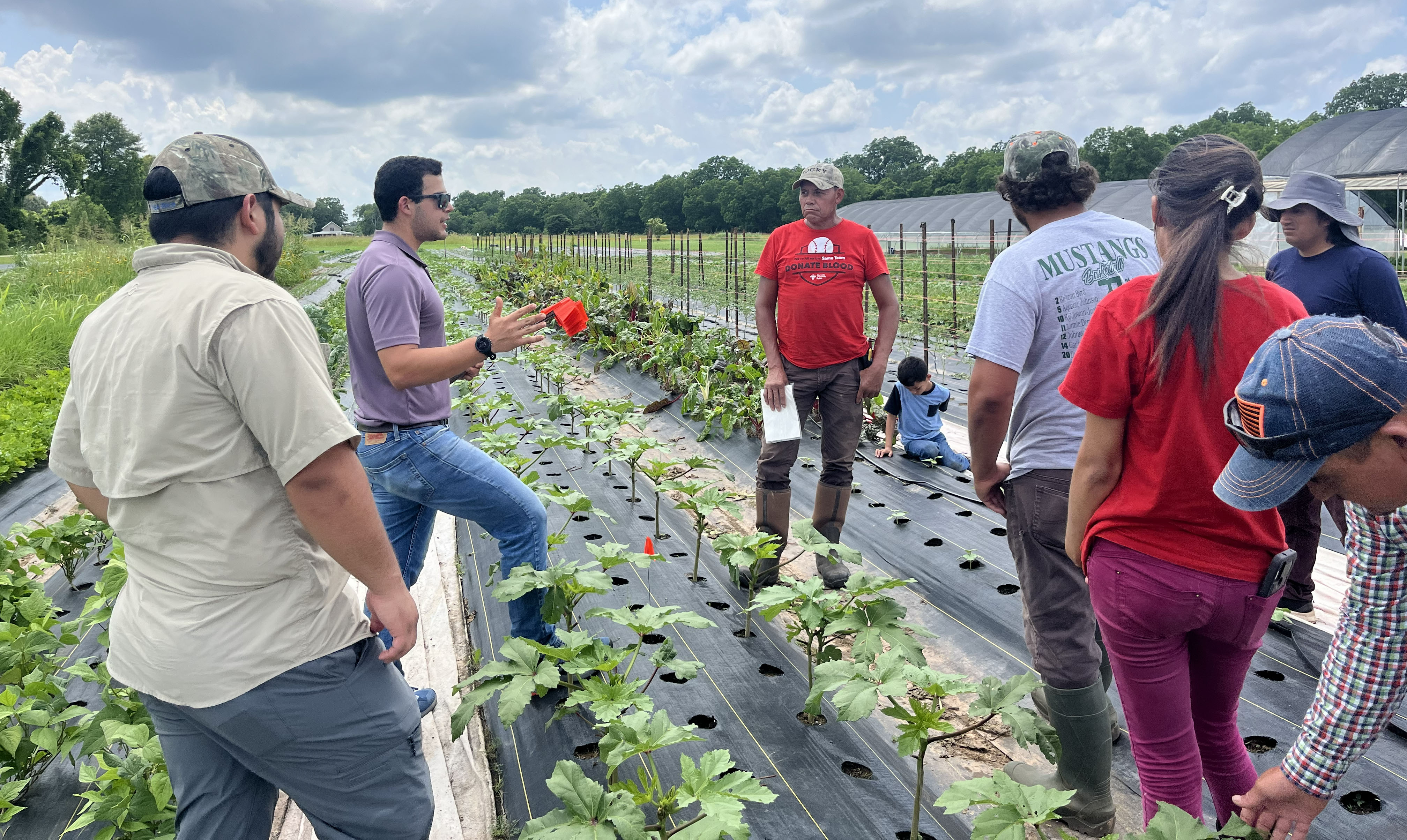
The Achyut Adhikari Research Group conducts food safety training recently with a group of farm workers.
“Much of our research is aimed at helping local industries. We are fortunate to receive funding from the Department of Agriculture that allows us to conduct community-informed research and disseminate our findings to the growers, farmers, and manufacturers who need them.”
Around the time that Adhikari started his work at LSU, the Food Safety Modernization Act (FSMA), signed into law in 2011, was transforming the nation’s food safety system and practices, forcing a shift from responding to foodborne illness to preventing it.
“That regulation changed a lot of things we were doing on the farm,” Adhikari said. For example, one new requirement was that if farmers were using raw manure as fertilizer in a farm, they needed to wait at least nine months from the day of application to harvest any crop grown in that area. That turned out to be nearly impossible for Louisiana pecan growers, who often follow a double cropping system and raise cattle in pecan orchards until right before harvest.
But Adhikari was determined to find a solution. After discussions with both pecan growers in Louisiana and FDA experts, Adhikari and his team figured out that if they could come up with a process to decontaminate pecans after harvesting from cattle fields, they could help growers continue to benefit from double cropping practices. Working with growers, the lab developed a validated hot water treatment technique that not only decontaminates the pecans but yields high quality, whole pecan kernel. The lab published their findings, and now pecan growers across Louisiana use this technique.
Today, Adhikari’s lab continues to develop new methods to help farmers and growers keep food safe while also saving time, money, and other resources. The lab’s research aims to reduce contamination in practical, science-based ways that growers and food producers can realistically adopt—improving public health while supporting sustainable agriculture.
The graduate students in Adhikari’s lab are integral to both conducting this research and disseminating the findings with hands-on training sessions with farmers and growers. Here are four researchers who are helping to develop next generation food safety practices.
Ivannova Lituma
Controlling Contamination in Hydroponic Systems
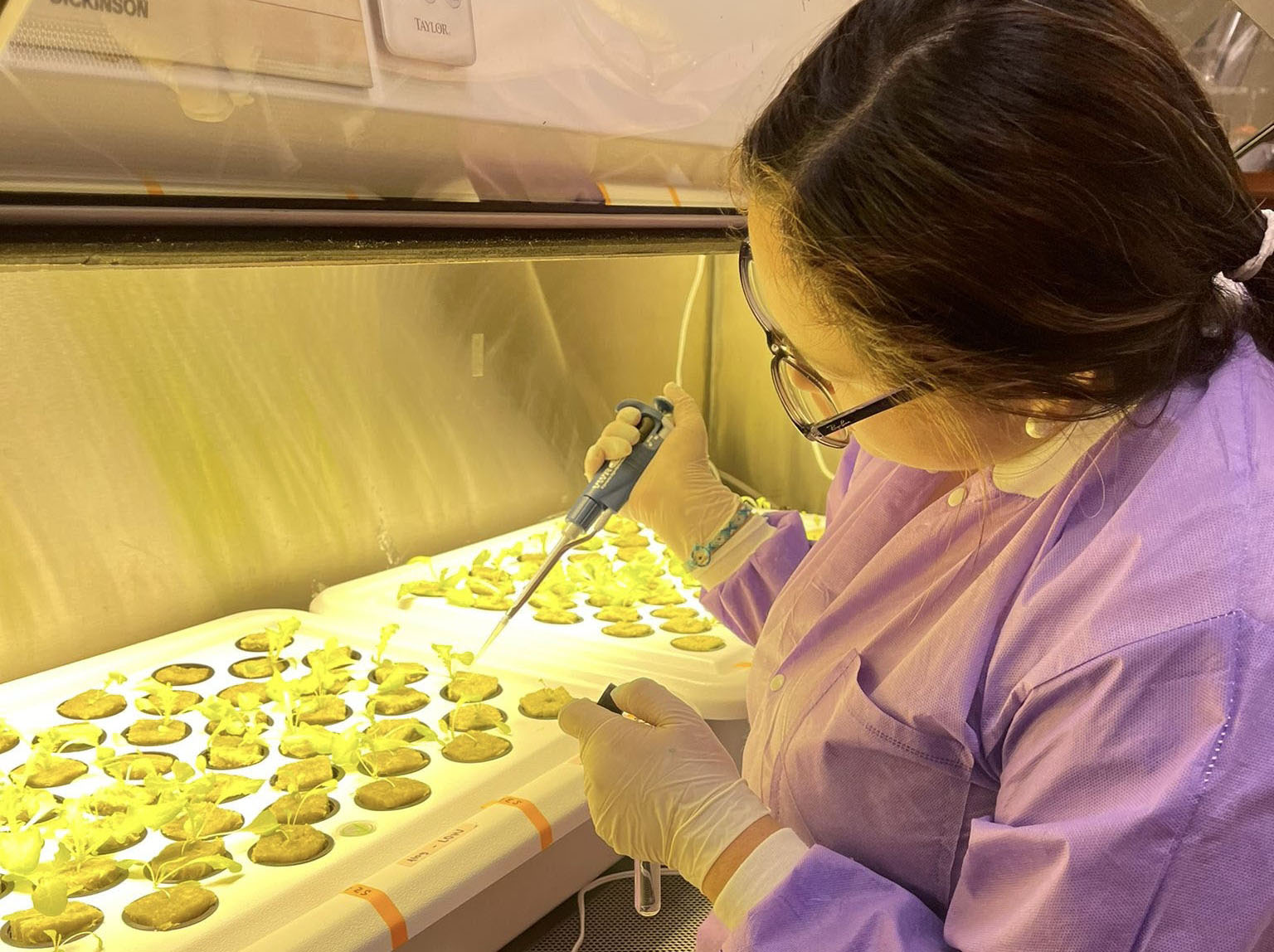
Ivannova Lituma inoculating hydroponic system with Listeria cocktail.
Ivannova Lituma began an internship in the Adhikari lab as an undergraduate student in 2020, during which she evaluated how well air bubbles could dislodge microorganisms from bell peppers and cucumbers during washing. She also helped start farm worker hygiene training in multiple languages that the lab continues to do today.
Lituma is now a third year Ph.D. student. Her research focuses on food safety in hydroponic production systems—where plants are grown in nutrient-rich water instead of soil.
Hydroponics minimizes many soil-related risks, but like any production system, it has its own considerations. Since water is recirculated, preventing the contamination of environmental pathogens would minimize spreading throughout the system. Lituma’s research examines each component of a hydroponic setup—the nutrient solution, growing substrates (the material the plants grow in), seeds, and internal surfaces—to understand where and how pathogens may establish themselves.
“I'm working right now with hot water and steam treatments to decontaminate the substrate of the hydroponics,” she said, “because if there is contamination, they can spread all over, so we want to prevent that, right?”
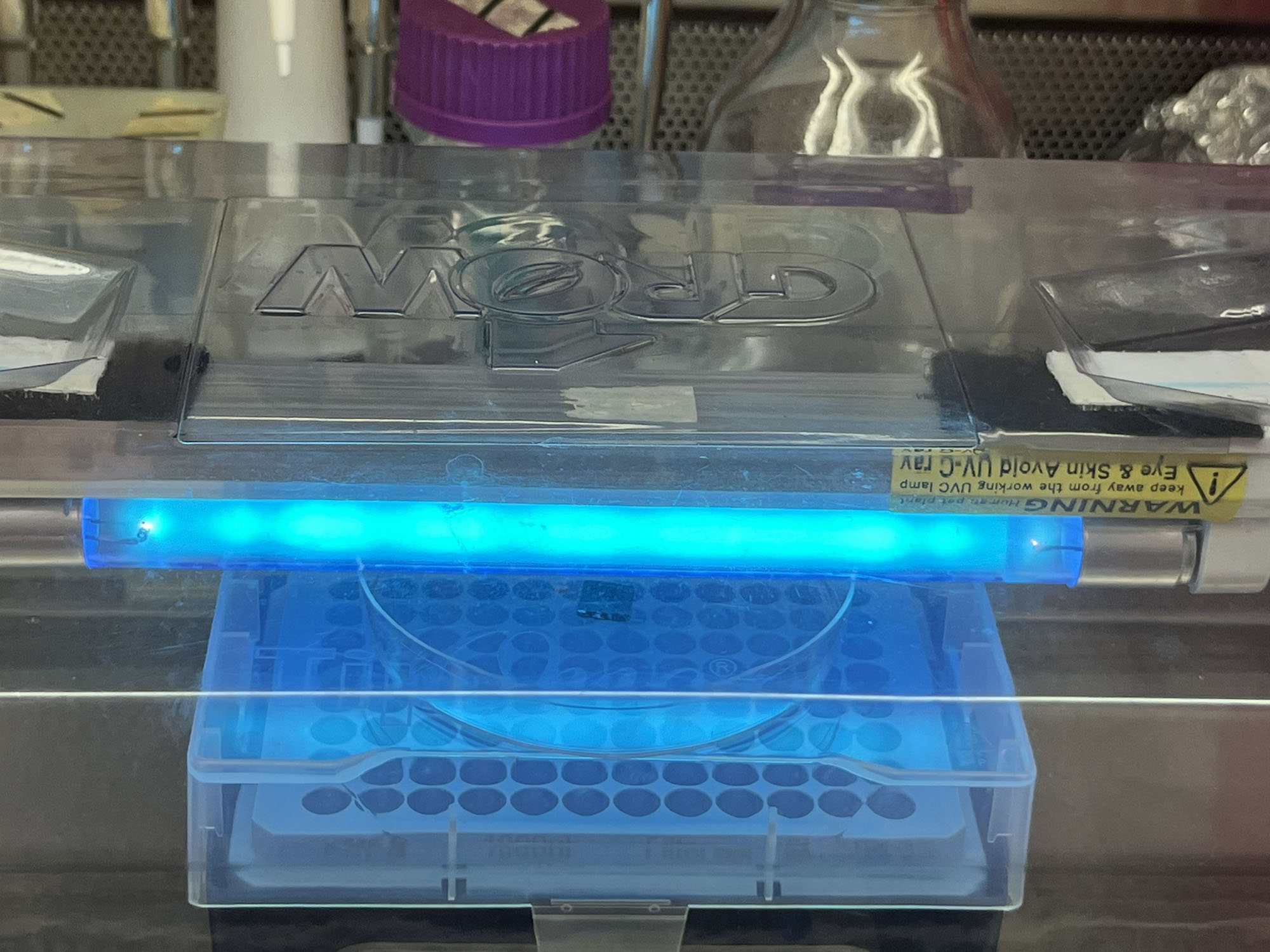
UV-C light application to hydroponic coupons.
During her master’s work, she studied ultraviolet-C (UVC) light as a sustainable, chemical-free method to disinfect water. For her Ph.D., she is investigating biofilm formation within hydroponic systems, since biofilms can prevent cleaning treatments from reaching bacteria and allow them to persist.
Lituma is also testing pecan shell extracts, which contain naturally occurring antimicrobial compounds, as seed treatments to reduce bacterial contamination before plants even enter the system.
Her approach is holistic: intervene early, disinfect efficiently, and design strategies growers can realistically use.
Sheetal Jha
Disrupting Bacterial Communication to Prevent Biofilms
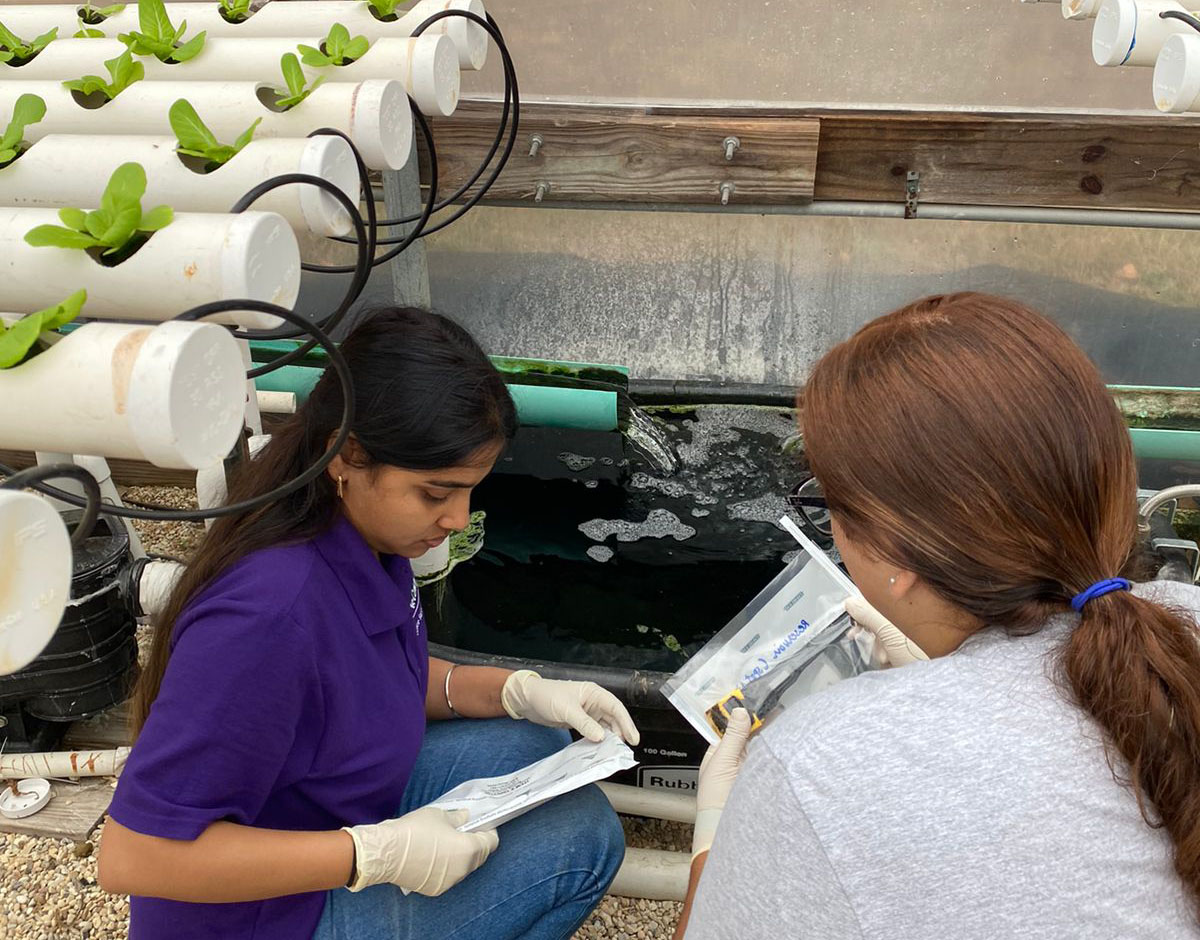
Sheetal Jha collects swab samples from a lettuce growing hydroponic farm in Louisiana.
Jha is a Ph.D. student in the Adhikari lab. She studies biofilms on food contact surfaces—structures formed when bacteria communicate, attach to surfaces, and build protective communities.
In food production environments, biofilms are a major concern because they make bacteria more resistant to sanitizers and harder to remove.
Her research targets the communication process itself, known as quorum sensing. Bacteria release chemical signals to coordinate behavior; when enough bacteria accumulate, they organize into biofilms.
Jha is working with antimicrobial peptides, naturally occurring bacteria-fighting proteins, that disrupt this signaling process. By interfering with bacterial “conversation,” she aims to prevent biofilms from forming in the first place.
“If they don't talk, they don't communicate, they don't sit together and form a biofilm,” she said.
She has also demonstrated that these peptides can significantly reduce established biofilms, breaking apart the dense bacterial networks seen under microscopy.
This work could lead to more effective sanitation methods for food production facilities, reducing the need to discard contaminated equipment and improving long-term hygiene management.
Daniel Leiva
Safer, Faster Treatment of Animal Manure
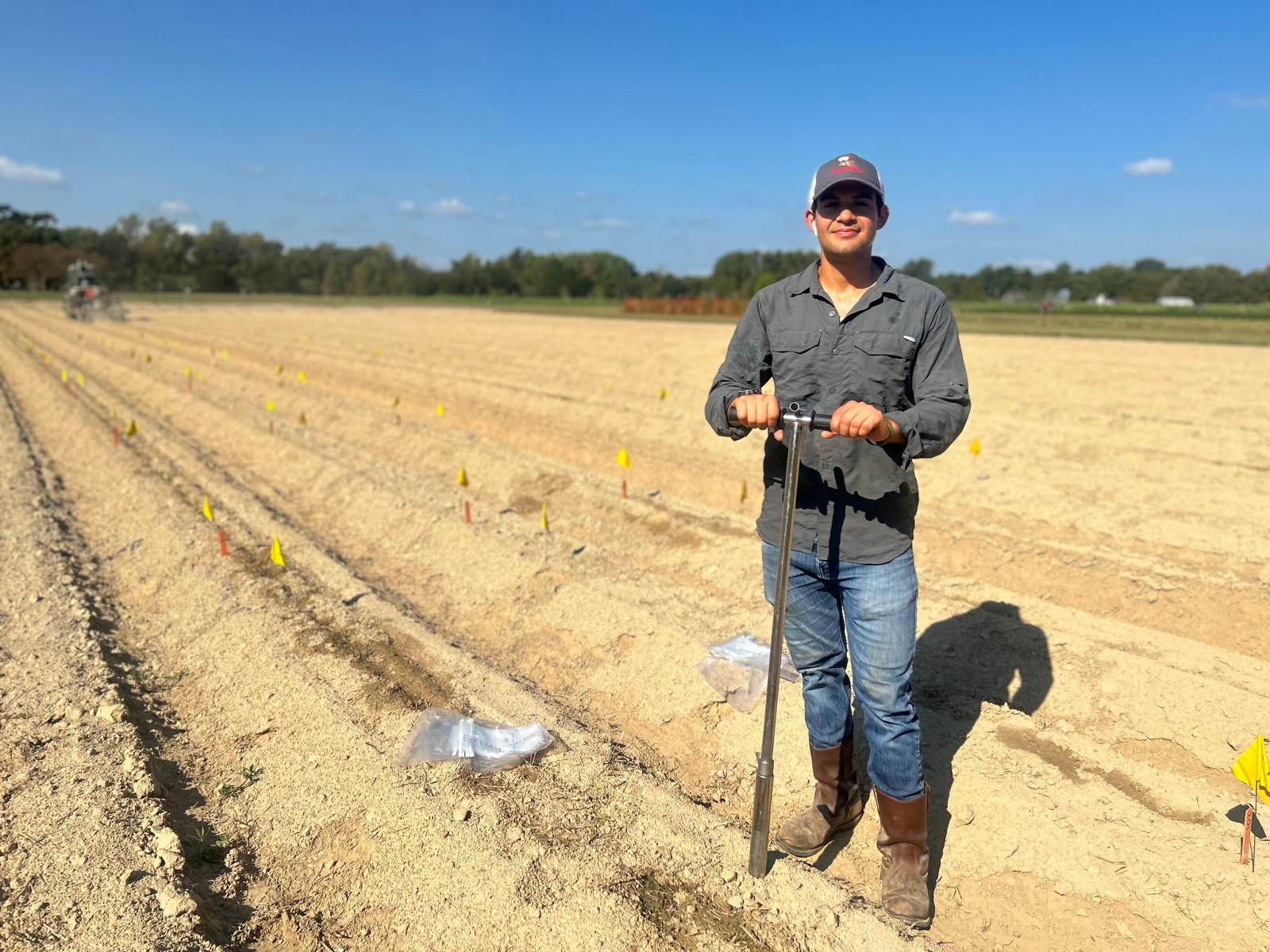
Daniel Leiva’s work addresses one of the most significant contamination routes on farms: untreated animal manure used as fertilizer.
Daniel Leiva started working in the Adhikari lab as an intern during his senior year of college in 2022 and is now a Ph.D. student in the lab. Leiva’s work addresses one of the most significant contamination routes on farms: untreated animal manure used as fertilizer. Manure is nutrient-rich and widely used, particularly in organic agriculture, but it can carry harmful pathogens such as E. coli.
Current federal regulations under the Food Safety Modernization Act (FSMA) require scientifically validated composting processes that can take weeks or months to achieve sufficient pathogen reduction.
“We are looking at alternative methods to that, so that farmers can treat manure in an easier way that is more feasible for them,” he said. “And that will ensure that they are killing all the microorganisms, but that they are still getting the benefits of this nutrient-rich fertilizer.” Manure contains many nutrients derived from beneficial microorganisms.
Using a specially designed solar dryer that concentrates heat, he exposed manure samples inoculated with E. coli to high temperatures and monitored bacterial reduction over time. Early results show promising decreases in bacterial levels within a single day.
The goal is to determine whether solar drying can achieve the required reduction in pathogen levels. If successful, this method could provide farmers with an accessible, energy-efficient treatment option that meets regulatory standards while reducing labor, cost, and time demands.
Aakankshya Dhakal
Turning Bacteria into Sustainable Packaging
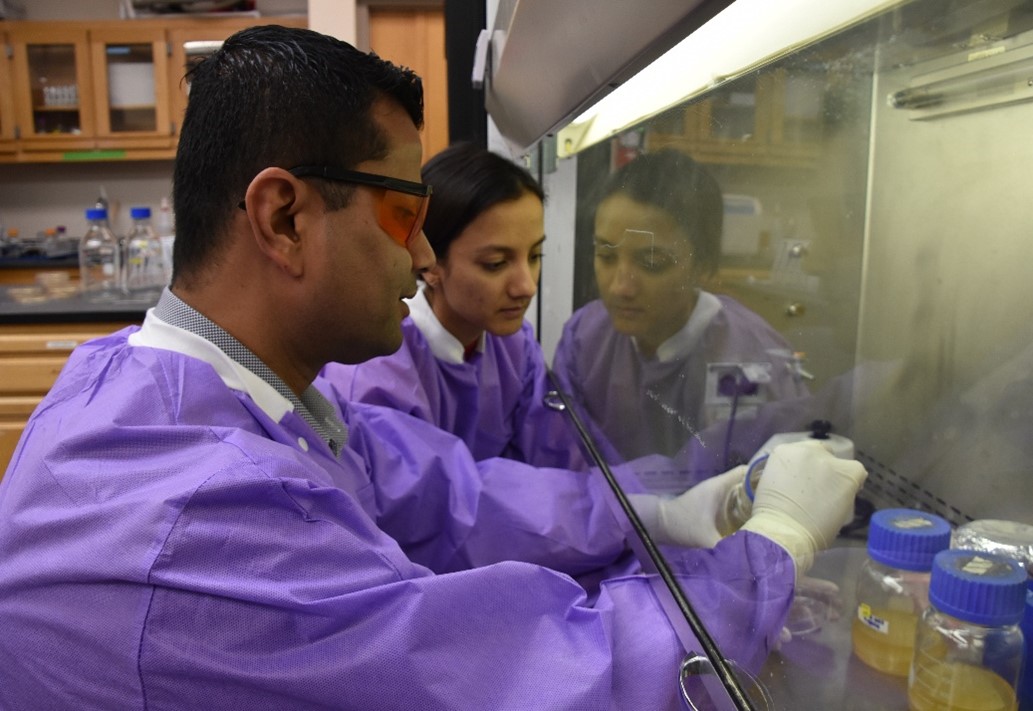
Harvesting bacterial cellulose pellicle after fermentation.
Aakankshya Dhakal is a Second-year Ph.D. student in the Adhikari lab. Dhakal’s research focused on one of the most overlooked stage of the food system: packaging. While packaging plays a critical role in protecting food, it also contributes significantly to global plastic waste, an issue Dhakal hopes to help address through her research.
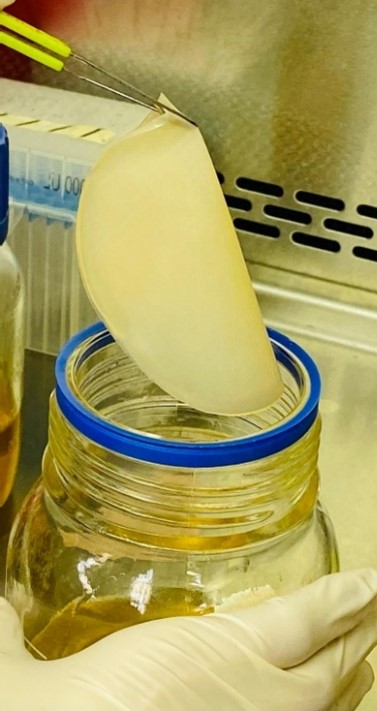
Harvesting bacterial cellulose pellicle after fermentation.
She is developing a biodegradable, antimicrobial film made from bacterial cellulose—a natural material produced by certain bacteria through fermentation. Bacterial cellulose is highly pure and structurally versatile, making it suitable for engineering into thin flexible films suitable for food packaging applications.
To give the material antimicrobial properties, she incorporates silver nanoparticles produced through a “green synthesis” process that minimizes chemical use. Lab testing has shown that the resulting films can inhibit food borne pathogens, potentially helping improve food safety and extending the shelf life of the food product.
Beyond antimicrobial performance, she has evaluated its biodegradability under greenhouse and controlled conditions, finding that the material degraded in soil within approximately four weeks.
“We conducted a biodegradability study for a period of eight weeks,” she said, “because if we claim that the material is sustainable and biodegradable, we need to understand how long it takes to actually degrade in a natural environment.”
Her ongoing work focuses on scaling and engineering the film for real-world applications, ensuring it can effectively wrap fresh produce or meat products while maintaining strength, flexibility, and antimicrobial properties.
The broader aim is to reduce plastic waste while extending shelf life and improving food safety.
A Systems-Level Approach to Food Safety
While each project targets a different stage of the food chain—seed treatment, hydroponic production, surface sanitation, fertilizer treatment, and packaging—they are united by a systems-level perspective.
Rather than addressing contamination only after outbreaks occur, these researchers are developing preventive strategies grounded in microbiology, materials science, and agricultural practice. Their work reflects a growing understanding that improving food safety requires coordinated interventions across the entire farm-to-table continuum.