
When the Universe Does the Experiment
August 06, 2026
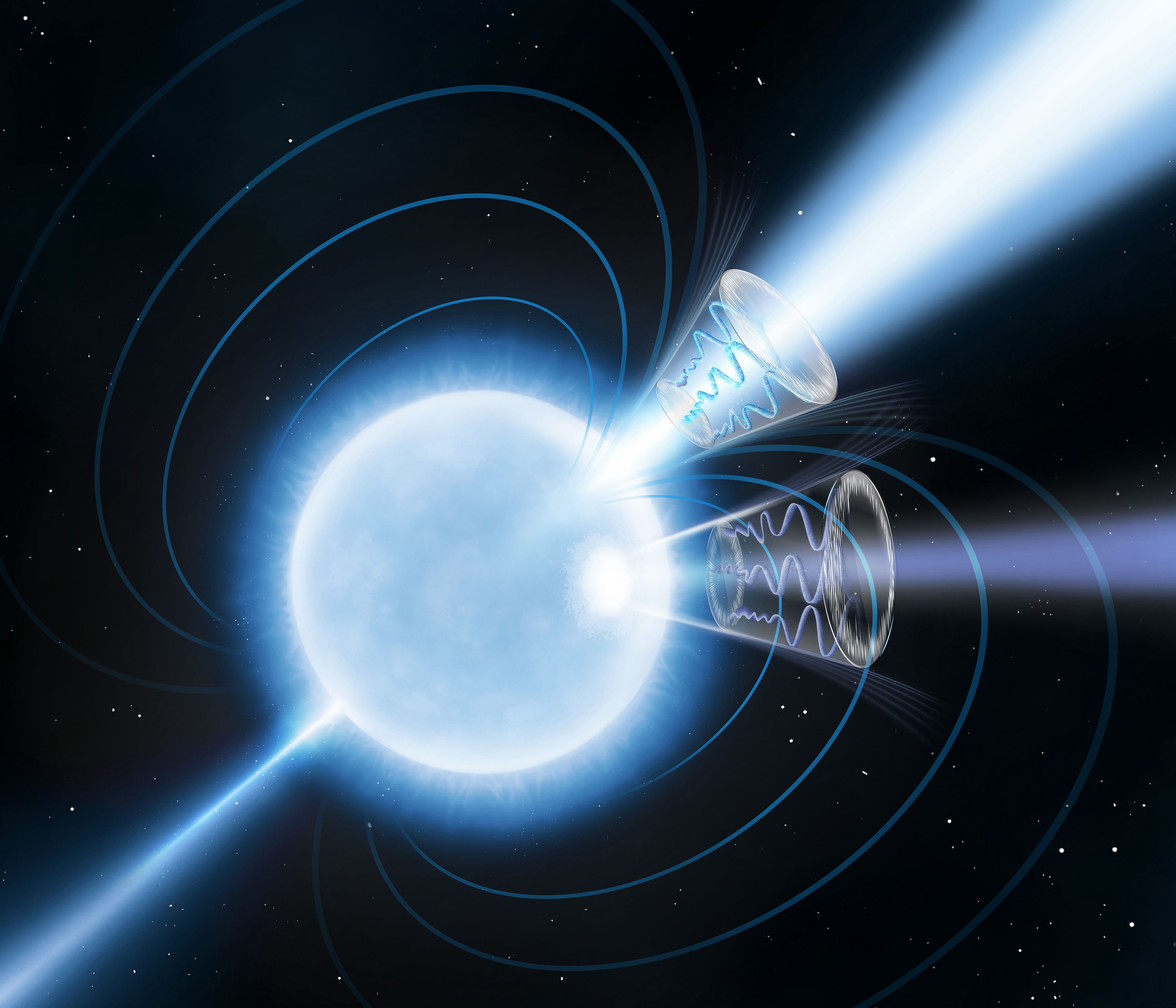
This artist's concept shows the magnetar 1E 1547.0−5408, whose immense magnetic field has given scientists the strongest evidence yet that empty space can change how light travels—a remarkable confirmation of a nearly 90-year-old prediction of quantum physics.
– Credit: NASA/Pablo Garcia.
Some experiments can’t be done in a laboratory. At least not one built by humans.
Even the world's most powerful magnets and particle accelerators can't recreate the extreme conditions needed to test some predictions of quantum physics.
Fortunately, nature already has.
Magnetars are among the universe's most powerful natural laboratories. These collapsed remnants of massive stars generate the strongest magnetic fields known — reaching tens to hundreds of billions of Teslas, compared with about 10 for an MRI scanner. Those extreme environments allow scientists to test predictions in conditions that remain beyond the reach of experiments on Earth.
One of those predictions is vacuum birefringence, a phenomenon proposed by quantum electrodynamics nearly 90 years ago. The theory predicts that empty space isn't truly empty. Instead, it is filled with short-lived particle-antiparticle pairs that constantly appear and disappear. Around a magnetar, the star's immense magnetic field alters the vacuum's properties, changing how light travels through it and causing empty space itself to behave like a polarized filter.
A group of scientists that includes LSU astrophysicist Michela Negro has now reported the strongest astrophysical evidence yet that this effect is real.
Published in Nature, the study combines observations from NASA's Imaging X-ray Polarimetry Explorer (IXPE) with radio and X-ray data from other observatories to study the magnetar 1E 1547.0−5408. Unlike traditional telescopes, which measure how bright an object appears, IXPE measures the polarization of X-rays — the direction in which the light waves oscillate.
Those measurements gave researchers a way to test whether vacuum birefringence was occurring around the magnetar.
The researchers detected an unusually high degree of X-ray polarization — far stronger than existing models could explain. According to Negro, "the only way to get that [such a high polarization signal] for this magnetar is through this vacuum polarization filtering along the way."
Previous observations hinted that vacuum birefringence might exist. This study provides the strongest — and first direct astrophysical — evidence that vacuum birefringence occurs around a magnetar.
"What I really like about this work is that astrophysics becomes a laboratory for fundamental physics," Negro said. "We're not just studying astronomical objects anymore; we're using them to test the laws of nature."
Like Einstein's theory of General Relativity before it, quantum electrodynamics has earned scientists' confidence by surviving decades of increasingly demanding tests. Each new confirmation strengthens the foundation on which future discoveries are built — including this one, performed by a magnetar more than 13,000 light-years away.
Learn more
NASA's Imaging X-ray Polarimetry Explorer (IXPE) is the first space mission dedicated to measuring the polarization of cosmic X-rays. Read NASA's press release to learn more about the mission, the observing campaign, and the international collaboration behind this discovery.