
Study Reveals How Species Competition Shapes Trait Diversity Worldwide
January 29, 2026
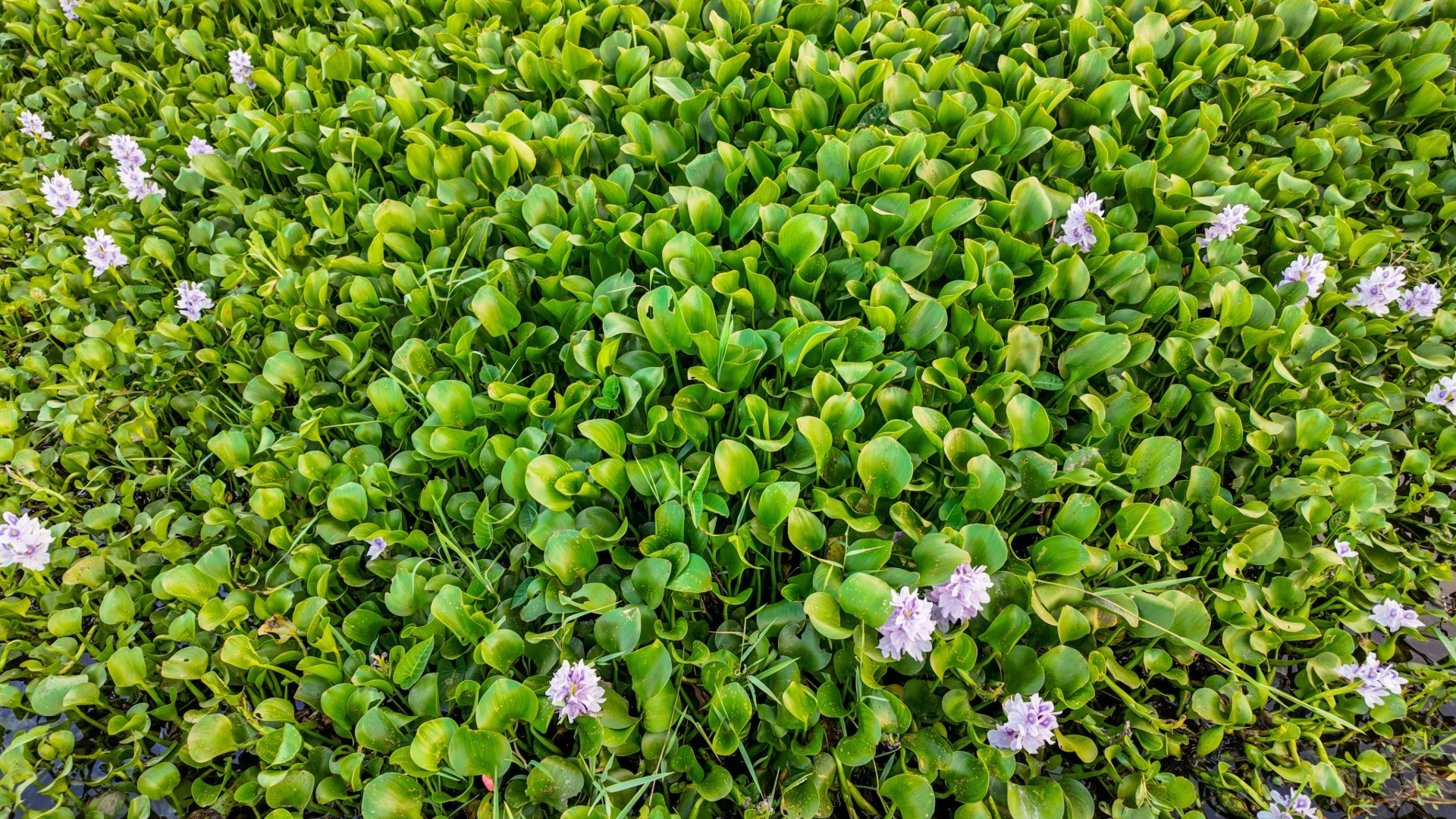
Dense mats of water hyacinth show how competition intensifies as ecosystems become crowded, altering growth, reproduction, and survival—patterns revealed in a new global trait-based study.
– Adobe Stock.
Every ecosystem is shaped by billions of invisible battles: organisms competing for light, nutrients, space, or mates. These competitive interactions determine which species survive, how they evolve, and how vibrant and resilient ecosystems remain. Yet, despite decades of research, scientists have struggled to answer one key question: how competition alters traits, such as body size, lifespan, and behavior, that define how species exist in nature.
A new global study led by LSU Assistant Professor Jiaqi Tan and published in Nature Communications brings new clarity to that question.
A Missing Framework
Picture a grassland growing denser after a wet season, a lake where a new fish species arrives, or a forest already stressed by warming temperatures facing an invasive insect. In each case, competition intensifies. But ecological competition doesn’t happen in isolation; it unfolds across the globe, between native species and invaders, among plants and animals, and across many types of traits.
Until now, no one had assembled a truly global picture of how competition influences trait changes within species, or whether those patterns are consistent across ecosystems and species origins. Without that synthesis, ecologists lacked a framework to predict how species will respond as environments change, whether due to climate shifts, habitat loss, or the spread of nonnative species that can disrupt established communities.
A Global Trait-Based Perspective
To address this gap, Tan’s team analyzed data from 346 published studies spanning plants and animals worldwide. They assembled 3,779 observations from experiments and field studies that measured how traits respond to competition. Rather than asking which species “wins,” the researchers focused on how competition reshapes traits within species.
Across ecosystems, a consistent pattern emerged. As competition increased, average trait values tended to decline. For example, plants often grew smaller when crowded by neighbors, animals showed slower growth rates when competing for food, and reproduction was reduced under intense competition.
“ When communities get crowded, species struggle more, but they also get more creative, by exploring new ecological opportunities ”
At the same time, variation among individuals increased. Within a single population, some individuals adopted alternative strategies, growing faster early in life, maturing sooner, or exploiting slightly different resources, allowing them to persist even as average performance declined. This widening spread of trait values suggests that competition can suppress overall performance while promoting diversity within populations.
“When communities get crowded, species struggle more, but they also get more creative, by exploring new ecological opportunities,” said Tan.
The researchers also found a striking contrast between species origins. Native species consistently showed strong trait shifts when competition intensified, whether they were competing with other natives or with nonnative species. Nonnative species, however, often showed little change when competing with natives, a pattern that may help explain why some invaders spread rapidly despite crowded conditions.
Predicting Change in a Crowded World
By identifying general rules for how competition reshapes traits, this study offers a new predictive lens for ecology. It helps scientists anticipate how species are likely to respond as habitats shrink, resources become scarcer, and ecosystems grow more crowded.
Those insights matter for conservation, invasive species management, and understanding how biodiversity will change in the decades ahead. Rather than treating each ecosystem as a special case, ecologists can now draw on global patterns to better predict who adapts, who struggles, and how life responds to competition in a rapidly changing world.