
Before Humans Reach Mars, Scientists Want to Rethink the Rules of Exploration
November 18, 2026
As space agencies prepare for human missions to Mars, scientists face a challenge: How can they protect the planet from contamination by Earth microorganisms without limiting future exploration?
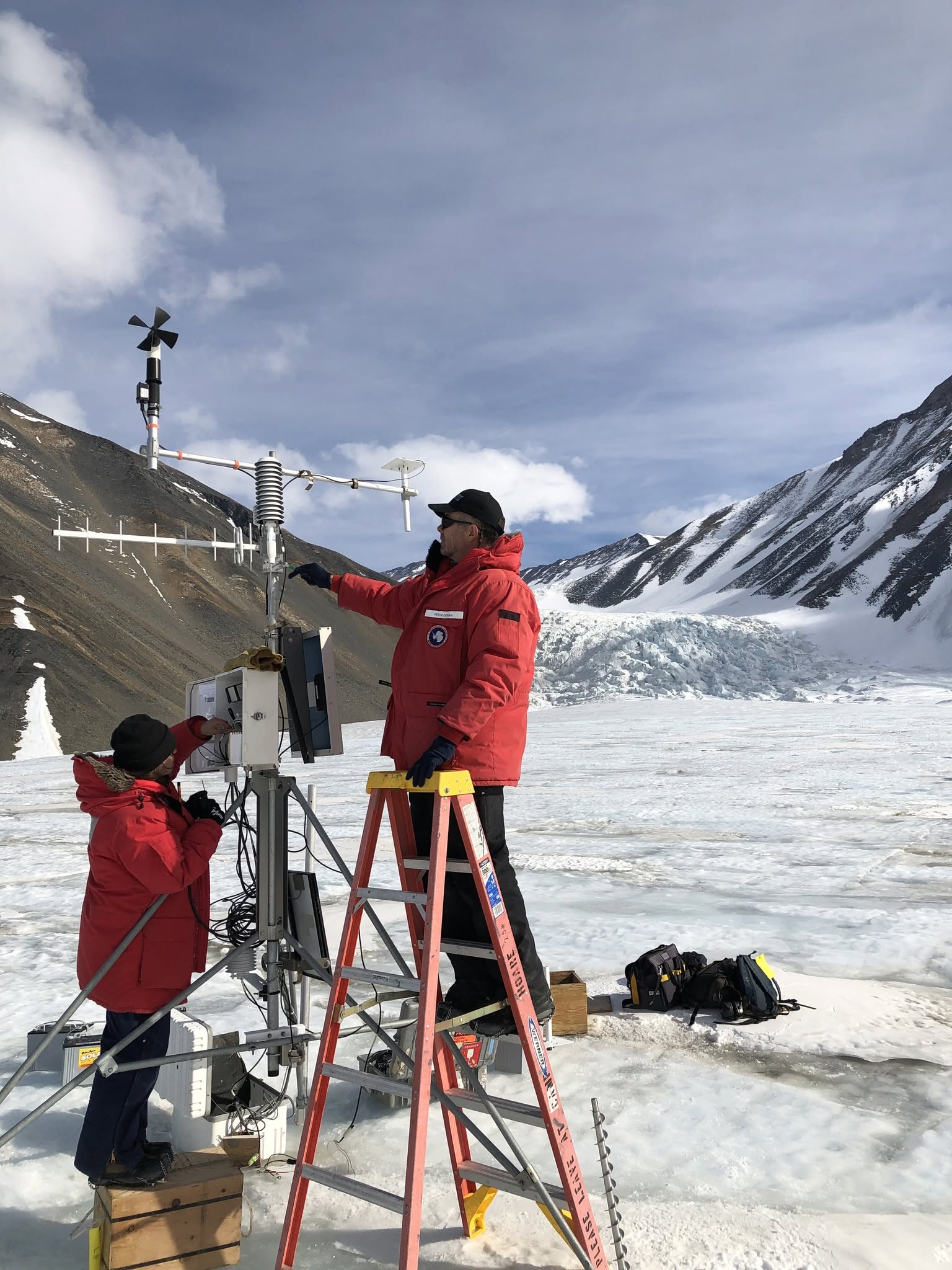
LSU Professor Peter Doran repairs a meteorological station on Canada Glacier in Antarctica's McMurdo Dry Valleys. With their extreme cold, dry conditions and barren landscapes, the valleys are among Earth's closest analogs to Mars. Doran and other researchers study these environments to understand how life survives under extreme conditions and what they might teach us about where to search for life on Mars and elsewhere in the solar system.
Peter Doran, a professor in LSU's Department of Geology & Geophysics and vice chair of the Committee on Space Research (COSPAR) Panel on Planetary Protection, is among the international scientists and policymakers calling for updated Mars exploration policies in Nature Astronomy.
Planetary protection aims to prevent biological contamination between Earth and other worlds. This includes keeping Earth microorganisms from contaminating environments scientists want to study (forward contamination), protecting Earth from potentially hazardous extraterrestrial material brought back by space missions (backward contamination), and preserving the scientific integrity of returned samples.
“When we talk about forward contamination, we’re protecting arguably the most important scientific question humans can ask: Are we alone?” said Doran.
Current policies limit the number of microorganisms spacecraft can carry to Mars to avoid compromising the search for extraterrestrial life. While these requirements have guided decades of robotic exploration, they become impractical for human missions, as astronauts cannot be sterilized and would continuously introduce microorganisms into the Martian environment.
To address this challenge, the international team, led by Professor Karen Olsson-Francis of The Open University in the United Kingdom, proposes returning to a probability-based contamination risk framework, similar to the approach used during NASA's Viking missions in the 1970s.
Rather than relying primarily on fixed microbial limits, the approach would assess the probability of contaminating Mars, with a proposed threshold of less than 1 in 10,000 per mission. The researchers also propose a 50-year Period of Biological Exploration (PBE) dedicated to protecting the search for native Martian life.
According to Doran, the 50-year timeframe is based on projections of how long it would take to conduct approximately 100 missions, a number estimated to be sufficient to investigate whether life exists on Mars. Restrictions could then be potentially relaxed depending on scientific findings, while the timeframe could be revised as new evidence emerges.
Under the proposed framework, individual mission teams and national space agencies would determine how to meet planetary protection requirements, subject to a rigorous scientific peer-review process.
Because planetary protection requirements influence how missions are designed, the proposed shift could help space agencies plan increasingly ambitious missions, including future human exploration of Mars, while preserving the scientific integrity of the search for life.
“ When we talk about forward contamination, we’re protecting arguably the most important scientific question humans can ask: Are we alone? ”
“The COSPAR Panel on Planetary Protection’s leadership and members have been working toward this for some time, and it’s a heavy lift,” Doran said. “We build an international scientific consensus that the changes will still appropriately protect the science. Then when we are satisfied we have that consensus, we make sure these major changes are properly written into the policy.”
“Planetary protection is an international responsibility, and as exploration becomes more ambitious, our policies need to evolve with the science and with the realities of future missions,” said Olsson-Francis, lead author of the commentary. “This work represents the next step in that process, but policy development must be staged and evidence-led.”
The work builds on a UK Space Agency International Bilateral Fund grant.