
Behind LIGO's Discoveries: LSU Leads $4 Million NSF Computing Project
November 04, 2026
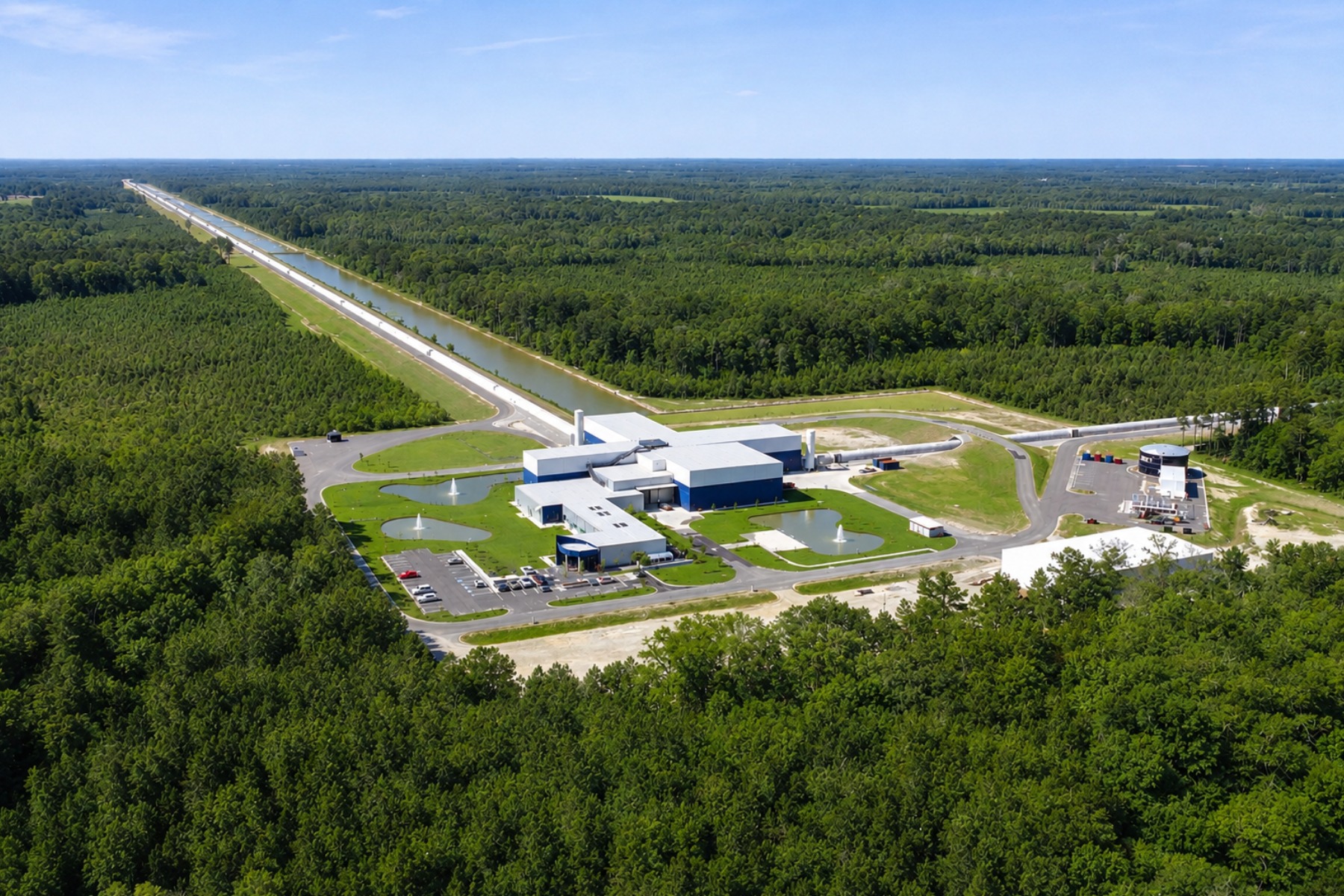
Aerial view of the Laser Interferometer Gravitational-Wave Observatory (LIGO) in Livingston, Louisiana. The facility's L-shaped detector consists of two perpendicular, 4-kilometer-long arms that use laser beams to measure incredibly small changes in distance caused by gravitational waves passing through Earth.
An NSF grant led by LSU will support the computing operations behind LIGO's search for gravitational waves, helping scientists analyze signals from colliding black holes, neutron stars, and other cosmic events.
In 2015, scientists detected gravitational waves from the collision of two neutron stars, allowing astronomers to observe the same cosmic event through both gravitational waves and light for the first time.
The discovery marked a milestone in multi-messenger astronomy, which combines different types of signals to build a more complete picture of events in the universe. But capturing those observations required more than detecting gravitational waves. Astronomers needed to know where to point their telescopes before the light from the collision faded.
At the time, it took approximately 40 minutes to send an alert to participating astronomers. Today, automated systems can distribute preliminary public alerts within seconds, giving researchers a better opportunity to observe these fleeting events. Behind that speed are computing systems that process data from gravitational-wave detectors, identify potential signals, and share information with astronomers around the world.
Now, a new $4 million, two-year grant from the U.S. National Science Foundation, led by LSU, will help maintain and improve those capabilities.
Beyond What Telescopes Can See
Gravitational waves are tiny ripples in spacetime produced by some of the universe's most powerful events, including collisions between black holes and neutron stars.
First predicted by Albert Einstein more than a century ago, they were directly detected for the first time in 2015 by the Laser Interferometer Gravitational-Wave Observatory, or LIGO. Since then, scientists have identified hundreds of gravitational-wave signals, helping researchers understand how black holes form, find one another, and grow.
Some of the black holes detected are so massive that scientists believe they could not have formed directly from the collapse of a single star. Instead, they may have formed through earlier mergers of smaller black holes.
Gabriela González, a Boyd Professor in LSU's Department of Physics & Astronomy and former spokesperson for the LIGO Scientific Collaboration, likes to describe these objects as the "grandchildren" of earlier black holes.
LIGO operates two detectors in the United States, one in Livingston, Louisiana, and another in Hanford, Washington, and is building another detector in Aundha, India. Together with the Virgo detector in Italy and KAGRA in Japan, they form an international network that allows scientists to combine observations and better determine where gravitational-wave events occur.
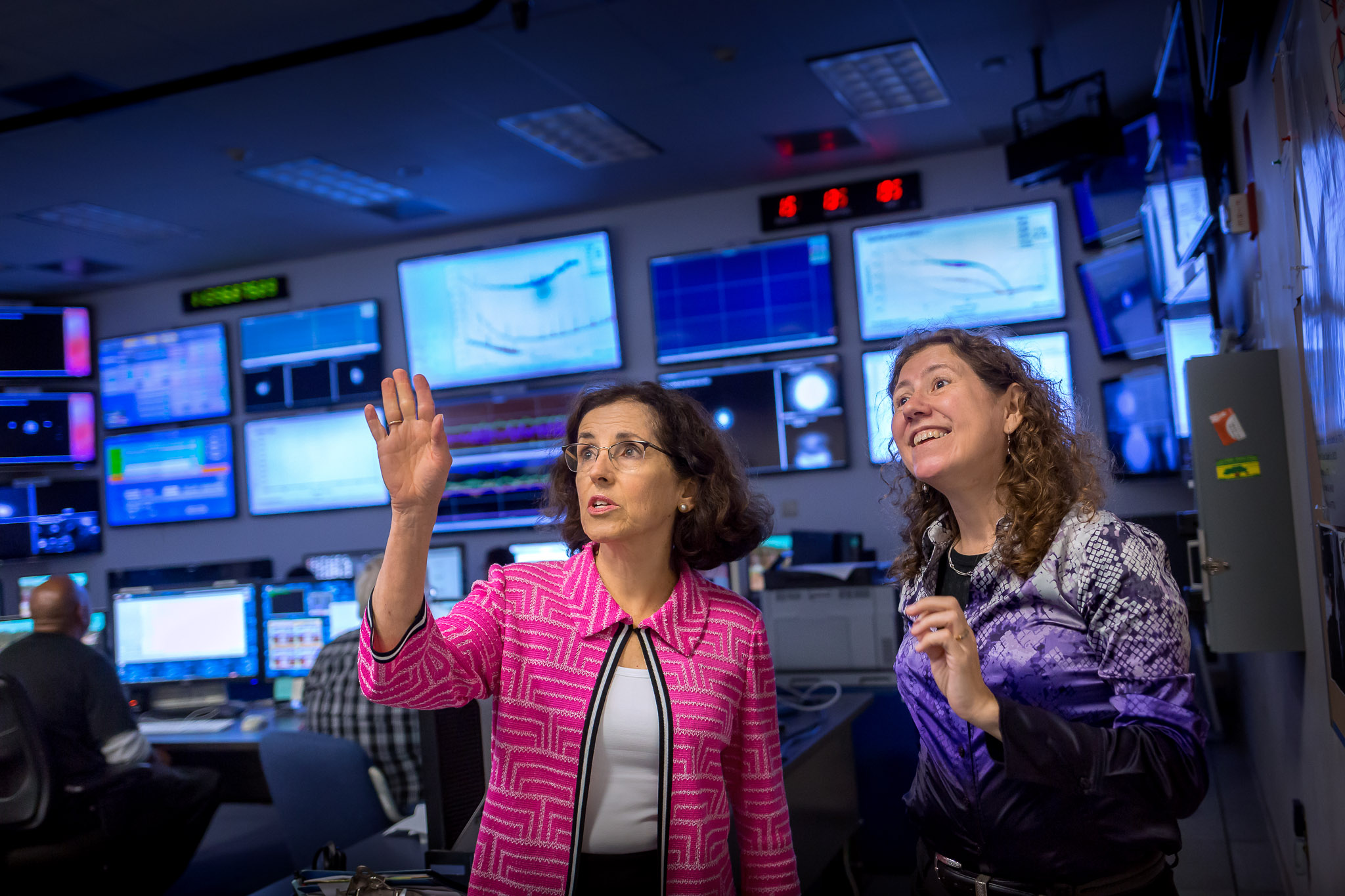
LSU physicist Gabriela González (right) and Dr. France Córdova (left), then director of the U.S. National Science Foundation, in the control room at the LIGO Livingston Observatory in Louisiana. Córdova visited the facility in 2016 following the announcement of the historic first detection of gravitational waves, recorded in September 2015.
Supporting the science behind the discoveries
The new NSF award will support the specialized personnel responsible for operating and improving the computing systems used by the LIGO Scientific Collaboration.
González serves as principal investigator of the collaborative project, which includes the California Institute of Technology, the University of Wisconsin–Milwaukee, California State University, Fullerton, Christopher Newport University and Pennsylvania State University.
While research teams develop new methods to search for gravitational waves, those methods must be integrated into systems capable of analyzing data continuously and delivering results quickly.
The funding will support efforts to modernize computing operations, improve data characterization, accelerate the distribution of alerts, and expand searches for different types of gravitational-wave sources. It will also support the tools needed to coordinate members and facilitate communication across the LIGO Scientific Collaboration. Together, these improvements will help maintain the reliable computing infrastructure that researchers depend on to operate and enhance instruments, collect and analyze data, and make new discoveries about the universe.
The award builds on more than a decade of NSF support for these operations, previously coordinated through the University of Wisconsin–Milwaukee. With LSU now serving as the lead institution, González will oversee the work of the participating universities.
What will LIGO discover next?
As gravitational-wave detectors become more sensitive, scientists hope to identify more distant events and sources that have not yet been observed.
For González, one of the most exciting possibilities is another neutron star collision. Unlike black hole mergers, neutron star collisions can produce light across the electromagnetic spectrum, allowing astronomers to combine gravitational-wave observations with signals detected by telescopes.
She also hopes scientists will eventually detect gravitational waves from a nearby supernova, a stellar explosion that could produce gravitational waves, light, and neutrinos.
But what excites González most is the possibility of discovering something entirely unexpected.
“I would love to see a strong gravitational-wave signal detected by multiple observatories that doesn't match anything we know,” González said. “That would mean we're seeing something new, something we don't yet understand about the universe.”