
LSU Physicists Help Build Massive Underground Experiment to Uncover Neutrino Mysteries
November 09, 2026
As construction of enormous underground detector structures begins in South Dakota, LSU physicists are preparing technology for an international experiment that could help explain why the universe contains more matter than antimatter.
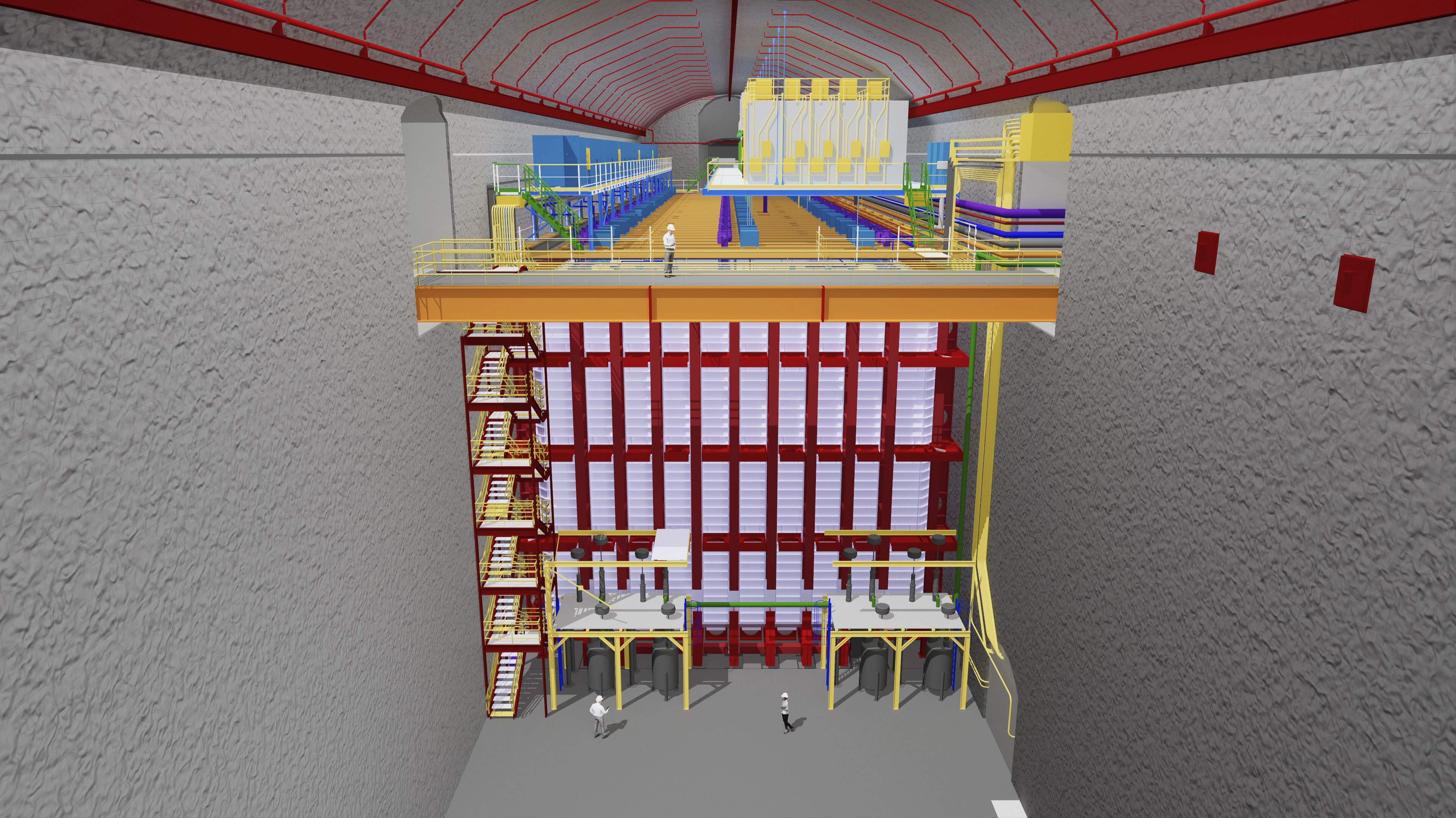
A rendering of one of the cryostat modules that will house the liquid argon detector.
– Credit: Fermilab.
Nearly a mile beneath the surface of South Dakota, crews are assembling thousands of steel beams for an enormous scientific experiment designed to investigate some of the universe's biggest unanswered questions, including why matter exists in far greater quantities than antimatter.
The Deep Underground Neutrino Experiment, or DUNE, will study neutrinos, tiny particles that pass through ordinary matter almost undetected. By examining how these elusive particles behave, scientists hope to better understand their fundamental properties and whether they hold clues to the origins of our matter-dominated universe.
This month, installation crews from the U.S. Department of Energy's Fermi National Accelerator Laboratory (Fermilab), CERN, the European Organization for Particle Physics, and the Sanford Underground Research Facility began assembling two massive cryostats, insulated containers that will house DUNE's underground detectors.
Each cryostat will measure 216 feet long, longer than a Boeing 747 airplane, and hold approximately 17,000 tons of liquid argon cooled to nearly minus 300 degrees Fahrenheit. A total of 2,600 steel beams are being transported underground to form the structures, marking a major construction milestone.
LSU Professor of Physics Thomas Kutter has been involved in DUNE since its early development, helping design and test technologies that will eventually operate inside the detectors.
“For those of us who have worked on DUNE for many years, this is an exciting transition. We are moving from years of careful planning, research and development, and prototyping to constructing the actual detectors in the underground laboratory,” Kutter said.
How Do You Detect a Particle That Rarely Interacts With Matter?
Neutrinos are among the most abundant particles in the universe, yet they are notoriously difficult to detect. They have no electric charge and interact so weakly with matter that most pass straight through Earth without leaving a trace.
To capture the rare interactions that do occur, DUNE will use enormous volumes of liquid argon. When a neutrino interacts with an argon nucleus, it can produce charged particles that knock electrons loose from nearby argon atoms. A carefully controlled electric field guides these electrons toward sensitive readout systems, where their signals are recorded. Scientists can then use the signals to reconstruct what happened during the interaction.
At LSU, the work spans this entire process, from the structures that guide the electrons to the electronics and software that transform their signals into scientific measurements.
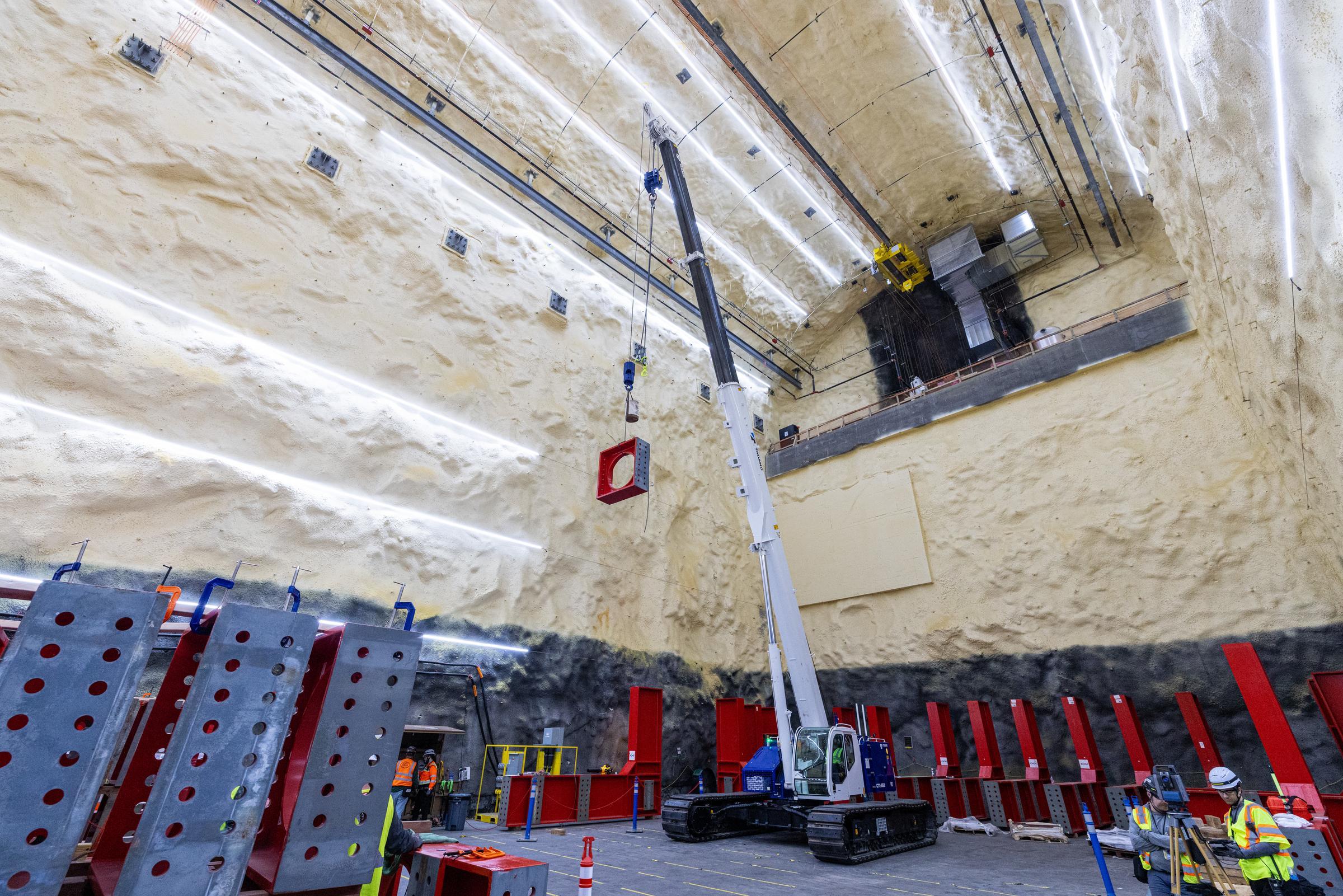
Construction of detector module cryostats began in early November with crews from CERN, Fermilab and SURF.
– Credit: Matthew Kapust, SURF
Kutter's team helped develop and build field cages for ProtoDUNE, a large-scale prototype experiment at CERN in Switzerland. These structures create the precisely controlled electric field needed to guide electrons toward the detector's readout planes. ProtoDUNE allowed the team to test the technology at large scale and gain experience assembling components before construction of the much larger DUNE detectors.
Now, parts for the full-scale detectors are being manufactured and tested at LSU. The work includes components for DUNE's horizontal-drift detector, which moves electrons sideways toward readout planes, and electronics testing for its vertical-drift detector, which moves electrons vertically.
Capturing those faint signals is another challenge. In Associate Professor Martin Tzanov's laboratory, students test electronics designed to amplify and record the tiny electrical signals produced by neutrino interactions. These components must operate at temperatures around minus 184 degrees Celsius.
Reliability is also critical. Once the detectors are assembled and filled with liquid argon, many of their components will be inaccessible for years. Testing under extremely cold conditions helps ensure the electronics will continue functioning throughout the experiment.
But recording the signals is only part of the challenge. Scientists must also interpret them.
Assistant Professor Hanyu Wei is a key developer of Wire-Cell, a software tool that uses advanced algorithms to turn raw electrical signals into detailed three-dimensional reconstructions of particle interactions. These reconstructions help scientists identify the particles produced and understand what happened inside the detector.
Together, the field cages, electronics, and reconstruction software enable the transformation of a fleeting neutrino interaction into data scientists can study.
LSU's contributions also extend to DUNE's near detector at Fermilab in Illinois. Kutter's team is developing and testing photosensors and readout electronics for a temporary muon spectrometer, an instrument that measures the momentum of muons produced in neutrino interactions. Combined with other measurements, this information will help characterize the neutrino beam close to its source.
For now, the work is taking place in laboratories at LSU. Once the cryostats in South Dakota are ready, the components will be shipped to the underground facility, where members of Kutter's team will help assemble the active detector systems.
An 800-Mile Journey Through Earth
DUNE's scientific program will include an intense beam of neutrinos produced at Fermilab in Illinois and directed approximately 800 miles through Earth to the underground detectors in South Dakota. Traveling at nearly the speed of light, the neutrinos will cover that distance in just four milliseconds, far faster than the blink of an eye.
No tunnel is needed for the journey. Because neutrinos interact so rarely with matter, they can travel through hundreds of miles of rock with little interference.
Along the way, neutrinos can change from one type, or flavor, into another, a phenomenon known as neutrino oscillation.
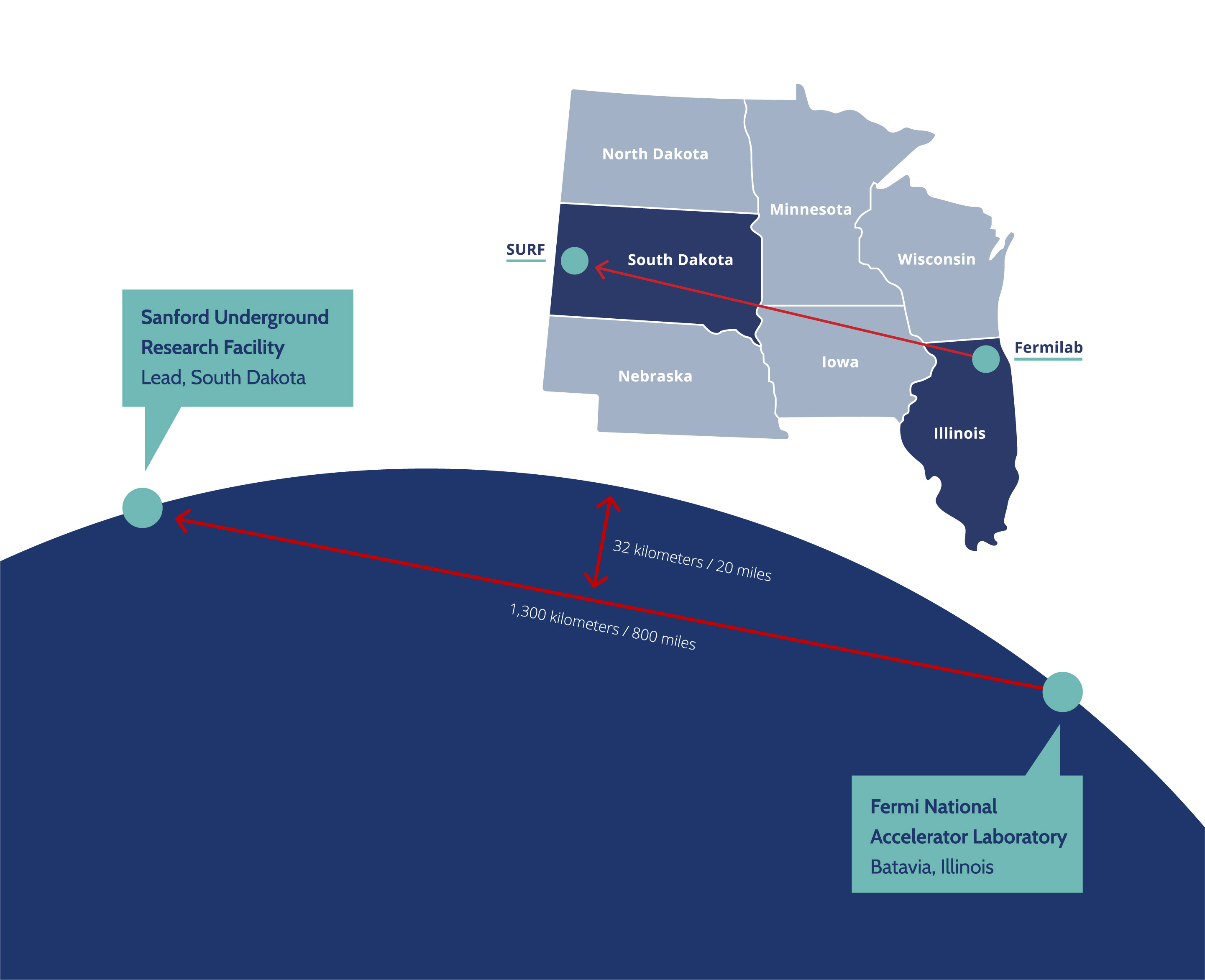
Fermilab will send a beam of neutrinos approximately 800 miles (1,300 kilometers) through the Earth from Fermilab in Batavia, Illinois, to the liquid-argon-filled detectors in South Dakota. Credit: Fermilab
– Credit: Fermilab.
DUNE will measure the neutrino beam near its source at Fermilab and compare those measurements with observations from the distant detectors in South Dakota. By examining how the proportions of different neutrino flavors change over that distance, scientists can investigate fundamental properties of neutrinos, including the ordering of their three masses and whether neutrinos behave differently from antineutrinos, their antimatter counterparts.
That second question could help investigate one of the biggest mysteries in physics.
Scientists believe matter and antimatter were produced in nearly equal amounts in the early universe. When they meet, they annihilate each other, releasing energy. Had they existed in exactly equal amounts and annihilated completely, there would have been virtually no matter left to form stars, planets, or life as we know it. Yet our universe is overwhelmingly made of matter.
By investigating whether neutrinos and antineutrinos behave differently, DUNE could provide new clues to the physical processes behind that imbalance, although such a discovery would not, by itself, fully explain the mystery.
DUNE will also look beyond Earth. Its underground detectors, shielded from much of the cosmic radiation reaching Earth's surface, will be capable of observing neutrinos arriving from the Sun and outer space, including a possible burst of neutrinos from a nearby exploding star, or supernova.
Such an observation could reveal what happens deep inside a star as it explodes, providing information that cannot be obtained from light alone.
From Years of Preparation to Discovery
DUNE brings together more than 1,500 researchers from institutions around the world, with Fermilab hosting the international collaboration and CERN leading the design and construction of the massive cryostats.
At LSU, undergraduate and graduate students, along with postdoctoral researchers, are involved in nearly every stage of the project, gaining hands-on experience contributing to one of the world's largest neutrino experiments.
The underground detector facilities are expected to be completed by 2029, with the detector apparatus scheduled for completion in 2030. The neutrino beam from Fermilab is expected to reach the detectors by 2031.
Looking ahead, Kutter reflected on what he hopes to see as DUNE moves toward operation.
“Those are the moments I am looking forward to most: first seeing this enormous detector that we have worked on for so long come to life, and then seeing what nature reveals once we begin collecting data,” Kutter said.
Read the original announcement from Fermilab.