
How Fire Shapes Life Beneath Longleaf Pine Forests
October 29, 2026
An NSF-funded project led by LSU will investigate how prescribed fires affect soil microbes across longleaf pine ecosystems in the southeastern United States.
Fire is essential to maintaining longleaf pine forests, where widely spaced trees allow sunlight to reach an understory rich in grasses and flowering plants. Without regular burns, shrubs and smaller trees can take over, displacing native vegetation.
But while the effects of fire aboveground are well documented, scientists know less about what happens beneath the surface.

Frequent fires are essential to maintaining longleaf pine ecosystems. By preventing shrubs and smaller trees from taking over, fire preserves the forests’ open structure and allows sunlight to reach the diverse grasses and flowering plants growing beneath the pines.
A new $1.31 million, five-year project funded by the U.S. National Science Foundation (NSF) and led by Assistant Professor Gaurav Kandlikar of the LSU Department of Biological Sciences will investigate how fire affects soil bacteria and fungi across longleaf pine forests in the southeastern United States.
The award is part of NSF's Fire Science Innovations through Research and Education (FIRE) program, which supports interdisciplinary research, education, and collaboration to better understand wildland fire and its effects on communities and the environment.
A Forest Shaped by Fire
Longleaf pine forests once extended from Louisiana to Virginia across much of the southeastern coastal plain. Historically, frequent fires maintained their open structure by limiting the growth of woody plants.
Indigenous communities used cultural burning practices in these landscapes for generations. Later, fire suppression policies disrupted those cycles, contributing to the spread of shrubs and smaller trees, a process known as woody encroachment.
Prescribed burning is now used to maintain and restore longleaf pine ecosystems, but its effects on soil microbial communities remain poorly understood.
"We know now that soil microbes play a really important role in shaping what we see aboveground, and of course, fire does too," said Kandlikar. "But how fires affect soils, especially in the context of the frequent low-intensity burns of the longleaf pine ecosystem, still remains a black box."
Tracing Fire's Effects on Soil Microbes
The LSU-led project will examine how fire affects soil microbial communities across two timescales. First, researchers will investigate whether decades of burning or fire suppression leave a lasting signature in the soil. They will compare sites with different fire histories, including neighboring plots where one has been regularly burned and the other left unburned.
Using DNA sequencing, the team will identify bacterial and fungal communities and examine how their composition varies with fire history.
The researchers will also measure changes following individual prescribed burns. Soil samples collected before and immediately after a fire, then one, three, six, and 12 months later, will help determine how microbial communities respond and change over time. A related experiment will investigate whether fire affects the decomposition of fallen pine needles, leaves, and other plant material.
Because this material also serves as fuel, changes in decomposition rates could influence the amount of fuel available for subsequent fires.
A Research Network Across the Southeast
To examine these questions across the longleaf pine range, the project will establish a network of researchers who will collect soil samples and conduct experiments using shared protocols.
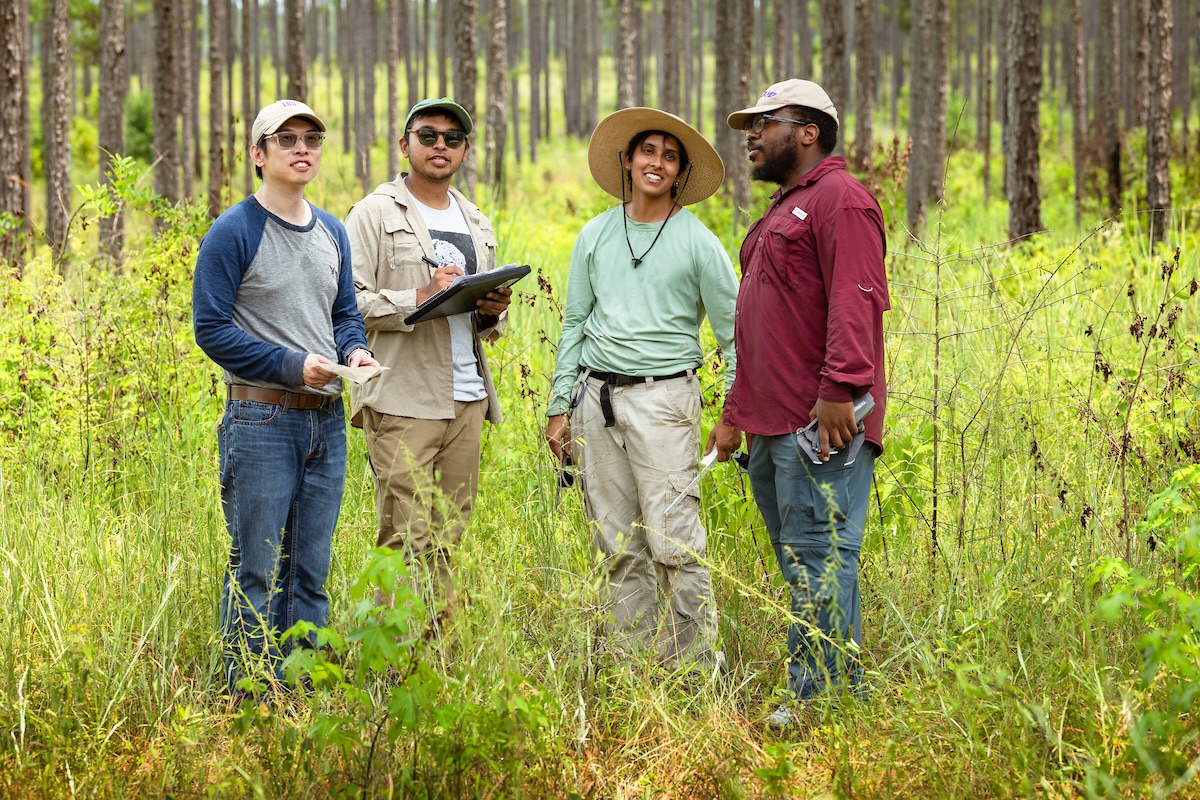
Understanding how fire shapes longleaf pine ecosystems requires studying forests across different environments and fire histories. The LSU-led project will establish a research network across the Southeast, bringing together scientists and land managers to collect soil samples, share data and investigate how microbial communities respond to fire.
This distributed approach will allow the team to compare microbial responses across forests with different fire histories and environmental conditions.
The project also includes a collaboration with a cultural burning association connected to the Lumbee Tribe in North Carolina. Researchers will compare fire behavior under cultural and agency-managed burning practices and examine how people relate to fire in these ecosystems.
The network will organize research meetings in Georgia, Florida, and North Carolina, bringing together scientists, students, and land managers.
At LSU, the project includes co-principal investigator and Associate Professor Jiaqi Tan, a microbial ecologist, and postdoctoral researcher Anita Simha, whose expertise in fire ecology helped develop the research questions.
The NSF grant will support an additional postdoctoral researcher focused on the social dimensions of fire, student research opportunities, and the development of educational materials on fire ecology.
For Kandlikar, one of the most exciting aspects of the project is what could emerge from these collaborations.
"It’s a privilege to bring together a diverse group of researchers, practitioners, and educators to deepen our understanding of fire ecology in this beautiful ecosystem," said Kandlikar. "Wildland fires present complex challenges for both science and society, and I’m excited to see what new questions we can explore and answer by working together."