
Inside a Frozen Record of Life—and What It Takes to Keep It Cold
September 23, 2026
One of the world’s oldest and largest vertebrate genetic collections holds more than 200,000 tissue samples gathered across nearly half a century. Keeping that biological record intact for scientists today — and for questions that may not be asked for decades — takes fieldwork, liquid nitrogen, and constant care.
Natural history museums are best known for what visitors see: exhibition halls and dioramas filled with birds, skeletons, fish in jars, and other specimens preserving snapshots of life from different places and times.
But much of what makes these collections scientifically valuable happens away from the public galleries.
Behind the scenes, researchers use museum specimens to study topics such as evolution, biodiversity, and environmental change. A specimen collected decades — or even centuries — ago can be examined again and again, allowing scientists to ask new questions as tools and technologies change.
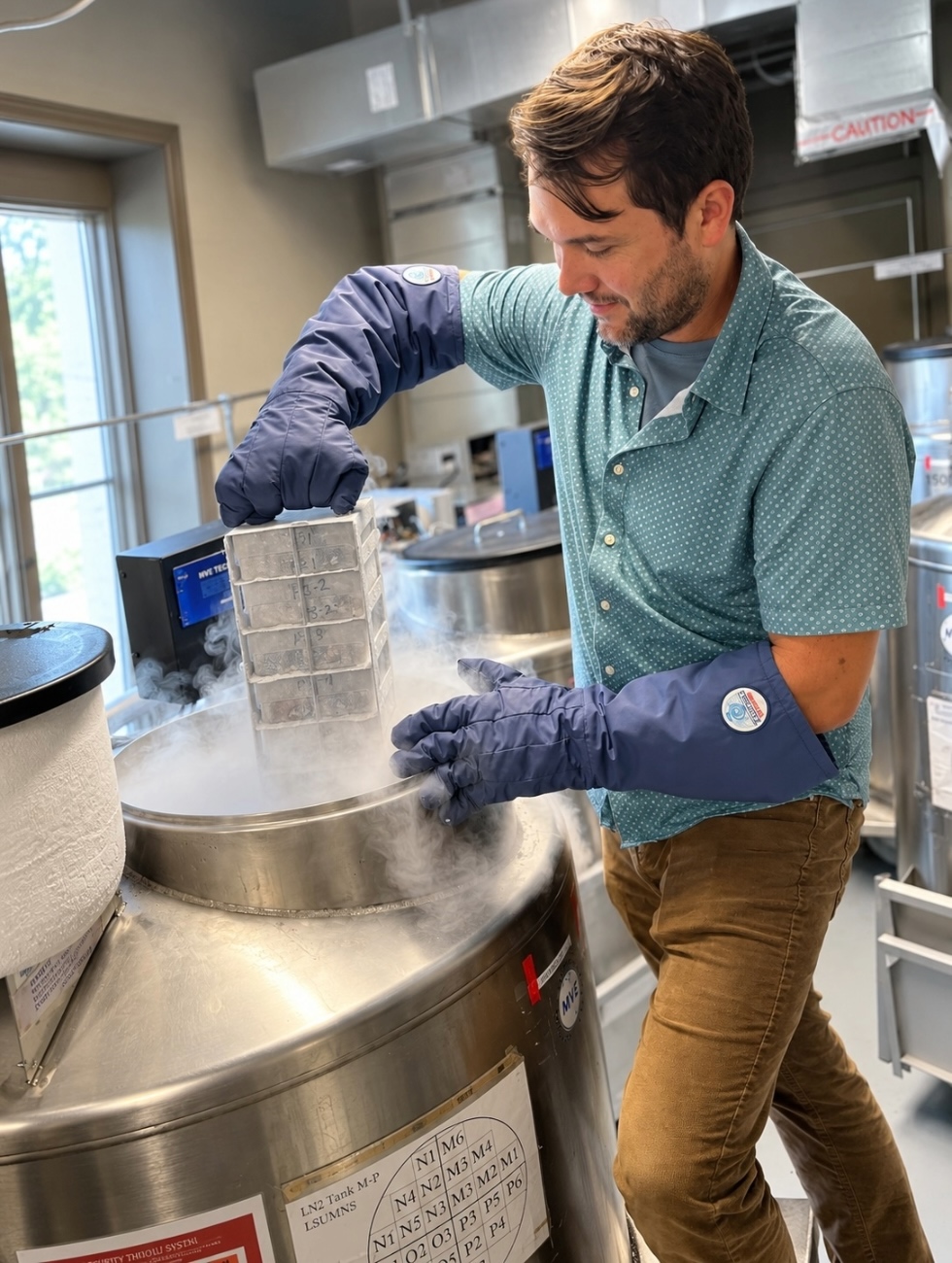
Gregory Thom, assistant professor and curator of genetic resources at the LSU Museum of Natural Science, helps care for a frozen archive built through decades of fieldwork.
And some of the most scientifically valuable material in a modern natural history museum may not look much like a museum specimen at all.
It might fit inside a tiny tube.
At the LSU Museum of Natural Science (LSUMNS), hundreds of thousands of those tubes are kept in a room most visitors will never see.
Instead of glass display cases, the room is dominated by large metal tanks. Inside, racks of tiny vials descend into an environment colder than minus 190 degrees Celsius. Open a tank, and the cold meets the warmer air, sending a cloud of white vapor spilling over its rim.
Established in 1979, LSU’s Collection of Genetic Resources is one of the world’s oldest and largest vertebrate genetic collections. It represents more than 140,000 individual organisms across roughly 8,660 species from every continent, most with multiple tissues, bringing the number of items preserved to more than 200,000.
For Gregory Thom, curator of genetic resources at the LSUMNS, the value of that archive lies not only in what scientists can learn from it now, but what it makes possible for the future.
“By cryopreserving tissues alongside museum specimens, we’re preserving high-quality biological material that researchers can return to as new technologies emerge,” Thom said. “It allows us to keep asking new questions about biodiversity long after a specimen was collected.”
A traditional museum specimen captures an organism’s physical characteristics, such as its size, shape, and coloration. Frozen tissues complement that record by preserving biological material for molecular research, including high-quality DNA, RNA, and proteins.
Often, the two are connected. A tissue stored in one of those tanks may be linked to a bird in the ornithology collection or a mammal elsewhere in the museum, allowing scientists to move between the physical specimen, information about where and when it was collected, and the molecular record preserved inside its cells.
That potential has made LSU’s frozen archive a resource for researchers around the world. Over the past decade, LSU has provided 628 national and international research loans totaling nearly 16,000 individual tissues. The collection contributes to more than 70 scientific papers each year. Those tissues have supported research well beyond evolutionary biology, including studies of West Nile virus and forensic tools for identifying illegally traded wildlife. The collection is also part of large international genomic efforts, including the Bird 10,000 Genomes Project, or B10K, which aims to sequence genomes from all living bird species.
The work behind the collection
Behind those numbers are decades of fieldwork — and thousands of samples whose journeys began long before they reached a freezer in Baton Rouge.
A large portion of its bird tissues — over 80,000 — comes from more than 40 years of expeditions to the Neotropics, the tropical regions of the Americas. Over the past two decades, the collection has also added material from places including Cambodia, Cameroon, China, the Dominican Republic, Equatorial Guinea, Ghana, Indonesia, Kuwait, Malaysia, the Netherlands, and South Africa. Other material has come through museums, zoos, breeding programs, and research institutions.
And this is where the work of a natural history museum can start to look a lot less like a museum.
“We can spend months at a time on expeditions in remote tropical areas,” Thom said. “We’re up hours before sunrise, walking miles in the tropical heat and dealing with intense rain and all sorts of bugs.”
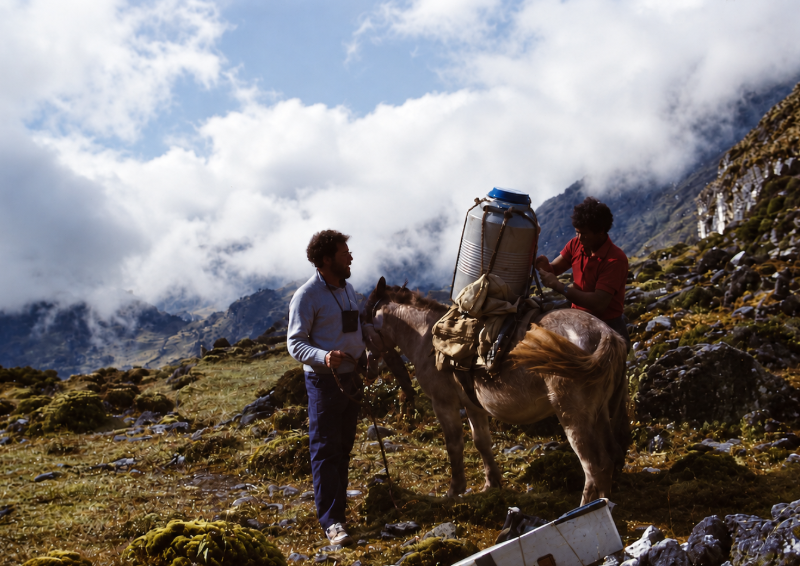
For more than 40 years, LSU Museum of Natural Science expeditions have brought liquid nitrogen into remote field sites to preserve tissue samples. During this 1985 expedition to Huánuco, Peru, researchers transported a roughly 100-pound liquid-nitrogen tank into the Andes by mule, helping build what is now LSU’s Collection of Genetic Resources. Photo by Ken Rosenberg.
Expeditions like that require extensive preparation to secure permits and organize equipment and supplies. They also depend on collaborations with local scientists and communities, and often bring together LSU and local students and researchers at different stages of their careers.
Once a tissue is sampled, time matters. Biological material begins to degrade, so researchers working far from a lab need a way to preserve it quickly.
When possible, they carry liquid-nitrogen dewars into the field to flash-freeze tissue soon after it is sampled. Nearly all bird and mammal specimens are double-sampled, with one tube flash-frozen in liquid nitrogen and another preserved in ethanol.
Bringing liquid nitrogen into remote locations creates its own logistical challenge. Researchers first have to find a reliable source near their destination, which can add days of driving and reshape an expedition’s route. They also have to carry enough to last the expedition — and often bring extra dewars in case one fails.
“Those dewars can weigh more than 40 pounds each, and we have to take them everywhere we go,” Thom said. “That can mean carrying them for hours up steep hills, while making sure we have enough liquid nitrogen to last the entire trip.”
At sufficiently low temperatures, tissue degradation essentially stops. Below roughly -130 to -135 degrees Celsius, chemical reactions that degrade DNA, RNA, and proteins essentially cease. Back in Baton Rouge, LSU’s nitrogen-vapor tanks keep tissues colder still — below -190 degrees Celsius.
The result is something like a molecular snapshot, preserved until a scientist has a reason to examine it.
The value of an old sample
When the collection was established in 1979, preserving tissues for future research was a forward-looking investment. Decades later, that early commitment is making studies possible that its founders could not have imagined.
A sample collected decades ago can now contribute to genomic, transcriptomic or proteomic research. A tissue frozen today might someday help scientists investigate an emerging disease, reconstruct the evolutionary history of a species, understand how populations responded to environmental change, or answer a question no one has thought to ask yet.
Recently, Thom’s lab encountered an example of why that foresight mattered. His team is producing high-quality reference genomes for a family of birds to study genome evolution. For one rare species, the White-masked Antbird, the only tissue available dated back more than 25 years, when LSU researchers rediscovered the species following more than 60 years without a recorded sighting. Tissue collected during that work was cryopreserved and deposited in LSU’s collection.
Modern long-read sequencing requires exceptionally high-quality DNA, and Thom wasn’t sure a sample that old would work.
“When we extracted it, the DNA looked just as pristine as DNA from samples we collected on our most recent field trip,” Thom said. “That tissue was preserved more than 25 years ago, and today it’s allowing us to generate genomic resources that otherwise wouldn’t be possible.”
But for that to remain possible, one thing is essential.
They have to stay cold.
When the collection calls
Most days, the tanks do that job quietly. Nine large nitrogen-vapor tanks hold much of the collection, while ultracold freezers preserve additional material. Staff record temperatures and nitrogen levels every day. Sensors watch around the clock, monitoring freezer and room temperatures, oxygen levels, and even water on the floor.
Other days, a stream of alerts starts popping up on Thom’s phone.
A temperature moves outside its safe range. Nitrogen runs low. A freezer malfunctions. Something needs attention.
The timing can be particularly unforgiving.
“Of course, problems always seem to happen during holidays or long weekends,” Thom said. “In the past two years, I’ve had to go to the lab on Christmas Day to check on the freezers after getting alarm notifications.”
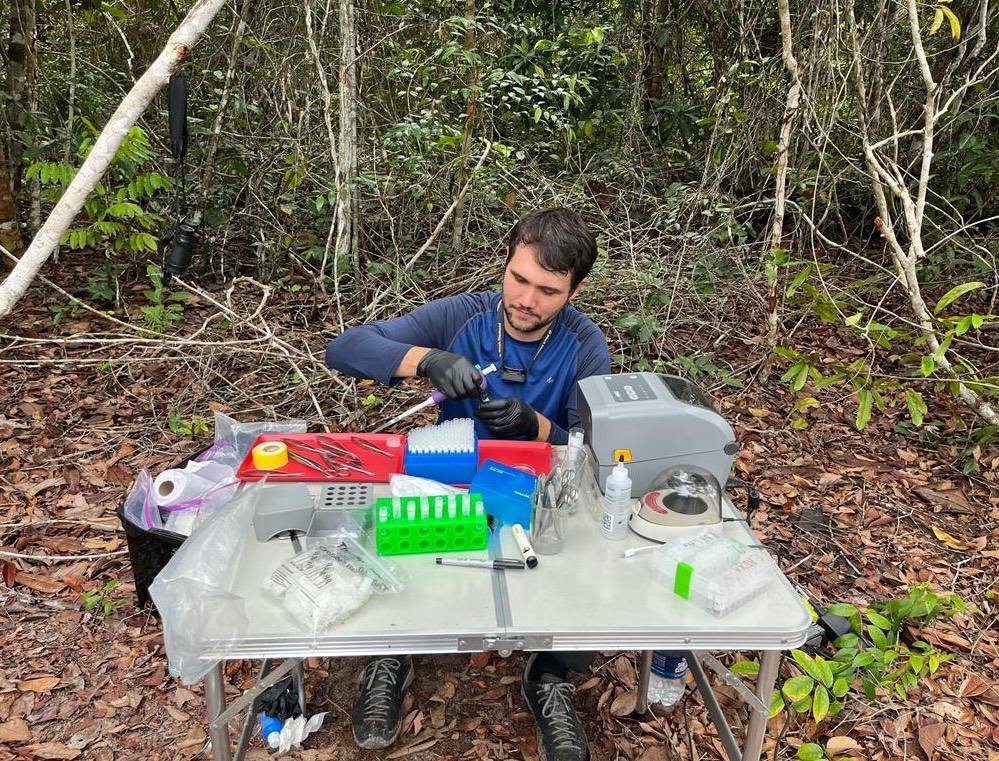
With pipettes, tubes, centrifuges and other portable equipment, modern field expeditions increasingly resemble traveling laboratories, allowing researchers to prepare and preserve samples for genomic, proteomic and other molecular research far from a traditional lab.
Many samples inside those tanks cannot simply be replaced. Some were collected in places LSU researchers may never visit again. Others represent animals that are rare, difficult to encounter, protected or even extinct. The collection includes roughly 1,500 samples from zoos and breeding programs, some representing species extraordinarily difficult or impossible to sample in the wild.
A freezer failure, then, is not just an equipment problem. If a tank or freezer fails, its contents need somewhere cold to go immediately.
Meanwhile, the archive keeps growing. LSU’s field program has accelerated in recent years, with international expeditions on four continents, while modern molecular research can require substantially more material from each individual. Some recent expeditions have generated as many as 20 tissue vials per specimen.
Then there is Louisiana weather.
The museum has backup power and monitoring systems, but the collection still depends on a steady supply of liquid nitrogen. During summer, its external supply tank can require refilling about every seven days — a vulnerability during hurricanes, when transportation and deliveries can be disrupted. During prolonged storms, museum staff have placed the collections under 24-hour watch.
Even if every storm passes and every tank behaves as it should, there is still a predictable problem: it is running out of room.
The nine nitrogen-vapor tanks are already about 85 percent full. At about 3,500 new specimens a year, they are expected to reach capacity within roughly five years.
And space is only part of the challenge. Every tissue needs a trail of information that gives it scientific meaning: what organism it came from, where and when it was collected, who collected it, what kind of tissue it is, and, when applicable, which physical museum specimen it belongs to.
LSU researchers now record much of that information digitally in the field, using tablets, cryogenic-resistant labels, and barcodes. But getting a sample from an expedition into the permanent collection still involves manual steps and cross-checking, and processing new material can take years.
Without reliable data, even a perfectly preserved tissue loses much of its scientific value. Preserving the information about a sample can be nearly as important as preserving the sample itself.
Making room for the future
Now, nearly $1 million in infrastructure funding from the U.S. National Science Foundation will allow the LSU Museum of Natural Science to expand and modernize its frozen archive.
The project will move the Collection of Genetic Resources into a larger space in Foster Hall, add nitrogen-vapor tanks and ultracold freezers, modernize monitoring systems, and create the backup capacity the collection currently lacks.
The museum also plans to generate its own liquid nitrogen on-site. That would reduce dependence on outside deliveries and the more than $45,000 currently spent each year on liquid nitrogen. The improvements are expected to increase storage capacity by at least 30 percent, creating room for more than 60,000 additional samples and enough to accommodate projected growth for at least another decade.
The upgrades will also connect more of the digital journey from field to freezer, linking data recorded during expeditions with accession records, labels, and barcodes used to track individual tissues among the collection’s more than 200,000 items.
The expanded infrastructure will support a collection already used by scientists around the world — and give it room to grow. The next tissue added to the collection may be used soon. Or it may stay frozen for decades. Either way, the job is to make room for it — and keep it cold.