
These Rocks Weren’t Supposed to Be There. They Helped Reveal How a Young Ocean Formed
May 25, 2026
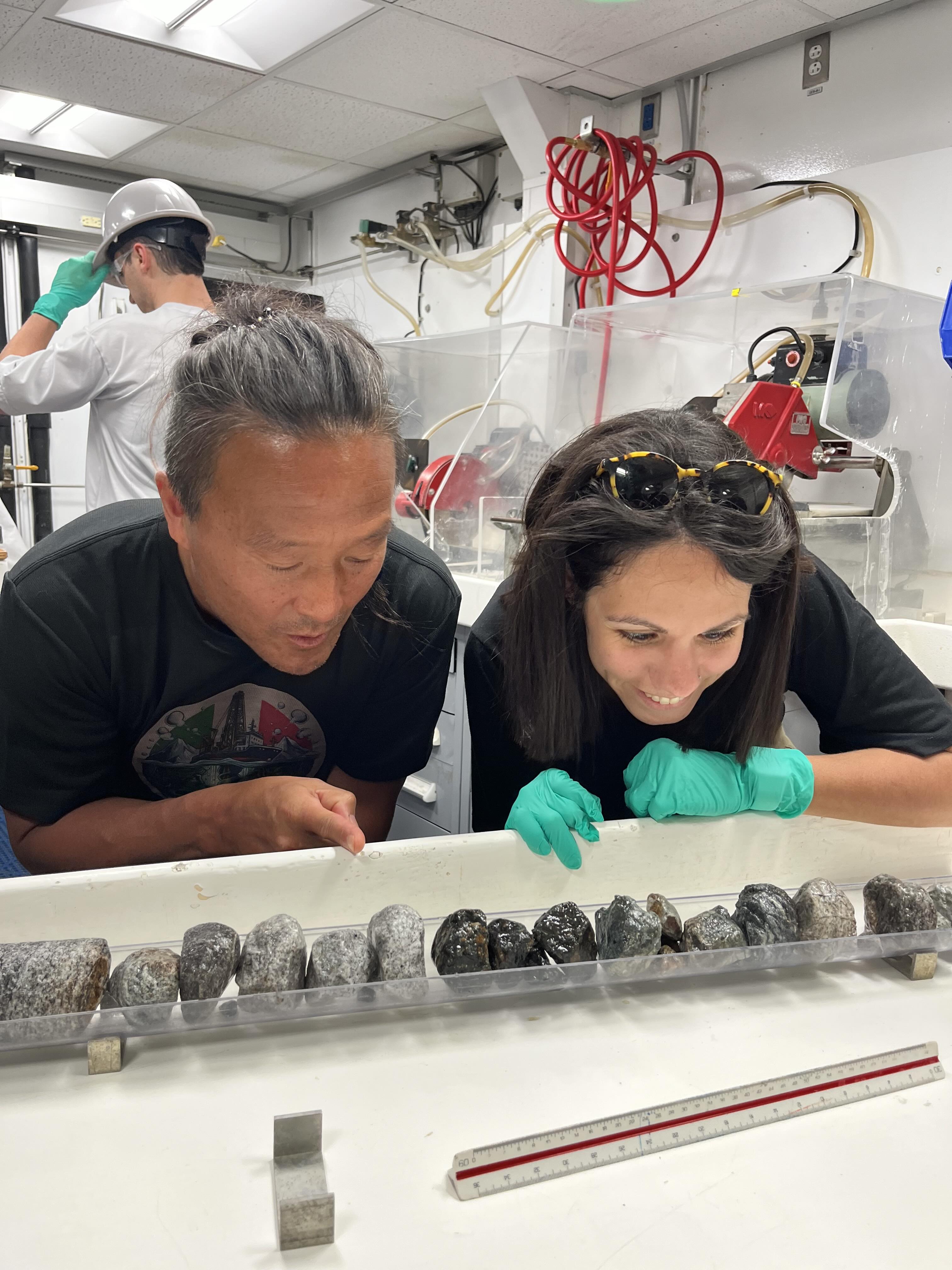
LSU geologist Eirini Poulaki (right) and Tomoaki Morishita of Kanazawa University, Japan, examine the final hard-rock core recovered by the research vessel JOIDES Resolution during an International Ocean Discovery Program expedition. The core contains mantle rocks sandwiched between granite intrusions—an unusual combination that helped reconstruct their path to the seafloor.
Deep below the Tyrrhenian Sea offshore Italy, scientists drilled into what they thought would be dark mantle rock — and found pieces of granite that seemingly had no business being there. Those unexpected intrusions turned out to offer a rare glimpse of how a massive fault rapidly pulled deep Earth rocks toward the surface during the opening of a young ocean basin.
“When we first recovered the granites, we were all surprised because these are rocks you normally associate with continental crust, not the oceanic crust or the mantle,” said LSU geologist Eirini Poulaki. “But it was also exciting, and I had a feeling they were going to help us piece together what happened along this fault system in a way we usually can’t.”
The Tyrrhenian Sea provides a rare opportunity to study how continents break apart and new ocean basins begin to form. It is what geologists call a tectonic window — a place where the crust became so stretched and thinned that scientists can access the upper mantle, a part of Earth normally buried far too deep to sample directly.
Millions of years ago, the basin started to open at rates of roughly 2 centimeters per year, about as fast as fingernails grow — while giant detachment faults worked like conveyor belts, hauling mantle rocks upward toward the seafloor as the surrounding crust pulled apart.
But understanding the timing and processes of how these faults operate has remained difficult. Scientists can often infer mantle exhumation from geophysical data and numerical models, yet rarely recover rocks that directly preserve the conditions under which deformation occurred.
There, the researchers recovered not only mantle rocks, but also unexpected granitic intrusions within the fault zone. In a recent study published in Science Advances, the team shows that these unusual granitic bodies acted like a built-in clock and thermometer, preserving a detailed record of how the fault evolved as deep rocks rose toward the seafloor — and may also have helped keep the fault system active and moving rapidly during the opening of the basin.
A surprising discovery beneath the seafloor
During International Ocean Discovery Program Expedition 402, scientists drilled into the Tyrrhenian Sea to investigate how mantle rocks become exposed during the opening of young ocean basins. Researchers expected to recover ultramafic mantle rocks, such as peridotites — dense rocks rich in iron and magnesium — along with fragments of oceanic crust. But among those mantle rocks, the researchers also discovered unexpected light-colored granite intrusions cutting through the mantle section.
These were not only pristine granites: some were intensely stretched and sheared, with deformation increasing toward a localized fault zone. That gradient is a hallmark of fault activity, with strain concentrated near the fault zone and fading away from it. The deformation also suggested the granites were not simply passive fragments trapped in the mantle, but were actively involved in the fault system itself.
The strange pairing of rock types raised a major question: were these ancient fragments of continental crust left behind as the basin opened, or did they form during the extension process itself? The answer depended on the age of the granites. If they were ancient, they were likely remnants of older continental crust. If they were young, they must have formed during the opening of the basin itself.
To solve the mystery, the researchers dated zircon and apatite minerals inside the rocks using uranium-lead geochronology. The results showed the granites formed about 4 million years ago — the same time the basin itself was opening.
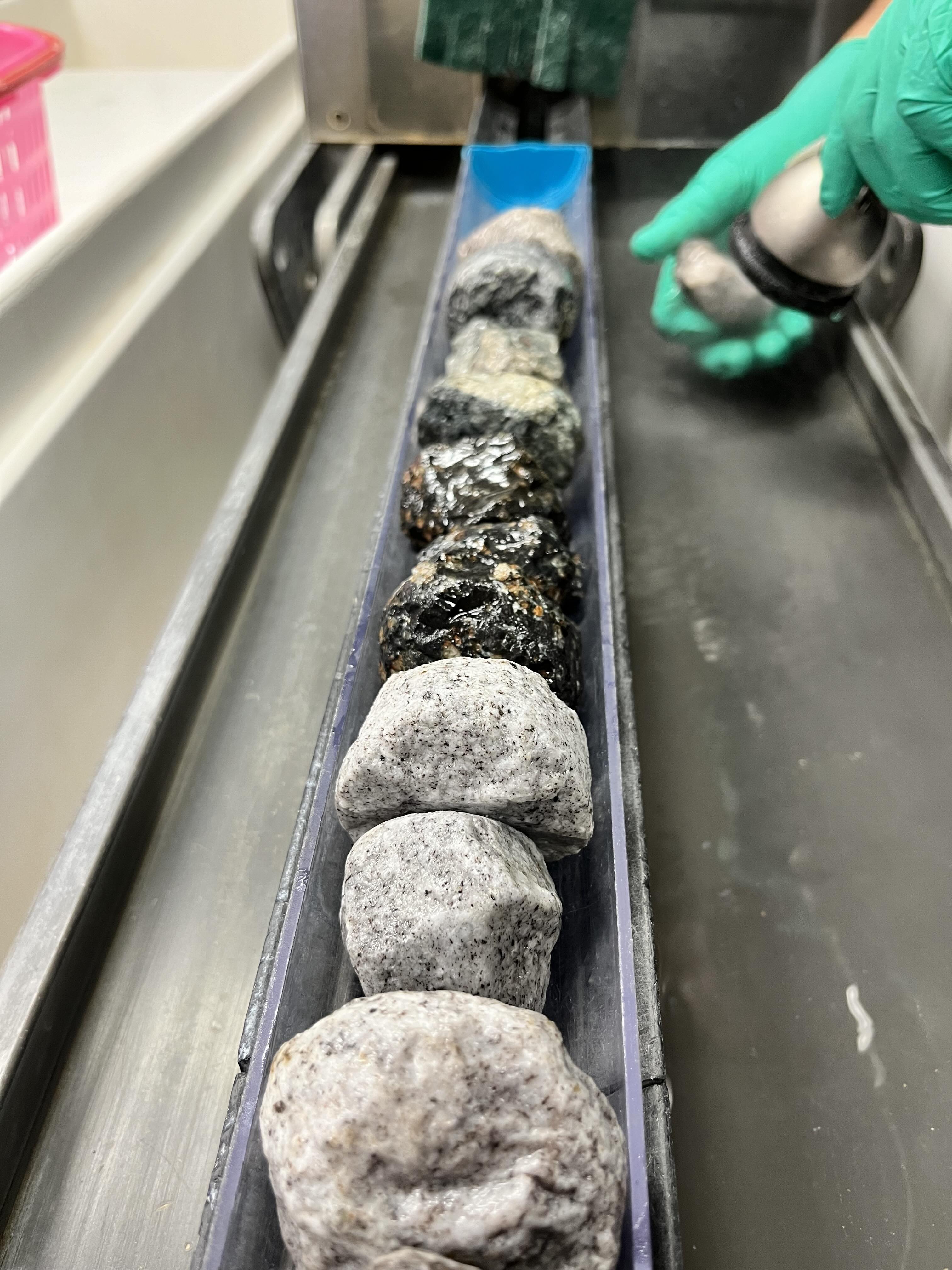
Granite and mantle rock, known as peridotite, look and behave very differently. The lighter-colored granite is made mostly of quartz and feldspar and contains small amounts of minerals such as zircon and apatite, which are generally absent from mantle rocks and provided important clues about the history of the Tyrrhenian Sea. The darker peridotite is rich in minerals such as olivine and pyroxene. Because quartz is mechanically weaker than olivine, granite deforms at lower temperatures than peridotite. Together, these differences allowed the granites to serve as both a clock and a thermometer, recording when and under what conditions the fault system evolved.
That meant the granites were not relics of older continental crust. Instead, they formed deep beneath the stretching crust and were injected into the mantle as the basin opened, becoming part of the active fault system. For the first time in this type of setting, scientists could use direct mantle rock samples containing multiple well-established mineral chronometers — tools normally used to study detachment faults in continental settings — to directly constrain the timing of fault activity in an ocean basin.
Reconstructing the rise of deep-Earth rocks
The granites also served as a thermometer, preserving clues about the temperatures the rocks experienced as they moved upward through the fault system. By combining mineral dating, microstructural analysis, and temperature estimates, the team reconstructed the sequence of events — from magma emplacement deep beneath the seafloor to the uplift of mantle rocks onto the ocean floor.
Mineral chemistry showed the granites initially crystallized at temperatures of roughly 600–700°C deep beneath the seafloor. Later microstructural analyses, paired with titanium-in-quartz thermometry, revealed that the same rocks continued deforming at cooler temperatures around 450°C as they were sheared along the fault and transported upward.
By comparing the ages of the granites with sediments deposited above them 3.5–3.6 million years ago, the researchers calculated that the rocks were rapidly exhumed from several kilometers beneath the seafloor to the ocean floor in less than half a million years.
That corresponds to exhumation rates of roughly 2 centimeters per year — rapid on geologic timescales and comparable to independent estimates of how quickly the basin was opening during this phase of extension. The findings suggest the fault accommodated much of the basin’s extension along a single major structure rather than distributing deformation across many smaller faults.
“We basically figured out how fast this fault moved,” Poulaki said. “And it was moving very fast, at the estimated speeds of the entire plate tectonic system.”
Taken together, the ages and temperatures reveal a continuous history: hot granite magma intruding deep within the lithosphere; solidified granite deforming as the fault pulled it upward; and eventually sediments burying the exhumed rocks at the seafloor.
The way deformation intensifies near the granites and fades away from them further supports the idea that most motion was concentrated along one dominant detachment fault.
Why granite — not seawater — drove early weakening
The timing information also helped the researchers answer another long-standing question: what actually weakens these faults enough to exhume mantle rocks so rapidly?
Geologists have debated whether fault weakening is driven primarily by magma intruding into the crust and mantle or by serpentinization — a process in which seawater chemically alters strong mantle rocks into weaker serpentine minerals. Oftentimes, numerical models of rapid mantle exhumation in similar settings have relied heavily on serpentinization.
But the new data from the Tyrrhenian Sea tell a different story.
By analyzing stable isotopes in surrounding peridotites, the ultramafic rocks hosting the granites, the team showed that serpentinization occurred later and at much lower temperatures — around 220–230°C — after the granites had already formed, deformed, and much of the exhumation had already taken place.
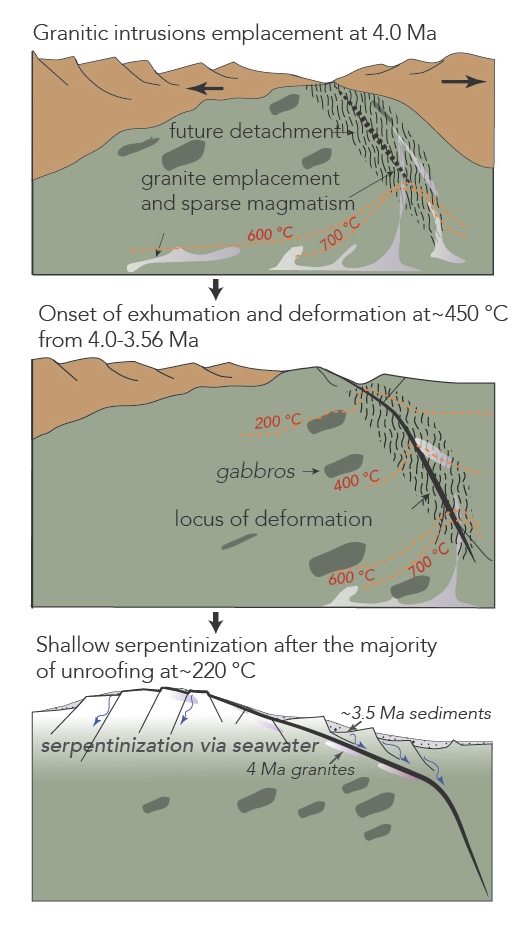
A reconstruction of the geological history recorded by the Tyrrhenian Sea rocks. The study shows that granite intrusions formed during basin opening, helped localize movement along a major detachment fault, and preserved the timing and temperature record needed to reconstruct how deep mantle rocks were rapidly brought to the seafloor.
Instead, the granites themselves appear to have done most of the early work.
Because granite is mechanically weaker than surrounding mantle rocks at intermediate temperatures, it deforms more easily. The researchers found that these granitic bodies localized strain along the detachment fault, helping it remain active and efficiently exhume deep rocks along a single major structure rather than a broad, diffuse zone.
“It potentially acts as a lubricant,” added LSU geologist Brandon Shuck, co-author of the study. “Even after the magma solidifies, it remains weaker than the surrounding rocks, helping deformation focus along the fault.”
Poulaki notes that the idea that magmatic intrusions, such as gabbros, can weaken faults is not entirely new. In other regions, mafic intrusions have also been shown to reduce fault strength. What makes the Tyrrhenian Sea unusual is that these granites are even weaker than those rocks while also preserving an exceptionally detailed record of how the fault evolved through time.
Understanding how continents break apart
Oceanic detachment faults like the one studied in the Tyrrhenian Sea are thought to play a major role in forming new oceanic lithosphere in regions with limited volcanism. But directly linking timing, temperature, and deformation mechanisms has remained difficult in these settings because scientists rarely recover rock samples that preserve evidence of all three.
The granites that were emplaced and trapped within the mantle in the Tyrrhenian Sea contain minerals with well-established methods to determine precise age and temperature records. These minerals are not commonly found in mantle rocks, and hence the study provides unique constraints on how large detachment faults operate during the formation of new ocean basins.
“No one had been able to link deformation to timing in this way before in these kinds of settings,” Poulaki said. “We were only able to do it because of the unique lithologies — this mix of mantle rocks and granites.”
Beyond the Tyrrhenian Sea, the findings may apply to many other regions where continents are breaking apart and new oceans are beginning to form. By showing that magmatic intrusions — not just later seawater alteration — can drive early fault weakening, the study offers rare direct evidence of how Earth’s crust stretches, fractures, and eventually breaks apart to create new oceans.