
Turning Down the Heat: LSU Chemists Find a Cooler Way to Build Complex Materials—Earning Journal Front Cover
April 15, 2026
For decades, making advanced inorganic materials has followed a familiar formula: mix elements, turn up the heat — often to nearly 1,000°C — and wait for structures to form.
Researchers at the LSU Department of Chemistry are showing there’s another way.
In a new study from Dr. Baranet’s lab, the group demonstrates how complex materials can be synthesized at a fraction of that temperature — earning front cover art selected by the journal’s editors.
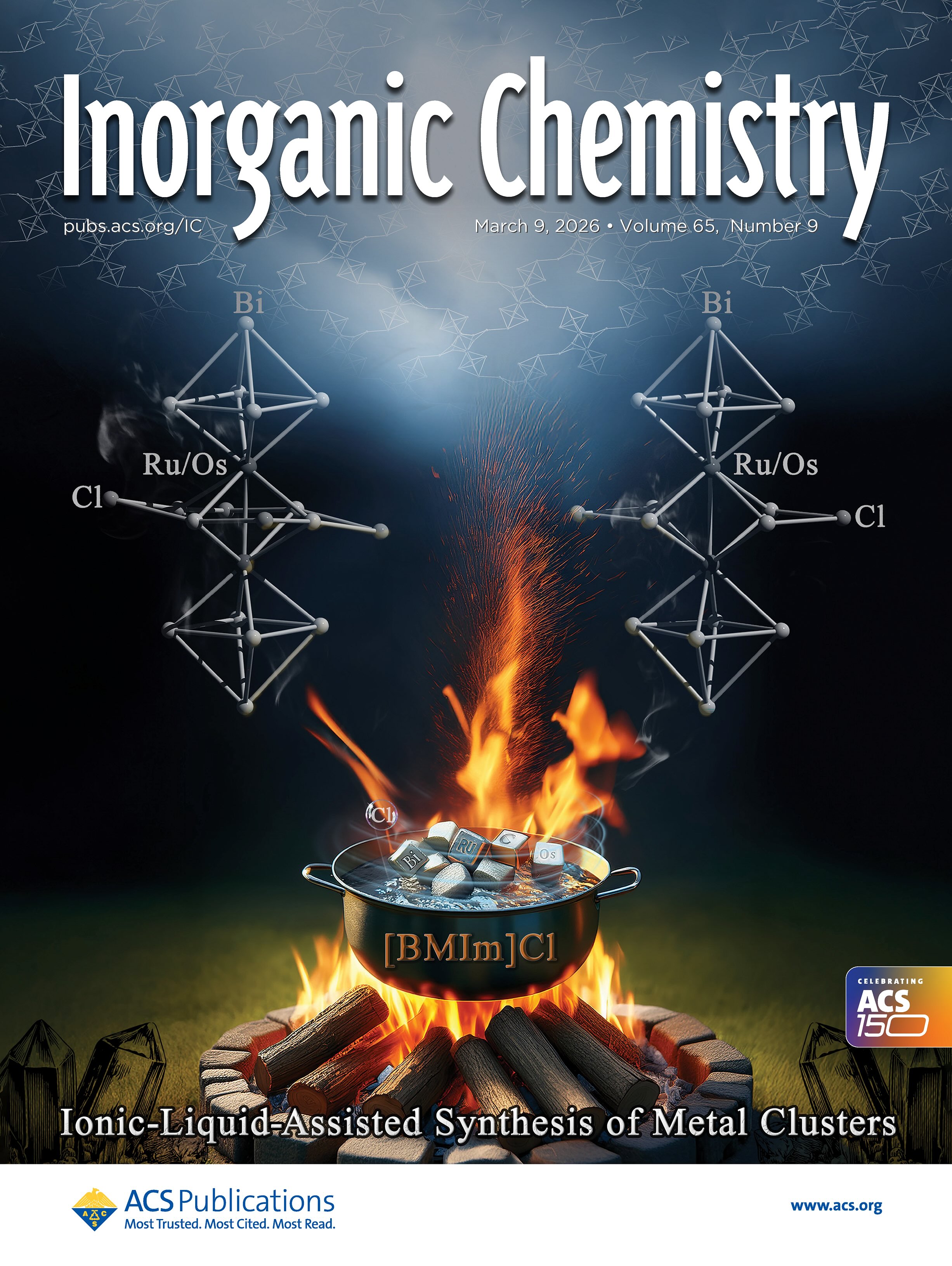
A cooler recipe for complex materials
Instead of relying on extreme heat, the team used ionic liquids — salts that remain liquid at relatively low temperatures — as a reaction medium to guide material formation.
Using this approach, they synthesized intricate inorganic cluster compounds at just 180–200°C, well below the temperatures required by traditional methods. These clusters, precisely arranged groups of atoms, are more than chemical curiosities. They are foundational building blocks for designing next-generation materials.
The group identified two distinct bismuth-based metal cluster forms, including one previously unreported, and showed how subtle shifts in the chemical environment can switch between them. To understand how these structures form, the team combined laboratory experiments with comprehensive structural studies and computational modeling, leveraging LSU’s high-performance computing resources and X-ray crystallographic facility to map molecular structures and electronic behavior.
This integration of experiment and theory moves the work beyond observation and toward prediction — laying the groundwork for designing materials with targeted properties.
Together, the study establishes not just a result, but a new synthetic pathway that other researchers can now build on.
Why this matters: energy, control, and design
Lowering the temperature isn’t just a technical improvement; it changes how materials can be made.
High-temperature synthesis is energy-intensive and costly, particularly at scale. By reducing those requirements, this approach offers a more efficient route to advanced materials, with potential implications for manufacturing and sustainability.
Just as important, ionic liquids provide a level of control that is difficult to achieve under extreme conditions. They create an environment where atoms assemble more selectively, allowing researchers to guide structure with greater precision.
A foundation for what comes next
While the study focuses on synthesis and structure, it opens the door to future applications.
Cluster-based materials like these are being explored across fields — from catalysis to energy technologies — where atomic-level structure determines performance.
In related work, the lab is already expanding this approach to discover materials with thermochromic (temperature-dependent color) and luminescent (light-emitting) properties, offering early signals of the broader potential of ionic liquid-based synthesis.