
Research Starts Early: How LSU’s CURE Program Brings Real Science into the First-Year Classroom
February 09, 2026
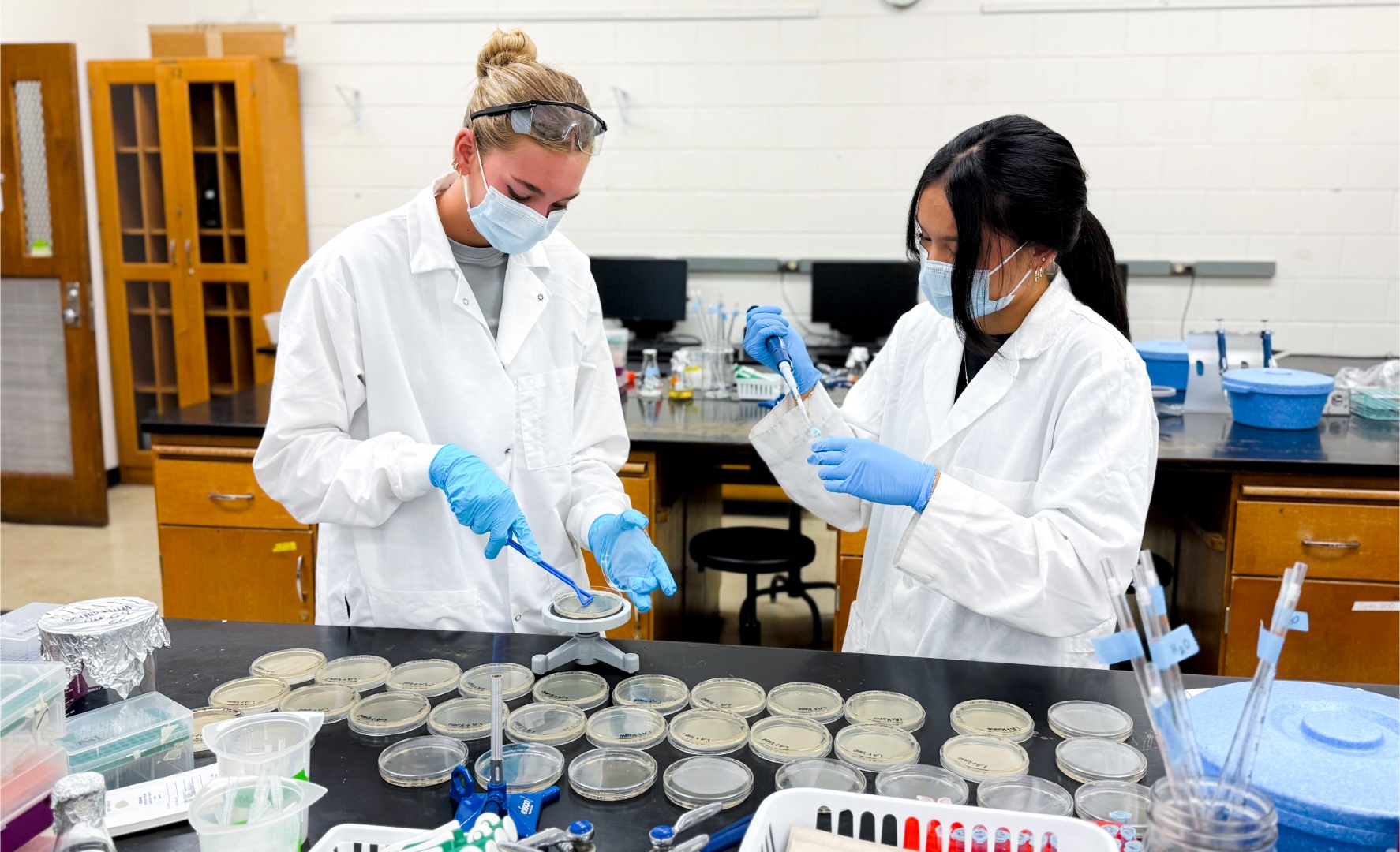
LSU Biological Sciences students engage in course-based undergraduate research on antibiotic resistance as part of introductory biology coursework.
– Photo: Mindy McCallum
For many students, undergraduate research is something that happens later, a few years into college, after they learn about opportunities, find the right mentor, or even discover an interest in research. At LSU, a different model is steadily reshaping that timeline.
Through Course-based Undergraduate Research Experiences, or CUREs, first-year biology students conduct authentic scientific research as part of a required introductory lab course. But instead of opting into research, they encounter it by chance.
“Students enroll in Biology 1208 or 1209 without knowing what kind of lab they’ll get. Then, those randomly assigned to one of my sections suddenly find themselves part of a real research project, asking real scientific questions, collecting original data, and learning how knowledge is built from the ground up,” says Mindy McCallum, CURE program coordinator.
That element of surprise is intentional. By embedding research directly into the freshman lab sequence, LSU’s CURE program reaches students who might never have sought out undergraduate research on their own, including those still discovering their interests in biology or science more broadly.
A Nationally Distinctive Model
While CUREs are gaining traction nationwide, LSU’s approach stands out. Each semester, LSU supports multiple CURE projects running simultaneously, reaching nearly 300 students. Each project is led by a graduate student and rooted in their own dissertation or thesis research.
“This isn’t inquiry-based learning where students explore something with a known answer,” McCallum says. “These are real, unanswered research questions. The students are doing authentic research that matters beyond the classroom.”
Graduate instructors spend up to a year transforming complex research questions into classroom-ready experiments, such as turning an assay’s user guide into a step-by-step protocol. The work requires deep scientific understanding, careful scaffolding, and a strong commitment to teaching.
“We’re taking techniques like DNA extraction and quantitative qPCR, things students usually don’t see until much later, and figuring out how to make them work in a freshman lab,” McCallum says. “It’s challenging, but that’s what makes the experience real.”
The result is a program that benefits undergraduates and graduate students alike. First-year students gain early research exposure, while graduate students develop mentorship, curriculum design, and leadership skills that extend well beyond the classroom.
Faculty also benefits. Because CURE projects are tied to active research programs, they often inform methodology development, generate pilot data, and contribute to broader impact statements in grant proposals. The research does not stop at the classroom door; there is genuine interest in the findings beyond the course itself.
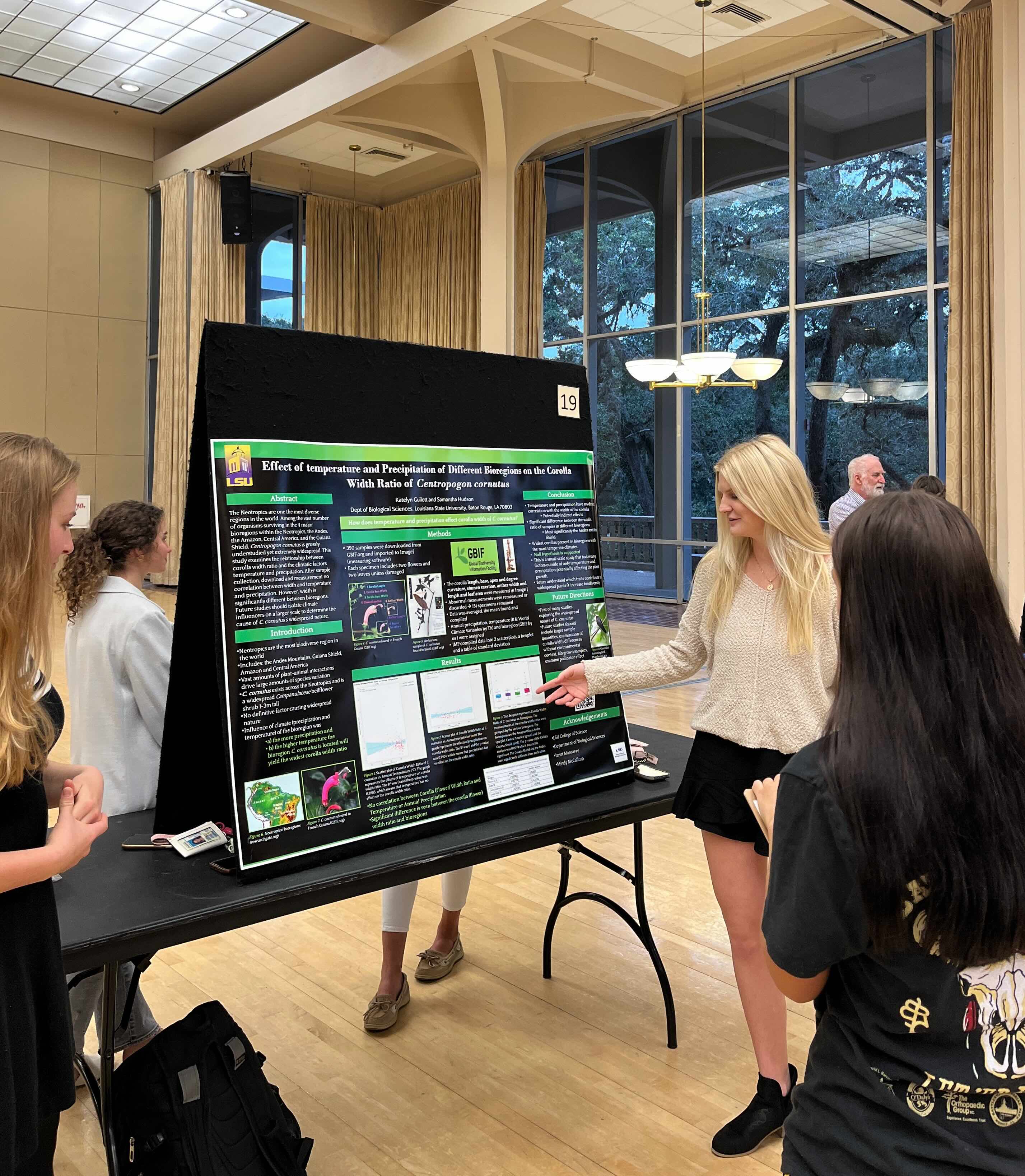
Beyond laboratory techniques, CURE students build communication and critical-thinking skills by preparing and presenting research posters at an end-of-semester symposium.
From Classroom Research to Published Science
A CURE project developed by McCallum in collaboration with graduate student Jada Daniels and Professor Jiaqi Tan, whose research focuses on plant–microbe interactions using duckweed as a model system, led to a recent publication in Integrative Organismal Biology. The paper describes the design and implementation of the course for introductory biology students and reports ecological research results generated by students across multiple semesters.
Using duckweed, a fast-growing aquatic plant well suited for classroom research, nearly 200 students across three semesters investigated how environmental factors such as habitat size and temperature influence plant growth and interactions with microbial communities. The experiments produced consistent, reproducible datasets, a key benchmark of rigorous scientific research.
Students found that larger habitats supported greater duckweed growth, reflecting fundamental ecological principles related to space and resource availability. Temperature experiments showed that duckweed and its associated microbial communities can be resilient to short-term warming, whereas early life stages, such as turion germination, are highly sensitive to extreme heat. Together, these findings reinforced core ecological concepts and generated preliminary data that can inform future research on plant–microbe interactions and environmental stress responses.
Learning the Process, Not Just the Outcome
Just as important as the results is how students arrive at them. CURE labs are intentionally designed to include uncertainty, iteration, and even failure, hallmarks of real research that are often absent from traditional laboratory courses. Students develop core laboratory skills such as pipetting and sterile techniques alongside data analysis and scientific writing, while also learning how to troubleshoot experiments, interpret variable data, and persist through setbacks.
As interest in CUREs grows nationally, institutions are increasingly examining different models for integrating authentic research into undergraduate education. LSU’s approach, which supports multiple, graduate-led CURE projects within the same course framework, has drawn attention for its scale and structure.
“To our knowledge, LSU is unique in running multiple CURE projects at the same time, led by different graduate students, and reaching hundreds of students each semester. That’s why other universities are starting to reach out to see how we do it,” McCallum said.
By introducing authentic research in the first year, LSU’s CURE program positions undergraduate research as an integral part of scientific training rather than a later, selective experience, offering a model for how research-intensive institutions can connect education and discovery from the outset.