
Ultrashort laser pulses catch a snapshot of a "molecular handshake"
December 09, 2025
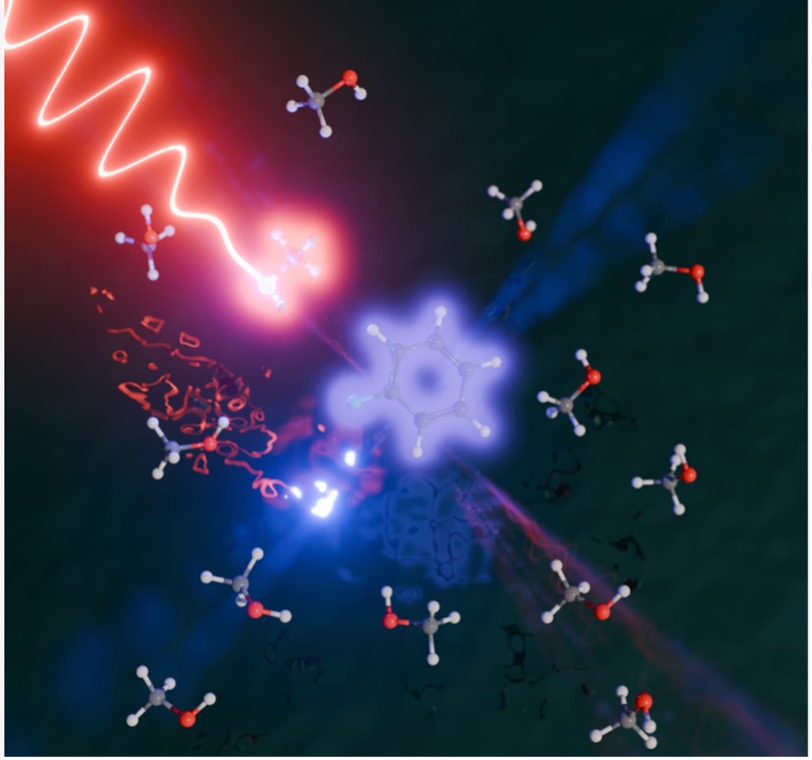
Artist's impression of high harmonic generation in a liquid solution of methanol and fluorobenzene. In this case, fluorobenzene modifies the methanol solvation structure and acts as a scattering barrier for electrons emitted from the methanol, causing suppression of certain frequencies of the emitted light.
– Image by LSU Department of Chemistry Professor Kenneth Lopata.
Liquids and solutions are complex environments – think, for example, of sugar dissolving in water, where each sugar molecule becomes surrounded by a restless crowd of water molecules. Inside living cells, the picture is even more complex: tiny liquid droplets carry proteins or RNA and help organize the cell’s chemistry. Despite their importance, liquid environments are notoriously difficult to study at the level of individual molecules and electrons. The core challenge is that liquids lack a fixed structure, and the ultrafast interactions between solute and solvent—where chemistry actually happens—have remained largely invisible to scientists.
A team of researchers from Ohio State University and Louisiana State University has now shown that high-harmonic spectroscopy (HHS)—a nonlinear optical technique capable of capturing electron dynamics on attosecond timescales—can reveal the tiny, local structures that form when one liquid dissolves into another. The study, published in PNAS, marks an important step toward directly probing solute–solvent interactions in the liquid phase.
HHS works by using ultrafast laser bursts to briefly pull electrons away from their molecules and then measure the light they emit when they snap back. This creates snapshots of how electrons and even atomic nuclei move, on timescales so short that ordinary techniques can’t capture them. Traditional optical spectroscopy has been the standard tool for studying liquids because light interacts gently with molecules, and it’s easy to read, but it operates at much slower speeds. HHS, by contrast, reaches into the extreme-ultraviolet range and offers time resolution on the order of an attosecond—a billionth of a billionth of a second.
Until now, HHS has been largely confined to gases and solids, where experimental conditions are easier to control. Liquids pose two major challenges: they absorb most of the emitted harmonic light, and their constant molecular motion makes the signals difficult to interpret. By using a new ultrathin liquid “sheet” that allows more light to escape, the OSU–LSU team has now shown—for the first time—that HHS can capture local structural changes and ultrafast dynamics in liquids.
Armed with this new method, the team turned to a set of simple liquid mixtures to see how HHS would perform. They applied intense, mid-infrared laser light to methanol mixed with small amounts of different halobenzenes—nearly identical molecules that differ only by a single atom: fluorine, chlorine, bromine, or iodine. Halobenzenes produce strong harmonic signals that appear clearly in the emitted light spectrum, while methanol offers a clean background. The team expected that even in dilute mixtures, the halobenzene signal would dominate.
For most mixtures, this held true: the harmonic emission looked like a simple combination of the two liquids. But fluorobenzene (PhF) behaved very differently. “We were really surprised to see that the PhF–methanol solution gave completely different results from the other solutions,” said Lou DiMauro, Edward E. and Sylvia Hagenlocker Professor of Physics at OSU. “Not only was the mixture-yield much lower than for each liquid on its own, we also found that one harmonic was completely suppressed.” He added that “such a deep suppression was a clear sign of destructive interference, and it had to be caused by something near the emitters.”
In other words, mixing PhF with methanol produced less light than either liquid alone—an unexpected result—and one specific harmonic vanished entirely, as if a single “note” in the spectrum had been muted. That kind of targeted disappearance is extremely rare and suggested a specific molecular interaction was blocking the electron’s path.
To probe this interaction, the OSU theory team performed large-scale molecular dynamics simulations. John Herbert, professor of chemistry and leader of the theory effort, explained: “We found that the PhF–methanol mixture is subtly different from the others. The electronegativity of the F atom promotes a ‘molecular handshake’ (or hydrogen bond) with the O–H end of methanol, whereas in other mixtures the distribution of the PhX molecules is more random.” In short, PhF forms an organized solvation structure that the other halobenzenes do not.
The LSU theory team then tested whether such a structure could reproduce the experimental observations. Mette Gaarde, Boyd Professor of Physics, noted: “We speculated that the electron density around the F atoms was providing an extra barrier for the accelerating electrons to scatter on, and that this would disturb the harmonic generation process.” Using a model based on the time-dependent Schrödinger equation, the team confirmed that this kind of scattering barrier could produce both the suppressed harmonic and the lower overall yield. “We also learned that the suppression was very sensitive to the location of the barrier—this means that the detail of the harmonic suppression carries information about the local structure that was formed during the solvation process,” added Sucharita Giri, postdoctoral researcher at LSU.
We were excited to be able to combine results from experiment and theory, across physics, chemistry, and optics, to learn something new about electron dynamics in the complex liquid environment.
Mette Gaarde, LSU Boyd Professor of Physics
While further work is needed to fully explore the capabilities of HHS in liquids, these early findings are highly promising. Because so many important chemical and biological processes occur in the liquid phase—and because the electron energies involved mirror those that cause radiation damage—understanding how electrons scatter in dense liquids could have wide-reaching implications across chemistry, biology, and materials science. As DiMauro noted, “Our results demonstrate that solution-phase high-harmonic generation can be sensitive to the particular solute–solvent interactions and therefore to the local liquid environment. We are excited for the future of this field.”
Building on this outlook, researchers anticipate that the technique will spark renewed interest in ultrafast liquid-phase studies. As Gaarde noted, advances in both experiments and simulations will enable scientists to better understand harmonic generation in different liquids and extract detailed structural and dynamical information about how they respond to an ultrafast laser pulse.
**
Key contributors to this work include Eric Moore, Andreas Koutsogiannis, Tahereh Alavi, and Greg McCracken from OSU; and Kenneth Lopata from LSU. This study was funded by the DOE Office of Science, Basic Energy Sciences, and by the National Science Foundation.