
Mapping Parrot Evolutionary Tree to Protect Species and Curb Trafficking, Backed by $1.1M NSF Grant
July 24, 2025
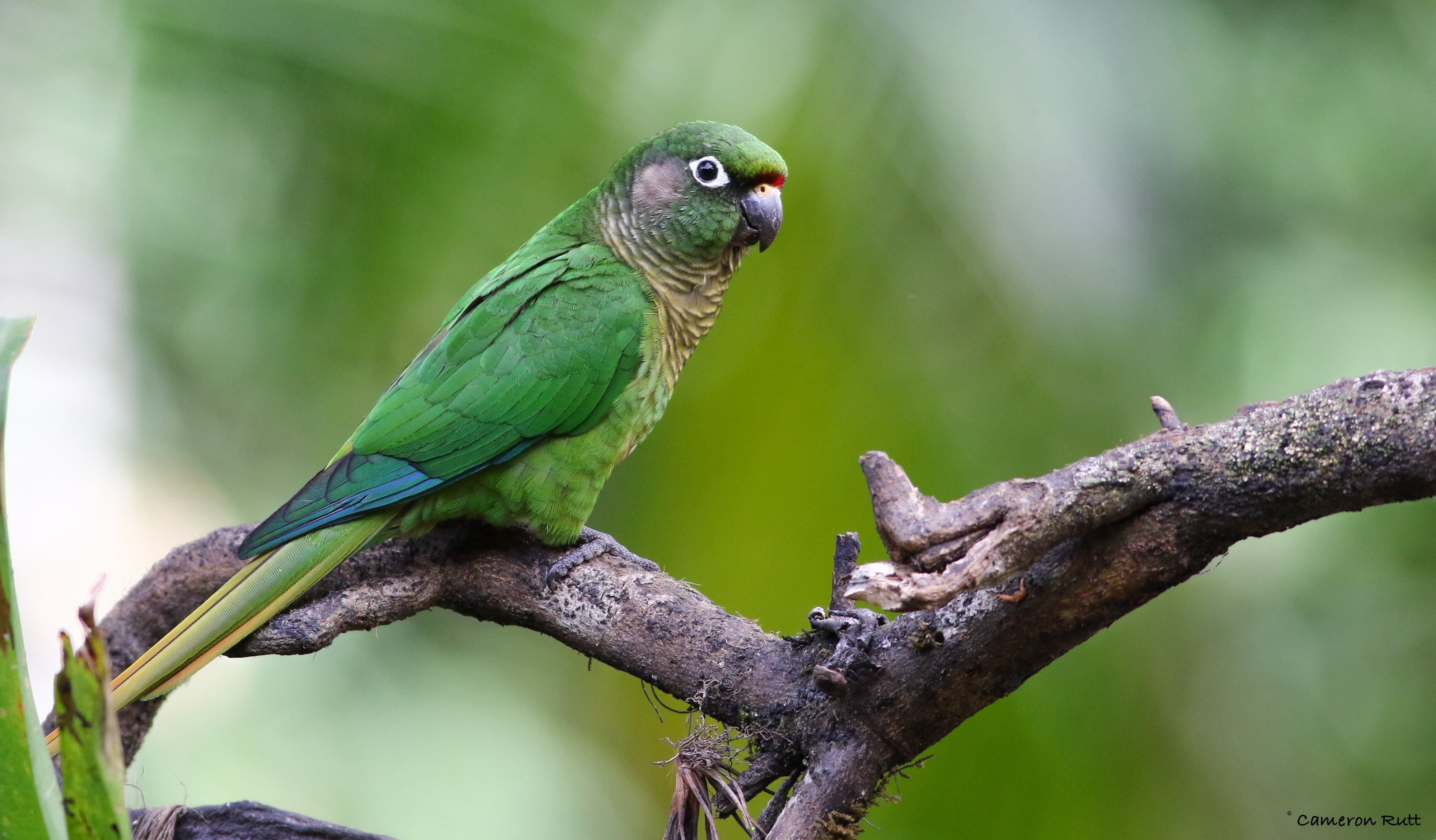
Beneath the colorful plumage lies the potential for genetic tools to fight illegal wildlife trade.
– Credit: Cameron Rutt.
Parrots are among the most endangered groups of vertebrates on the planet. Admired
for their vivid colors and intelligence, they face a deadly combination of habitat
loss and relentless illegal trafficking. Of nearly 400 known species, more than 100
are listed as threatened by the International Union for Conservation of Nature (IUCN),
with at least half of those endangered species directly impacted by poaching and the
wildlife trade.
As conservationists work to save them, they face a fundamental challenge: we still don’t fully know how many distinct species and subspecies exist—or where they fit into the parrot family tree. This lack of clarity makes it much harder to track parrot diversity, uncover illegal trade routes, and identify which populations most urgently need protection.
“To protect parrots effectively, we need a detailed evolutionary map that shows how all these birds are related,” said Dr. Gregory Thom, curator of genetic resources at the LSU Museum of Natural Science (LSU MNS). “Without knowing exactly what we have, it’s impossible to know what to protect.”
Thom’s recently awarded $1,157,522 NSF Collaborative Research grant will support the creation of the most comprehensive parrot phylogeny to date. His team will sequence DNA from museum specimens representing nearly every known population of parrots—about 800 species and subspecies from around the world.
But unraveling their evolutionary history isn’t as simple as just sequencing DNA.
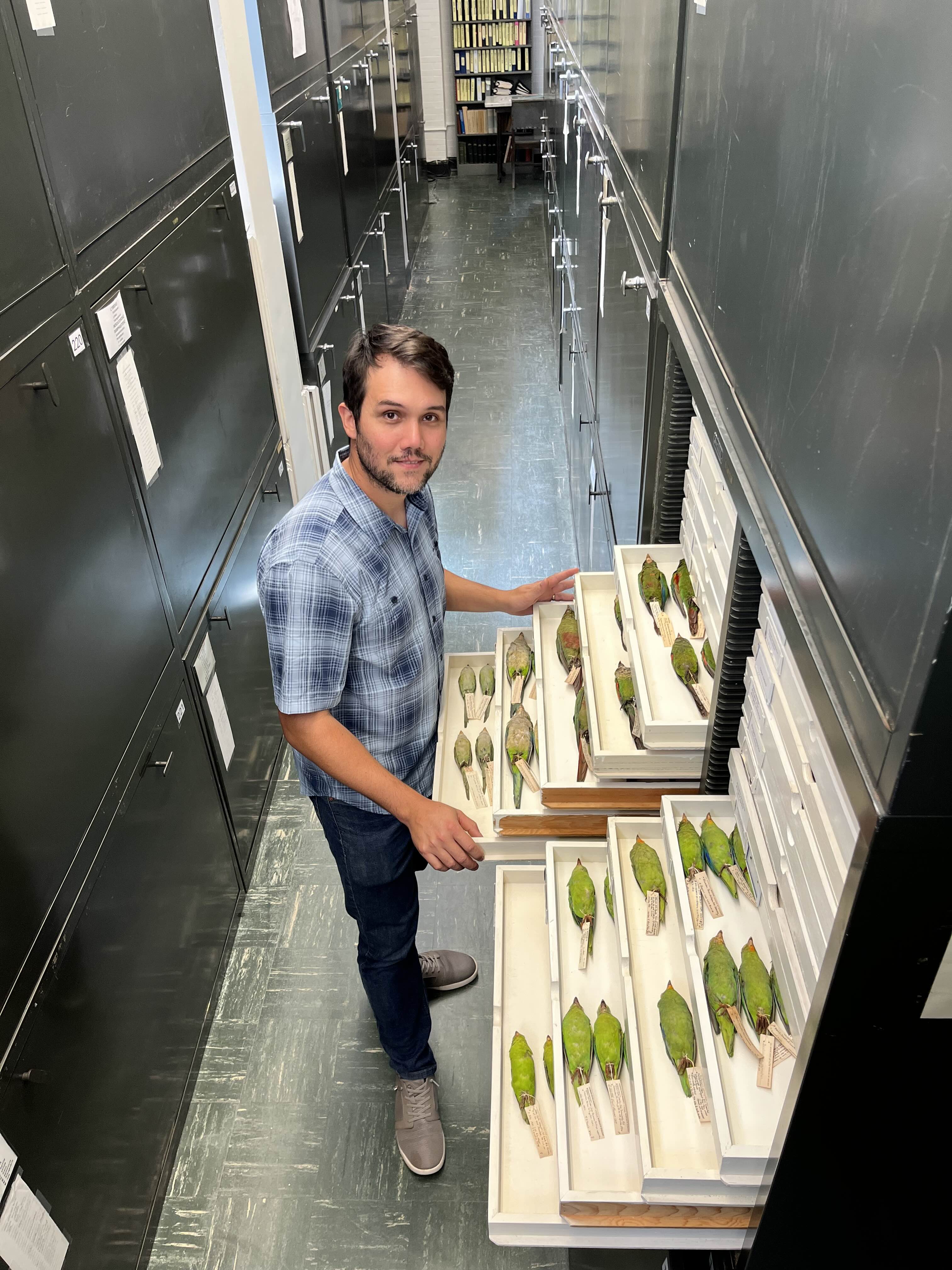
Dr. Gregory Thom, assistant professor and curator of genetic resources, uses DNA from museum specimens—including century-old parrot skins—to study evolution. LSU’s Museum of Natural Science houses one of the world’s most comprehensive bird collections.
A Tangled Tree of Life
Evolutionary trees might look like tidy diagrams where one species splits neatly into two, with branches steadily diverging. In reality, the branches of the tree of life often twist, overlap, and reconnect—because species don’t always remain completely separate.
“A big challenge in phylogenetics is that when species exchange genes—what we call gene flow—it complicates our ability to accurately reconstruct phylogenetic trees,” Thom explained.
Take, for example, the complexity of our own species’ evolution: Many people of European descent carry small amounts of Neanderthal DNA—a relic of ancient interbreeding that happened after modern humans migrated out of Africa around 60,000 years ago.
That’s because Neanderthals lived in Europe and western Asia. When modern humans encountered them, they interbred. But people whose ancestors stayed in Africa never met Neanderthals—so they didn’t inherit those genes.
This creates conflicting signals in the human genome. “Say you want to draw a family tree of modern human populations and Neanderthals,” Thom said. “Looking at the entire genome, all modern humans—regardless of ancestry—cluster together as one lineage. But if you focus only on the segments inherited from Neanderthals, it can look like Europeans are genetically closer to Neanderthals than to Africans, even though all modern humans belong to the same species.”
“That’s the problem,” he added. “The phylogenetic signal can vary a lot across the genome.”
Parrots are known for hybridizing. When populations become separated—by rivers, mountains, or other barriers—and later reunite, they often interbreed. This flow of genes between populations leaves a complex pattern in their DNA that can obscure true evolutionary relationships.
With nearly 800 species and subspecies of parrots worldwide, these repeated cycles of separation and mixing have created a tangled evolutionary history. Large-scale genomic datasets add to the complexity: some parts of the genome reflect ancient ancestry, while others capture more recent gene flow between lineages.
To untangle this, Thom and his collaborators will explore parrots’ genomic architecture—the structural and functional organization of the genome and how different regions behave and evolve over time. Not all stretches of DNA tell the same story. Regions on large chromosomes, where recombination occurs less frequently, tend to preserve older evolutionary relationships. In contrast, smaller, fast-recombining chromosomes are more influenced by recent gene exchange.
“We're building a phylogeny for all taxa of parrots, including species and subspecies, to understand the relationship between genomic architecture and phylogenetic signal,” Thom said. “And by building this phylogeny, hopefully we will solve several problems with the taxonomy of parrots.”
Thom adds that the new parrot phylogeny could guide future research into how complex
traits like vocal learning, intelligence, and social behavior evolved. By tracing
the genetic and neurobiological roots of these abilities, scientists could gain insights
into human cognition and communication.
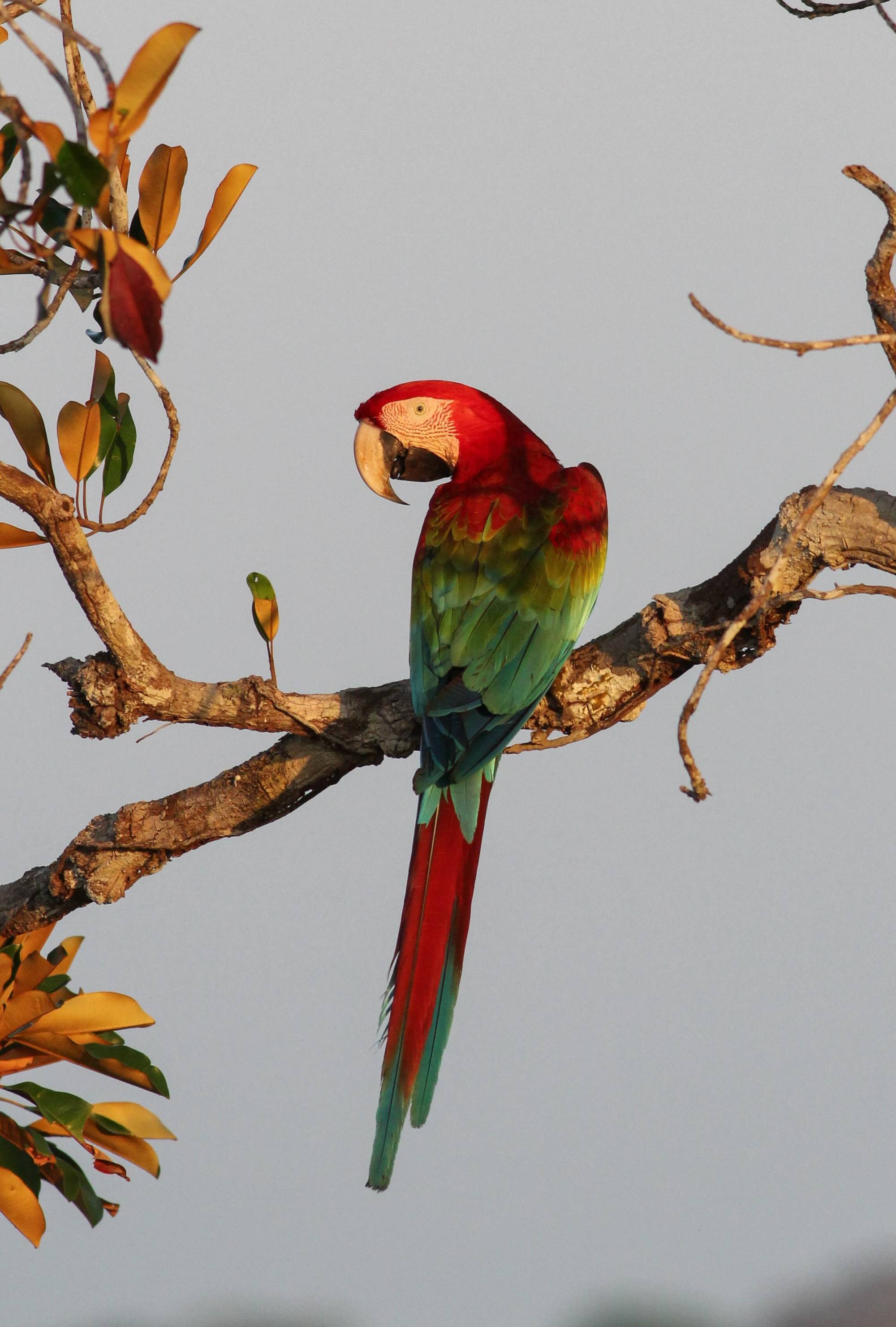
One of the largest macaws, the Red-and-Green Macaw (Ara chloropterus) is native to tropical forests across Central and South America, especially in Brazil, Paraguay, Bolivia, Colombia, Peru, and Venezuela.
– Credit: Cameron Rutt.
A Global Collaboration, Rooted in Museum Drawers
The team is combining insights with DNA extracted from museum specimens—some dating back to the early 1900s—primarily drawn from two major collections: LSU MNS and the American Museum of Natural History (AMNS).
LSU’s own Museum of Natural Science houses one of the largest collections of Neotropical birds and the third-largest university-based bird collection worldwide, along with one of the oldest and most extensive genetic resources collections globally. Additional specimens come from the AMNS, home to Dr. Brian Smith, curator in the Department of Ornithology and a former LSU MNS postdoctoral researcher, who is a key collaborator on the project.
Together, the two collections provide most of the samples used for the grant, covering nearly the full spectrum of parrot biodiversity, from the Amazon to Australia.
Using refined genomic techniques, they’ll extract and sequence thousands of genetic regions, even from degraded DNA in century-old museum skin specimens. “We already have about 90% of the samples we need,” Thom said. “The rest we’ll request from collections in South America, Australia, and elsewhere, where we have established collaborations over the years.”
For a select group of parrots, they’ll also sequence entire genomes to better understand how genomic architecture shapes the distribution of evolutionary signal.
The resulting dataset will not only clarify how parrots are related to one another—it could also correct outdated or inaccurate taxonomic classifications. In the long term, these methods could be applied to other organisms as well.
That alone would be a major contribution to evolutionary biology—but Thom’s team is
going further.
From Phylogenies to Forensics
In partnership with the U.S. Fish and Wildlife Service’s forensic lab in Oregon, the team is working with Dr. Jessica Oswald—another former LSU MNS postdoc and currently a senior forensic scientist at USFWS—to design a set of molecular barcodes based on their new phylogeny. These genetic identifiers will help authorities determine the species or subspecies of confiscated parrots, feathers, or eggs—materials often seized from traffickers but difficult to identify. Because many parrot subspecies are found only in specific countries or even on single islands, the tool could also help trace trafficking routes and flag regional trade hotspots.
At its core, the project aims to untangle the parrot family tree—not just to understand where parrots came from, but to help protect this fascinating group of birds.