


LSU’s DeepFire Team Wins XPRIZE Wildfire Award for AI That Sees Fires Coming
September 23, 2026
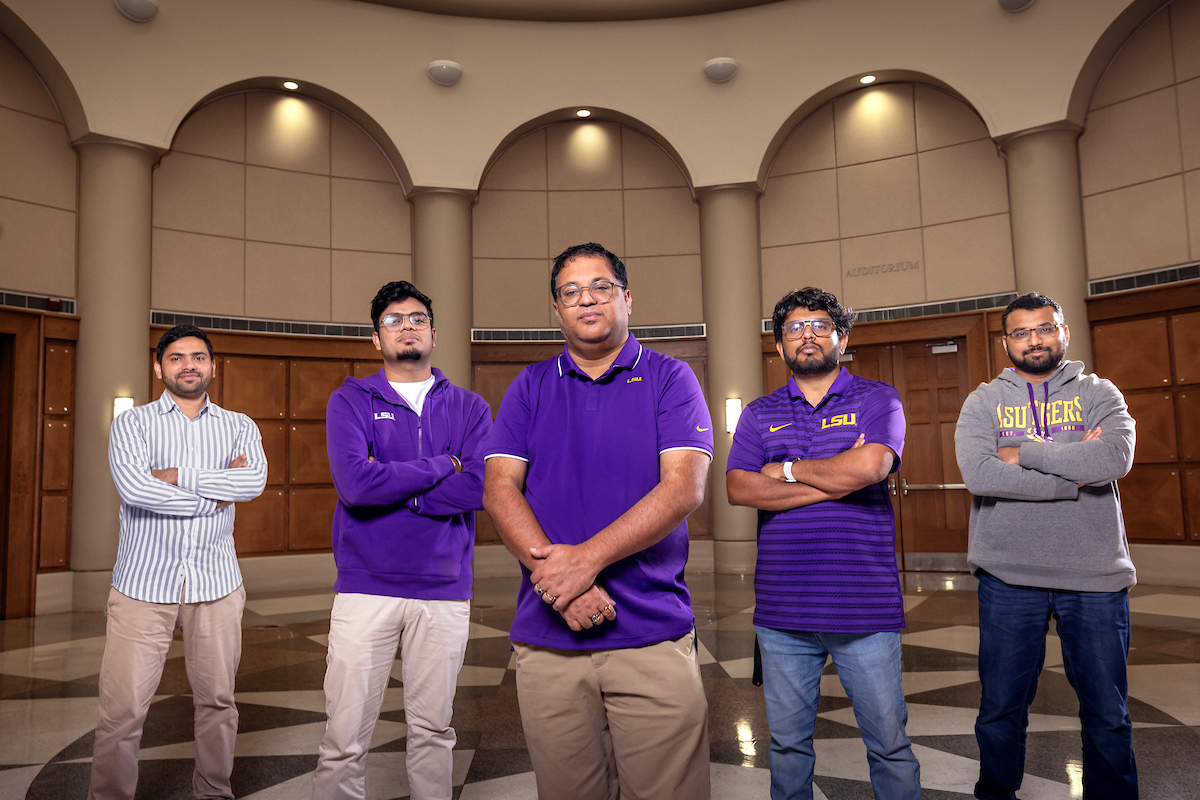
(Left to right) Saiful Sajol, Amit Ranjan, Supratik Mukhopadhyay, Magesh Rajasekaran, and Muhammad Waheed Sabir
Out of more than 300 teams worldwide, LSU’s team became one of eight finalists in a four-year, $11 million global competition to end destructive wildfires. Today, the team received a $100,000 Special Recognition award at the XPRIZE Wildfire awards ceremony at the New York City Fire Museum.
The team, DeepFire, is led by Supratik Mukhopadhyay, professor in the Department of Environmental Sciences in LSU’s College of the Coast & Environment and a faculty member in the LSU Center for Computation & Technology. It competed in the Space-Based Wildfire Detection & Intelligence track, where a system has as little as 60 seconds to detect every fire across a landscape larger than many countries and 10 minutes to report them to decision-makers on the ground with the fewest false alarms.
DeepFire is an AI-based platform that can detect wildfires early, before they become destructive, and was recognized by XPRIZE for demonstrating its operational capability. The team won one of five awards totaling $1.05 million in the space-based detection track.
“These teams pushed the boundaries of what is possible today, demonstrating meaningful advances in wildfire detection and response while helping identify where continued innovation is needed to move these technologies toward real-world deployment at scale,” said Andrea Santy, XPRIZE Wildfire executive program director.
“This is a great example of how LSU’s unified research enterprise brings together the best minds from across our campuses to solve problems that matter to Louisiana and the world,” LSU Chancellor Jim Dalton said. “Recognition on this stage tells the country what we already know: LSU is poised to reach its goal of becoming a top 50 research institution through meaningful innovation and excellence.”
DeepFire is three AI models working as one. A prediction model digests years of fire history, real-time weather, lightning forecasts, land cover and vegetation to map where fire is most likely to break out in the days and weeks ahead. Those risk maps tell a detection model where to look, focusing satellite feeds on the highest-risk ground so it can spot a fire while it is still small enough to stop. A third model forecasts how a fire, once found, will spread. Traditional wildfire forecasting is roughly 70% accurate, while DeepFire is above 90%. Wiring the three models into a single loop, DeepFire stands out from other systems that react only once a fire is already burning. DeepFire has been licensed from LSU by Firemark AI, a startup based in Calgary, Canada, which plans to commercially deploy the system.
“Wildfires take lives, homes, forests and entire local economies,” Mukhopadhyay said. What DeepFire gives fire managers is the thing that matters most in their work, and that is time. Catch a fire early and you can put crews where they will count, instead of chasing one that is already past stopping. But a warning only helps if it is almost never wrong.”
The final XPRIZE round put that claim to the test. Teams had to find fires in real time over New South Wales, Australia, where the 2019–20 bushfires killed 33 people and burned tens of millions of acres. Across the test days during the final, 96 percent of the fires DeepFire reported were independently confirmed, and the 10 alerts the platform was most confident in each day were confirmed every time.
Mukhopadhyay leads the DeepFire team alongside Thomas Douthat, associate professor of environmental science; Rubayet Bin Mostaviz, research assistant professor with the LSU AgCenter and LaHouse; and Saiful Sajol, a graduate research assistant in environmental sciences and doctoral student in computer science.
Students did much of the building. Dylan Wichman, a Stamps Scholar from wildfire-prone Montana who graduated in computer science in 2023, led work on the prediction model, an idea he first explored in a high school science fair project. He also developed the space-based detection system in collaboration with Sajol.
“This award belongs to a team, and above all to our students,” Mukhopadhyay said. “We have been building this technology at LSU since 2019, and the XPRIZE gave us the chance to prove it in the real world against the best systems on Earth. The problems we work on here, for Louisiana’s forests, its coast and its communities, are the same problems the whole world is facing.”
Along the way in the Wildfire XPRIZE competition that started in 2023, DeepFire earned a spot among 20 teams in 2024, chosen from more than 300 worldwide. It won a $50,000 Milestone Award for its data analytics in 2025, and a place among eight finalists judged live this year. LSU honored the team in February through its We Build Teams That Win recognition program.
About XPRIZE Wildfire
XPRIZE Wildfire is a four-year, $11 million competition to develop technologies that rapidly and accurately detect, understand and respond to wildfires. It awarded $3.5 million across its two tracks in September 2026. Its co-title sponsors are the Gordon and Betty Moore Foundation and Pacific Gas and Electric Company; the Space-Based Wildfire Detection & Intelligence track is presented and co-designed by the Minderoo Foundation. Lockheed Martin sponsored the Accurate Detection Intelligence Bonus Prize, and supporting sponsors include the Conrad N. Hilton Foundation, Costa Navarino, American Family Insurance, Fairfax Financial and the Roddenberry Foundation.