
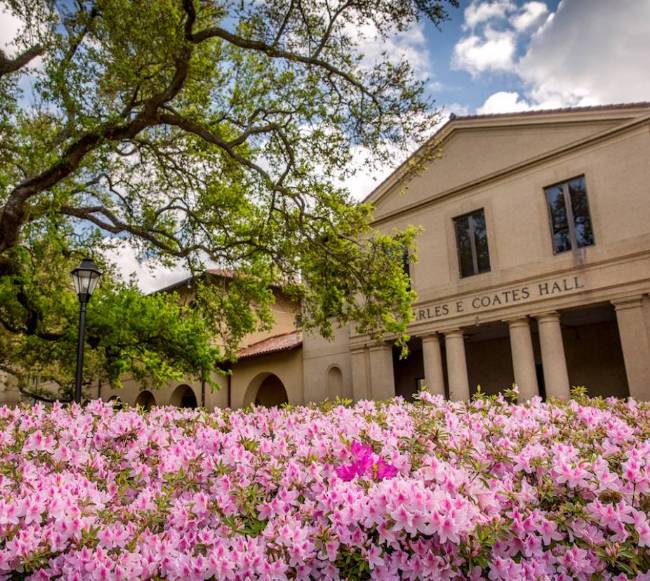


Synchrotron radiation upends theory about LSU campus mounds construction
August 20, 2026
A new study challenges a widely publicized theory that the LSU campus mounds, earthen structures that may be the oldest in the Americas, were built in phases and used in ritual fires.
In 2022, LSU Geology Professor Emeritus Brooks Ellwood used radiocarbon dating of core samples to show the two mounds were thousands of years older than previous estimates. He argued construction on Mound B began more than 11,000 years ago, and that both mounds were built in two phases, with a pause of 500 to 1,000 years in between. Ellwood and colleagues also identified layers of light-colored material deep within the mounds as ash from intense fires that may have been used for ceremonies or cremation.
New research using high-intensity X-ray beamlines challenges the last two claims—but not the mounds’ age.

A research team used high-intensity X-ray beamlines at Louisiana Light Source to analyze core samples from the campus mounds.
A team of researchers led by LSU Research Professor Josef Hormes used high-intensity X-ray beamlines at LSU’s Louisiana Light Source and the Solaris synchrotron in Poland to analyze core samples from the mounds.
X-ray fluorescence (XRF) showed no difference in the elemental composition of the samples on either side of the theorized construction gap, according to the study published in American Antiquity. X-ray absorption spectroscopy (XAS) revealed no significant differences in the chemical makeup between the light- and dark-colored material in the cores.
“We are not touching Ellwood’s statement that the mounds might be the oldest manmade structures in the world. We did not examine their age,” Hormes said. “What we argue is that if building stopped for hundreds of years, we would see different elements in the samples on either side of the ‘gap.’ We did not.
“The idea the light-colored materials were a layer of ash is also incorrect. Our analysis shows the light-colored material is soil, not ash.”
Using synchrotron radiation in archaeological research is common in Europe and Japan but rare in the United States.
“The technique offers a major advantage: it’s non-destructive. You can put extremely valuable things into X-ray beams without destroying them,” Hormes said. “You don’t have to grind a sample into powder to analyze it as you would with microscopy.”
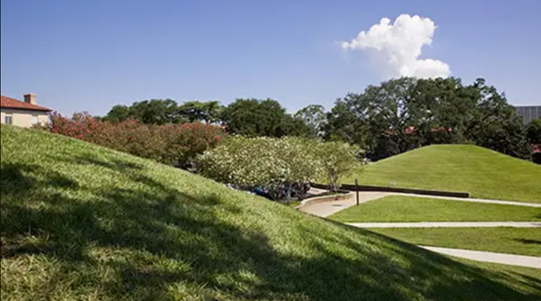
The LSU campus mounds.
Ellwood’s study was controversial from publication. At the time, scientists estimated the mounds were around 6,000 years old, in the same range as other mounds in North America. Other scientists, including former state archaeologist Charles McGimsey, one of the co-authors of the synchrotron study, questioned Ellwood’s construction, ash, and age theories.
The new study supports McGimsey’s arguments. What remains uncertain, for now, is the mounds’ age.
Hormes said another study underway is expected to answer that question. A different research team will use optically stimulated luminescence (OSL) to determine when the soil beneath the first layer of construction was last exposed to sunlight, giving them an estimate of when mound construction started.