
LSU Physicist Thomas Corbitt Named Fellow of the American Physical Society
October 07, 2026
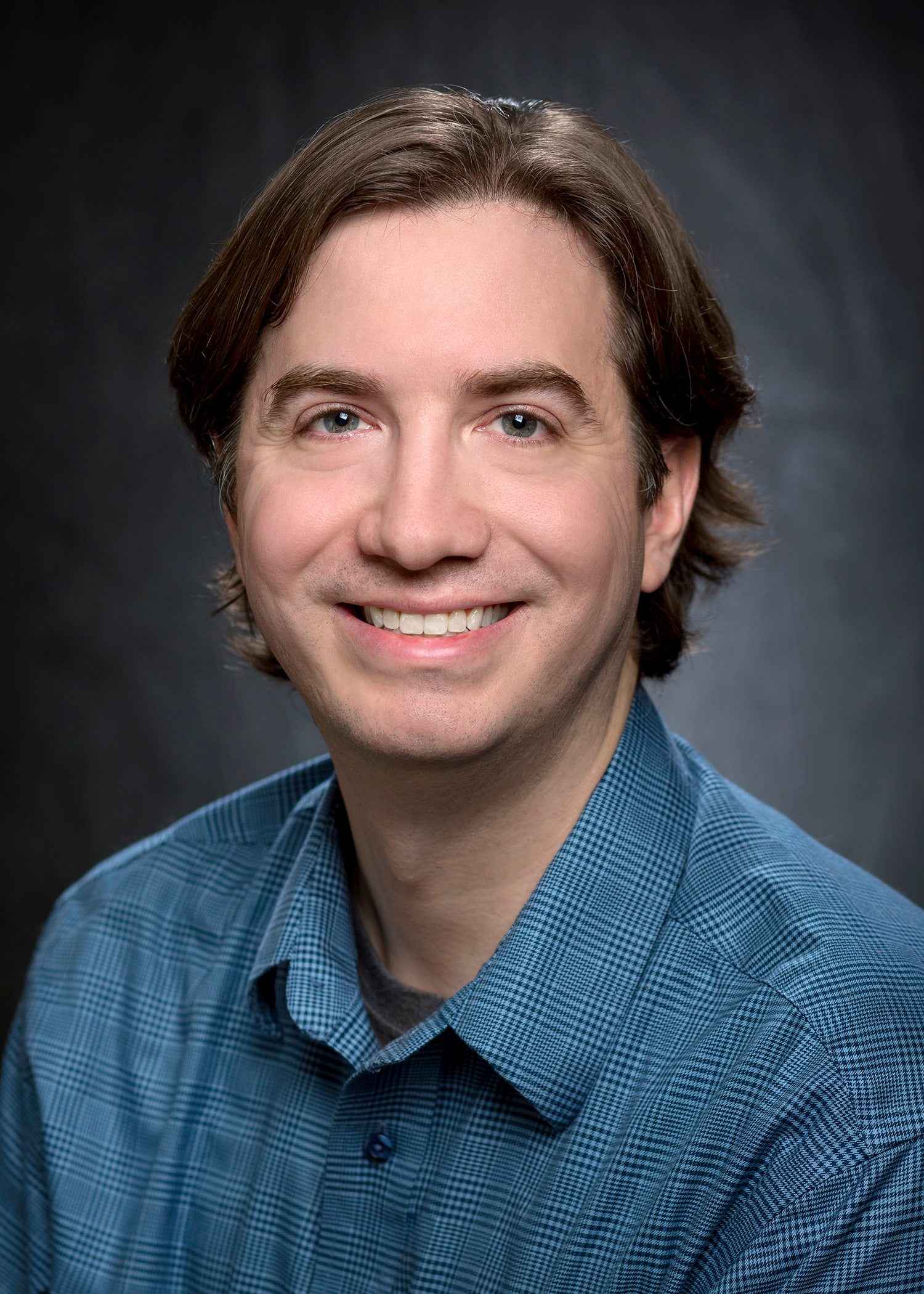
Dr. Thomas Corbitt, Professor of Physics
Thomas Corbitt, professor in the LSU Department of Physics and Astronomy, has been named a Fellow of the American Physical Society (APS). The APS elects no more than 0.5% of its members as Fellows each year.
The APS cited Corbitt "for contributions to the development of quantum-optical and optomechanical techniques for gravitational-wave astrophysics." He is the first LSU faculty member elected as an APS Fellow since 2015.
Quieting the quantum noise in gravitational-wave detectors
Corbitt leads an experimental group at LSU that works on quantum optics and quantum noise reduction in gravitational-wave detectors such as the LIGO instruments. His work on quantum radiation pressure, a fundamental quantum limit caused by photons pushing on the test masses of the detectors, has been published in Nature, Nature Physics, Nature Photonics, Physical Review Letters, and Optics Letters.
His lab has been funded by the National Science Foundation since 2012, when he received a prestigious NSF CAREER Award for work on cryogenic interferometers in the quantum regime. In 2019, his group reported in Nature the first observation of quantum radiation pressure noise at room temperature, using miniature optomechanical cavities with micrometer-scale mirrors, special coatings, and cantilevers that suppress thermal noise. The next year, the team reported in Nature Physics that light with very specific properties could cancel quantum noise and that the cavity itself could create “squeezed” states of light that suppress it.
More recently, the group applied these techniques in a cryogenic environment and reached noise levels in the audio band below the standard quantum limit, with the findings published in Physical Review Letters. In 2026, they showed that optical springs could nearly double the sensitivity of gravitational-wave detectors beyond the quantum limit in a study published in Physical Review Letters. The same measurement techniques have also been used for quantum back-action cancellation, laser power stabilization, searches for dark matter, and tracking of gravitational-wave signals. One result showed that detuning the signal recycling cavity in LIGO could increase Advanced LIGO’s sensitivity to gravitational-wave signals.
Teaching and Mentorship
Corbitt has also been recognized for his contributions to teaching and mentorship, receiving an LSU Rainmaker Award in 2022 and the LSU Distinguished Faculty Award in 2026. He has mentored LSU graduate students as well as students from institutions including MIT and the Australian National University who come to his lab to conduct thesis experiments.
Corbitt is also co-PI of LSU’s Research Experience for Undergraduates program, which brings about 10 students from other institutions to LSU each summer.
"I am so happy for Thomas. Being named a Fellow by the APS shows how much his peers respect his work, and it is a joy to see it recognized. Thomas is a leader in making quantum measurements precise enough to listen to the universe," said Parampreet Singh, chair of the Department of Physics and Astronomy. "Thomas is also a leader in REU Physics, where he helps bring undergraduates from other institutions to LSU every summer. He is a caring teacher and a generous colleague, and the students who come to his lab, from LSU and from around the world, are lucky to learn from him. This honor belongs to Thomas, and our department and the College of Science are very proud of him."
"I am delighted for Thomas. Quantum noise is one of the limits we have to overcome to make gravitational-wave detectors more sensitive, and his lab has shown clear and creative ways to do it," said Gabriela González, LSU Boyd Professor of Physics and Astronomy and past spokesperson of the LIGO Scientific Collaboration. "It makes me very happy to see the APS recognize this work. It is so well deserved, and we are lucky to have him as a colleague at LSU."
References:
Cripe, J., Aggarwal, N., Lanza, R., et al. “Measurement of quantum back action in the audio band at room temperature.” Nature 568, 364–367 (2019). DOI: https://doi.org/10.1038/s41586-019-1051-4
Aggarwal, N., Cullen, T.J., Cripe, J., et al. “Room-temperature optomechanical squeezing.” Nature Physics 16, 784–788 (2020). DOI: https://doi.org/10.1038/s41567-020-0877-x
Cullen, T., Pagano, R., Aronson, S., et al. “Surpassing the Standard Quantum Limit Using an Optical Spring.” Physical Review Letters 133, 113602 (2024). DOI: https://doi.org/10.1103/PhysRevLett.133.113602
Pagano, R., Aronson, S., Cullen, T., Cole, G.D., and Corbitt, T. “Thermal noise measurement below the standard quantum limit.” Physical Review Letters 136, 141401 (2026). DOI: https://doi.org/10.1103/m6h3-xmyf
Aronson, S., Pagano, R., Cullen, T., Cole, G.D., and Corbitt, T. “Optical spring tracking for enhancing quantum-limited interferometers.” Optics Letters 49, 6980–6983 (2024). https://doi.org/10.1364/OL.540195
Prestigious Pathway Award Recognition
This award is designated a Prestigious Pathway Award at LSU. The distinction includes a $5,000 stipend and recognition at the university’s Gold Standard of Excellence event, which honors faculty achievements that advance LSU’s research mission.