
LSU Physicist Constantin Schrade Wins Prize in Microsoft’s Quantum Pioneers Program
November 17, 2026
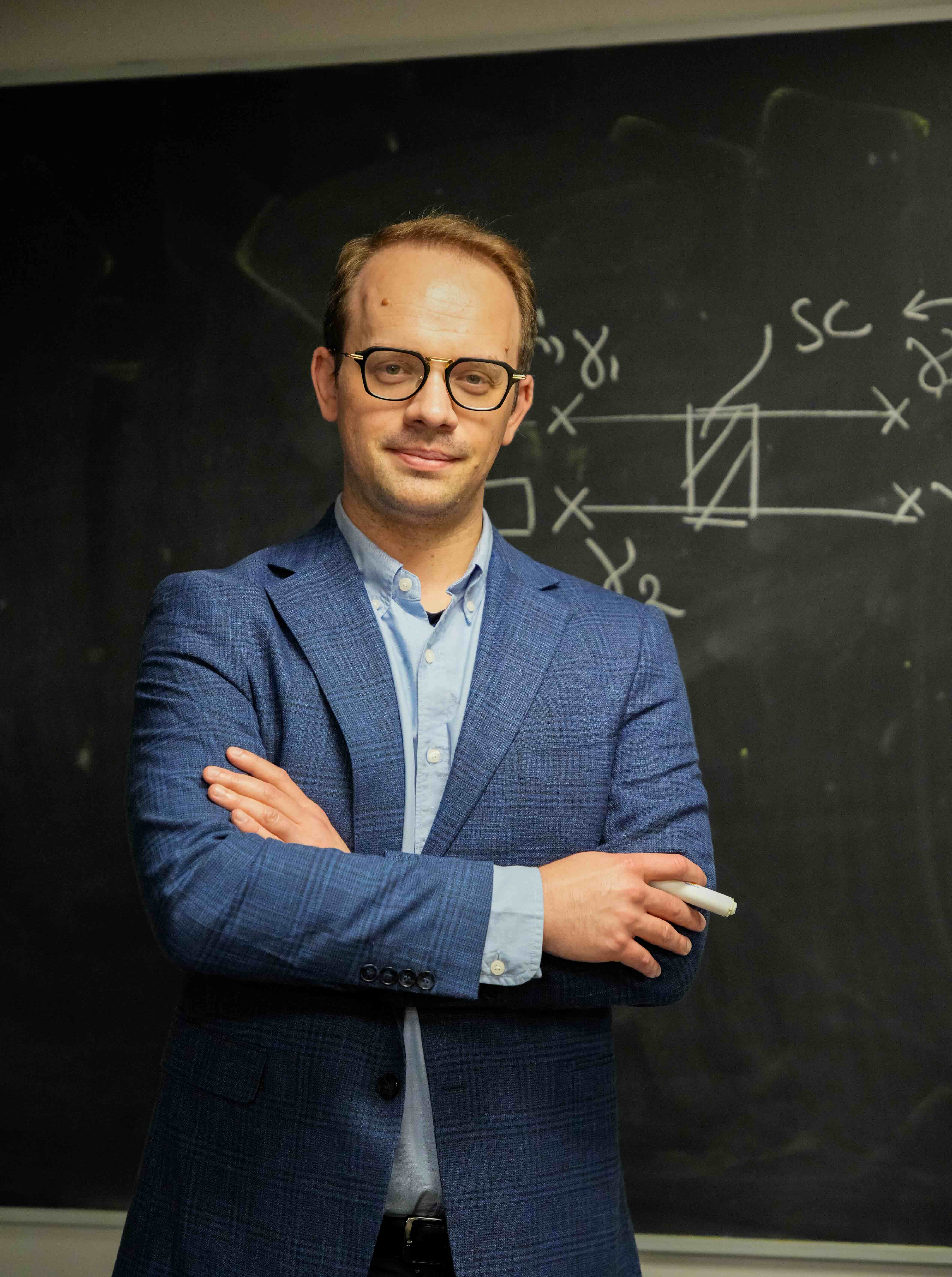
Constantin Schrade, assistant professor, LSU Department of Physics & Astronomy.
An LSU-Cornell University research team is among five winners of Microsoft’s Quantum Pioneers Program, which supports innovative approaches to building scalable quantum computers.
Constantin Schrade, assistant professor in the LSU Department of Physics & Astronomy and a member of the Hearne Institute of Theoretical Physics, and Valla Fatemi, assistant professor in the School of Applied and Engineering Physics at Cornell University, have won a $200,000 prize through Microsoft's 2026 Quantum Pioneers Program, with $100,000 awarded to LSU.
The Microsoft Quantum Pioneers Program recognizes academic researchers pursuing innovative approaches to scalable, fault-tolerant quantum computing. Schrade and Fatemi's research submission, “Evaluation of Fast, High-SNR Parity Measurements via Inductive and Dot-Free Methods,” was selected as one of five winning submissions in the Hardware Track through a competitive process evaluating research accomplishments, innovative ideas with the potential for significant impact, and submission quality.
Other winning teams in the program's Hardware Track include those led by Michel Devoret (2025 Nobel Prize laureate in Physics) and Andrea Young of the University of California, Santa Barbara; Ali Yazdani of Princeton University and Michael Zaletel of the University of California, Berkeley; Michael Wimmer and Anton Akhmerov of Delft University of Technology; and Shyam Shankar of the University of Texas at Austin.
“This prize places Dr. Schrade among the very best young researchers in quantum computing, and the company he keeps on this list says a great deal,” said Parampreet Singh, Ball Family Distinguished Professor of Physics and chair of the LSU Department of Physics & Astronomy. “His work with Dr. Fatemi addresses one of the central bottlenecks in the field, and Microsoft's support will help move it from promise to hardware. I am delighted to see this happen in our department, and it strengthens the quantum effort we are building at LSU.”
The LSU-Cornell team's research focuses on a key challenge in topological quantum computing: how to quickly and accurately measure the parity of a qubit device, determining whether its electronic state has an even or odd number of fermions.
The prize will support the team’s investigation of new approaches to these measurements. Schrade and Fatemi aim to identify methods that deliver faster measurements and higher signal-to-noise ratios. Such advances could improve the speed and reliability of quantum information processing and help open the way toward scalable quantum computing hardware.