
LSU Physics team turns light into a quantum machine for information processing
September 04, 2026
Quantum computers promise to tackle problems that are extraordinarily difficult for today’s computers. But there is a major obstacle: quantum systems are notoriously fragile. Noise, loss, and even tiny disturbances can destroy the delicate behavior that gives them their power. Building systems with many quantum particles is also extremely challenging.
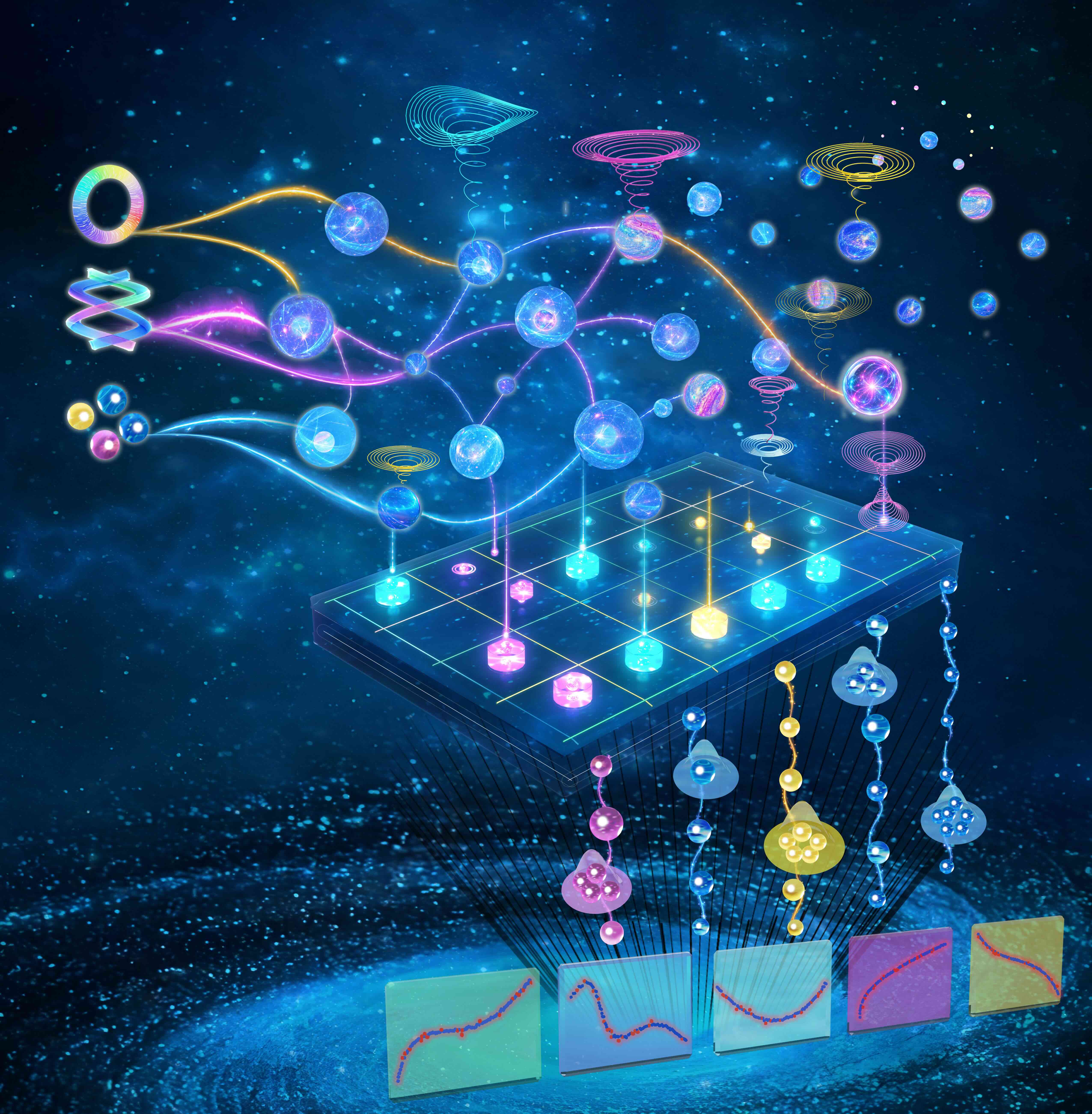
Artistic illustration of the LSU team’s multiphoton quantum reservoir. Different properties of light enter from the upper left and travel through an interconnected optical network. The network transforms the incoming light into a rich landscape of multiphoton patterns. Those patterns become a resource for information processing, allowing the system to learn and predict mathematical functions, illustrated by the curves along the bottom.
– Credit: LSU Quantum Photonics.
Now, physicists at Louisiana State University have demonstrated a different route. Instead of starting with a fragile source of quantum light, the team begins with bright, readily available classical light and uses an optical network together with measurements that count photons one by one. This combination reveals and uses hidden multiphoton quantum behavior for information processing.
In a study published in Advanced Science, researchers in LSU’s Department of Physics & Astronomy report the first robust multiphoton quantum reservoir of its kind to operate at room temperature while tolerating substantial noise and loss. The platform accesses multiparticle systems with up to 40 photons, simulates complex quantum dynamics, and uses the same optical machine to learn several very different mathematical functions.
Finding quantum behavior inside ordinary light
Bright classical light is much easier to produce than delicate quantum states and can contain large numbers of photons. Yet, from one measurement to the next, the number of photons reaching a detector naturally changes. The LSU team turned these fluctuations into a resource for quantum information processing.
Using photon-number-resolving detectors, which can distinguish how many photons arrive at a time, the researchers selected specific photon-number events. This allowed them to access different multiphoton quantum systems contained within the same classical light field. The researchers then combined three properties of light: polarization, spatial structure and photon number. Together, these properties created a vast network of possible states and connections that formed a multiphoton quantum reservoir. In the experiment, this reservoir provided 861 measurable components for processing information.
Reservoir computing uses the natural complexity of a physical system to perform difficult computational tasks. Information enters a complex network and travels through many interconnected paths, producing a rich pattern at the output. Instead of controlling every interaction along the way, researchers only need to train a simple readout to interpret the final pattern. In the LSU experiment, light itself performed the complex transformations, while photon-counting measurements revealed the information encoded in the resulting patterns.
“Rather than requiring perfectly isolated and extremely fragile quantum systems, we show that useful quantum behavior can be extracted from ordinary classical light, even in the presence of substantial noise and loss,” said Associate Professor Omar S. Magaña-Loaiza, leader of LSU’s Quantum Photonics Laboratory. “Our system operates at room temperature and gives us access to multiparticle quantum systems containing up to 40 particles. This allows us to explore complex quantum dynamics and use them to process information within the same platform.”
Putting the quantum machine to work
The researchers first used the platform as a quantum simulator—a system that uses one controllable physical system to reproduce the behavior of another. In one demonstration, photon-number measurements recovered the characteristic spreading of a quantum random walk even when the optical network was noisy. In another, a synthetic lattice made from different states of light reproduced thermalization and anti-thermalization: processes in which fluctuations in a many-particle system grow or shrink as the system evolves. These demonstrations showed that the same platform can reproduce several kinds of complex multiparticle quantum dynamics.
The team then asked whether the same device could learn. They fixed the optical network in a single randomly chosen configuration and encoded inputs in the polarization of light. The reservoir transformed each input into a much richer pattern across spatial modes and photon numbers. Only the final readout had to be trained. Without physically reconfiguring the reservoir, the system learned six very different mathematical functions. For the most nonlinear tasks, using the complete photon-number distribution improved the predictions, showing that higher-order multiphoton correlations provide a useful computational resource.
“We combined the light’s polarization and spatial structure with photon-number-resolved measurements in a single system,” said Mingyuan Hong, first and corresponding author of the study. “This creates a much richer information space. The same optical platform can explore multiparticle quantum dynamics and learn mathematical functions with very different behavior.”
A practical hybrid route toward quantum technologies
The key idea is to combine the best features of classical and quantum optics. Bright classical light provides a large supply of photons and is comparatively easy to generate. Photon-number-resolving measurements then select and read specific multiphoton components after the light has traveled through the network. Those components become resources for quantum simulation and reservoir computing.
Because the experiment operates at room temperature and remains useful even when noise and loss are present, it points toward quantum technologies designed for realistic laboratory conditions rather than perfectly isolated environments. The approach also offers a route to larger multiphoton systems, although future scaling will depend in part on faster and more capable photon-number-resolving detectors. More broadly, the work shows how familiar classical light sources can be combined with distinctly quantum measurements to build robust platforms for information processing.
The research was led by Hong and Magaña-Loaiza in LSU’s Quantum Photonics Laboratory within the Department of Physics & Astronomy. The collaboration included researchers from LSU, the Universidad Nacional Autónoma de México, and the Universidad Politécnica de Pachuca.