
LSU Engineering, Human Sciences, Art & Design Collaborate on Use of Digital Twins
September 08, 2026
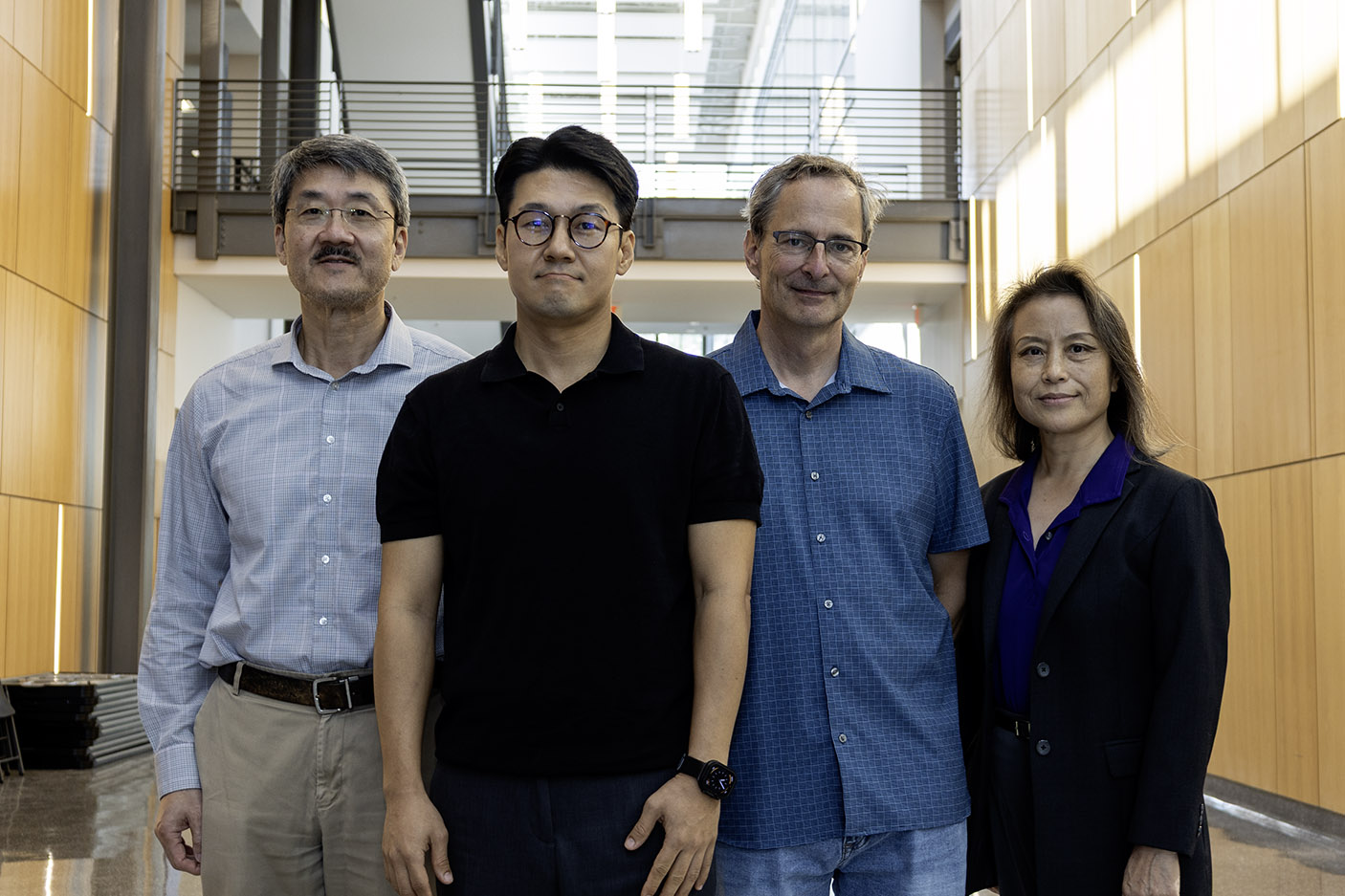
Yong-Cheol Lee pictured with Yimin Zhu, Marc Aubanel, and Jennifer Qian
A $744,660 U.S. National Science Foundation award will fund an inter-disciplinary project between LSU College of Engineering, LSU College of Human Sciences & Education, and LSU College of Art & Design who will explore how digital twin technology can help undergraduate students develop the holistic thinking skills needed to address increasingly complex challenges in architecture, engineering, and construction (AEC).
The project, “Enhancing Holistic Thinking among Undergraduate Students in Architecture, Engineering, and Construction through a Digital Twin-Integrated Learning Platform,” will develop and study a digital twin-integrated learning environment that helps students connect knowledge across disciplines and improve their holistic thinking through realistic, interdisciplinary learning experiences.
“This project is designed to help students develop holistic thinking by using the technological affordances of digital twins to move beyond viewing individual project components in isolation and understand the broader systems in which those components operate,” said Yong-Cheol Lee, LSU Construction Management (CM) associate professor and principal investigator of the project.
Modern building and infrastructure projects require professionals to understand how decisions involving design, engineering, construction, operations, cost, safety, sustainability, resilience, and stakeholder needs are interconnected. This project will use digital twins—data-enriched virtual representations of real-world systems—to help students examine these relationships and understand how changes in one area of a project can influence outcomes across its life cycle.
“By integrating digital twin technology into undergraduate learning, we can provide students with opportunities to explore realistic interdisciplinary problems, visualize connected processes across disciplines, test complicated decisions in real time, observe lifecycle consequences, and develop the integrative reasoning skills required by today’s AEC workforce,” Lee said.
LSU Associate Professor of Learning Analytics & Educational Technology Jennifer Qian, a co-PI on the project, said, “The future requires professionals who can see not just individual trees, but the entire forest—understanding how ideas, disciplines, and decisions connect, and envisioning new possibilities. I look forward to working closely with our interdisciplinary team and students to design, implement, and assess how a digital twin–integrated learning platform can develop students’ holistic thinking.”
Other co-PIs on the project include LSU CM Professor Yimin Zhu and LSU College of Art & Design Adjunct Professor Marc Aubanel. Senior personnel on the project include Su Jeong Jo and Zhiho Pang will will support architecture and engineering course integration.
The project will incorporate three key digital twin capabilities into selected undergraduate courses:
- Real-time reflection and immediate feedback
- Cross-disciplinary data fusion
- Life-cycle performance visualization and analytics
Through interactive learning activities, interdisciplinary scenarios, browser-based tools, and sandbox environments, students will investigate complex problems and evaluate the effects of their decisions on factors such as cost, schedule, safety, sustainability, resilience, and long-term building performance.
Researchers will examine five dimensions of holistic thinking: interdisciplinary integration; stakeholder and resource coupling; temporal and system-dynamics reasoning; adaptive cognition; and coherent synthesis. The project will use performance-based assessments, student self-reports, and detailed learning analytics to evaluate how digital twin-integrated instruction influences these capabilities.
The initiative is being developed as a Level II Engaged Student Learning project and is supported through the National Science Foundation’s Improving Undergraduate STEM Education: Education and Human Resources (NSF IUSE: EHR) program. The project aligns with the program’s focus on developing and studying innovative approaches that improve undergraduate STEM education.
In addition to studying student learning, the project aims to produce scalable educational resources that can benefit instructors and institutions beyond the participating courses. Planned outcomes include learning modules, educator-authoring templates, implementation guidance, publications, conference presentations, and open learning materials that may be adapted for related STEM education and workforce-development settings.
By bringing digital twin technology into undergraduate education, the project seeks to prepare future AEC professionals while also creating a scalable learning environment that can support students across broader STEM-related disciplines in thinking across fields, understanding complex systems, adapting to changing conditions, and making decisions with both immediate and long-term impacts in mind.