
Google.org Provides $1M in Funding for LSU Cybersecurity Clinic
May 04, 2026
 With $1 million in funding from Google.org, the LSU Cybersecurity Clinic is bringing
free education and evaluation services to Louisiana industry and government clients,
a major program expansion that will protect critical infrastructure across the state,
from water treatment facilities to oil wells and chemical plants.
With $1 million in funding from Google.org, the LSU Cybersecurity Clinic is bringing
free education and evaluation services to Louisiana industry and government clients,
a major program expansion that will protect critical infrastructure across the state,
from water treatment facilities to oil wells and chemical plants.
It’s LSU’s first-ever grant from Google.org, the philanthropic arm of the tech giant.
"Navigating the recent increase in disruptive cyber-attacks on essential services – from local power grids to hospitals – will rely on a strong cyber workforce capable of defending against everyday threats," said Maab Ibrahim, Head of Knowledge, Skills, and Learning for the Americas, Google.org.
"Cyber clinics are a crucial part of this effort: they give students the hands-on experience they need to start careers, while at the same time providing vital, no-cost security services to local organizations that need them most,” Ibrahim said. “It’s a smart investment in both our workforce and the critical infrastructure that communities depend on.”
“Here in Baton Rouge, we’re creating the national standard for excellence in cybersecurity,” LSU Chancellor James Dalton said. “We’re achieving this through every facet of our mission – teaching, research, and service to Louisiana. The LSU Cybersecurity Clinic is central to our cybersecurity efforts, and to our ability to protect and secure Louisiana and the nation.”
The LSU Cybersecurity Clinic was founded in 2023 by Aisha Ali-Gombe, an associate professor in the Department of Computer Science and Engineering in the College of Engineering and a researcher in the LSU Center for Computation & Technology. Ali-Gombe serves as director of the clinic, which is supported by three staff members.
The clinic combines hands-on student learning and state-wide community service. LSU engineering and business students get trained and certified in cybersecurity, then provide educational seminars and industry-standard assessments to Louisiana small business owners – at no cost.
Students so far have helped over 70 Louisiana small business owners through seminars that outline the risks posed by cyber criminals and how to better protect against fraud, stolen data, and service disruptions. Students have also completed 22 in-depth cybersecurity assessments for small business clients representing a variety of sectors, including finance, healthcare, marketing, manufacturing, defense, construction and roofing, education and childcare, and architecture and engineering.
With support from Google.org, the LSU clinic is able to:
- Expand cybersecurity services to critical infrastructure in Louisiana. Starting this fall, the clinic team will expand its service footprint to public and private water treatment plants, then to chemical, petroleum, agriculture, and shipping and logistics companies that are foundational to the state’s economy – and to national security and supply chains. The clinic will continue to serve small businesses.
- Bring real-world cybersecurity education to all LSU students. Thanks to Google.org support, the clinic is now accepting applications from all LSU students, regardless of major, who want to make an impact in the cybersecurity field.
- Increase the number of students trained. Over the course of the six-year grant, the clinic will benefit 213 students, a 17% increase. Students learn how to secure information technology and operations systems and industrial controls as well as earn industry-standard certifications.
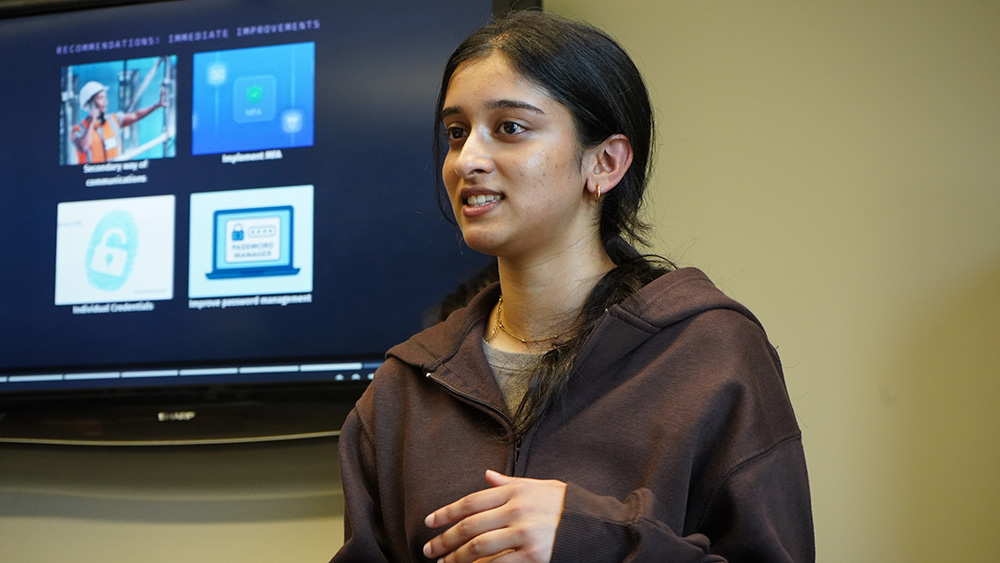
Cybersecurity Clinic presentation
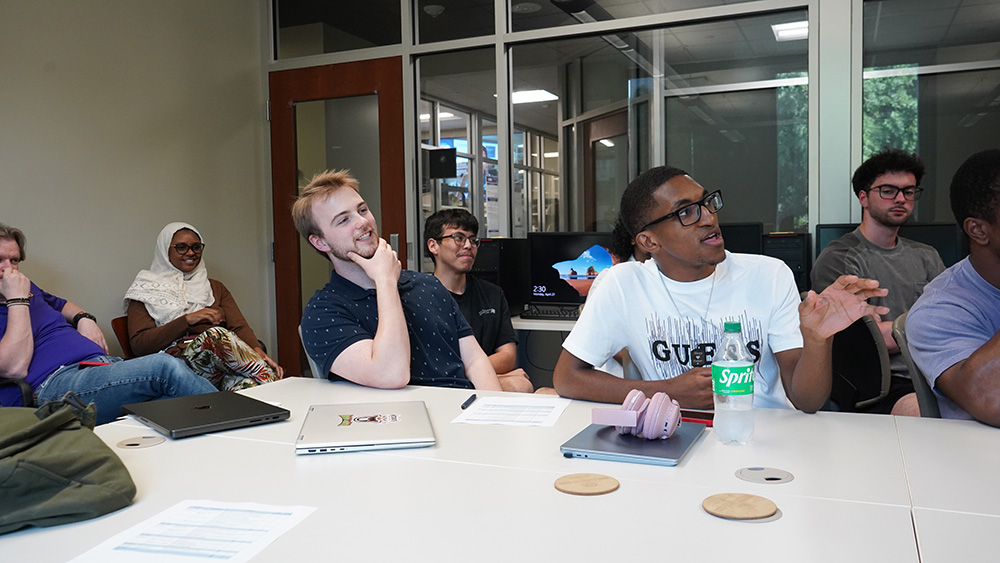
Students give feedback on current projects
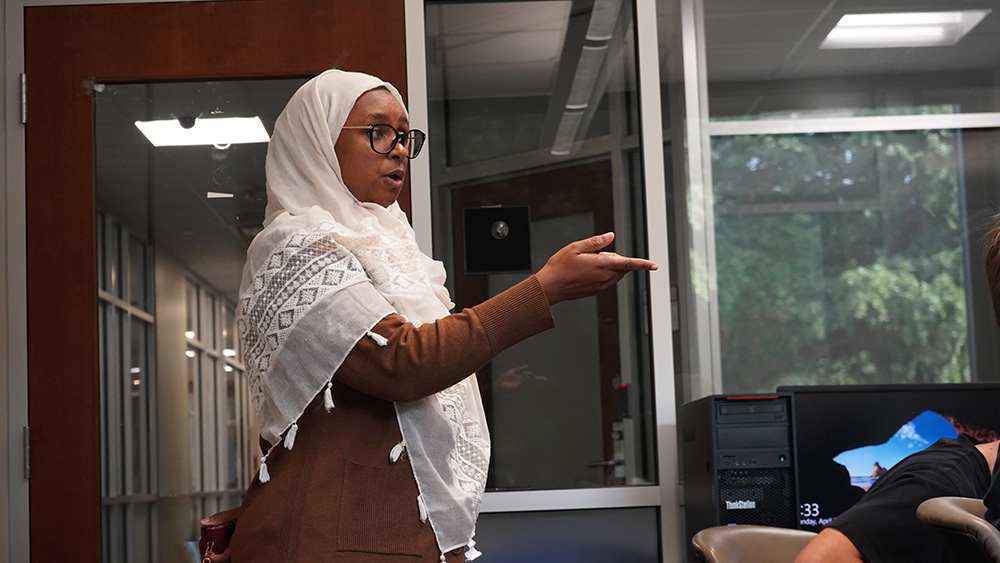
Aisha Ali-Gombe, LSU Cybersecurity Clinic Director
Students in the clinic work in teams of three. One is a member of the clinic’s “red team,” which focuses on offensive cybersecurity using penetration testing and vulnerability analysis. The other is a member of the “blue team,” which focuses on defensive operations through threat modeling and configuration assessments. And the third is a member of the “green team,” which focuses on governance, risk, policy, and compliance. Students not only get hands-on technical experience, but hone professional skills like writing and presenting, thinking critically and solving problems.
“At LSU, we believe cybersecurity education should create real-world impact,” Ali-Gombe said. “Through this clinic, we are not only preparing the next generation of defenders, we are helping strengthen the resilience of the utilities and critical infrastructure organizations our communities in Louisiana and beyond depend on every day.”
LSU’s Cybersecurity Clinic was the first in the nation to be funded by the National Security Agency, enabled by the university’s designation as a Center of Academic Excellence in Cyber Operations.
Some clinic students will be supported through LSU’s Scholarship for Service (SFS) CyberCorps program, funded by the National Science Foundation. Last year, LSU was the only university in the nation, among 89 SFS institutions, to see its funding renewed. The SFS program trains students for national security careers, and LSU students in the program are currently working for national laboratories that support the U.S. Department of Defense, the U.S. Department of Homeland Security, and the U.S. Department of Energy.
"Through this clinic, we are not only preparing the next generation of defenders, we are helping strengthen the resilience of the utilities and critical infrastructure organizations our communities in Louisiana and beyond depend on every day."
Aisha Ali-Gombe, LSU Cybersecurity Clinic Director
LSU is the first university to partner with the Department of Homeland Security, the Critical Infrastructure Security Agency, and Idaho National Laboratory on a new model for cybersecurity for critical infrastructure, installing an industrial control systems training platform known as the Tiger Skid on its flagship campus. Students in the LSU Cybersecurity Clinic train and work directly with industry through this platform, modeling networks and simultaneously attacking and analyzing them in a safe, controlled environment.
So far, the clinic has graduated 52 students, some of whom are now working at global firms that include Google, Deloitte, Lenovo, EisnerAmper, and, in Louisiana, for the Governor’s Office of Homeland Security & Emergency Preparedness.
Learn more about cybersecurity at LSU: https://lsu.edu/cybersecurity/