
Teaching Transformation: LSU Engineering Aims to Improve Tougher Engineering Courses
December 12, 2025
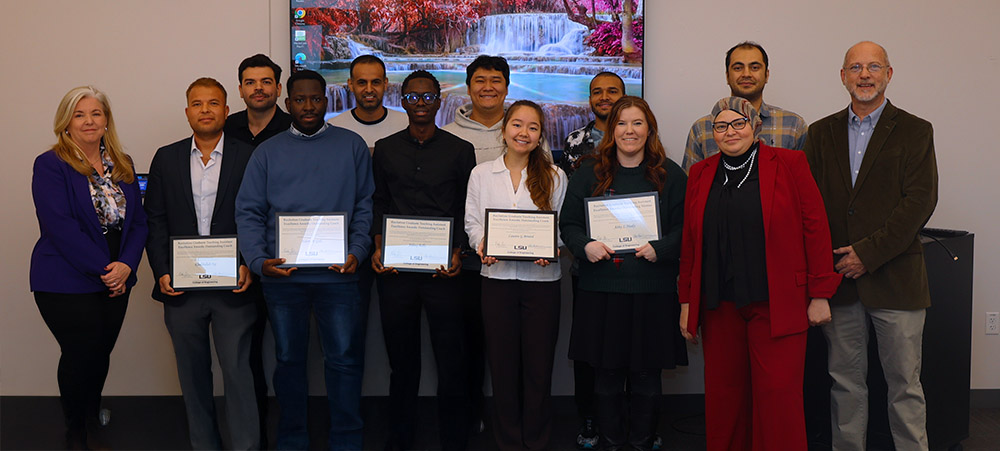
Recitation mentors, leaders, and coaches were celebrated by Dean Vicki Colvin and Associate Dean of Academic Affairs Marwa Hassan at an awards ceremony held last week.
To earn an LSU Engineering degree, students have to pass some notoriously difficult classes, some of which have high failure rates. To help more students pass these classes - and graduate on time - college leaders this semester came up with what they hope is a winning solution. They changed how the toughest classes are taught.
With support from LSU College of Engineering Dean Vicki Colvin, Associate Dean of Academic Affairs Marwa Hassan led a teaching transformation project this summer and fall aimed at improving engineering student success. Hassan and her team identified the courses with the highest failure and withdrawal rates and changed the teaching approach to include more course time per week, hands-on lessons, online lecture options, and small group instruction - all evidence-based approaches that improve student outcomes.
“The goal for this project is to ensure as many students as possible pass these critical courses and get to graduation,” Colvin said. “We are working towards a future where nearly all of our students pass these critical pathway courses the first time.”
To begin the project, Hassan dug into college data, flagging classes with high rates of D and F grades and class withdrawals, dubbing these classes “High DFW.”
Some High DFW classes include: Thermodynamics for ME and Non ME Majors, Fluid Mechanics, and Materials of Engineering in the Department of Mechanical Engineering; Statics, and Mechanics of Materials in the Department of Civil Engineering; Circuits in the Department of Electrical Engineering as well as Chemical Engineering Fundamentals and Comprehensive Electrical Engineering.
While Thermodynamics had a consistent DFW rate of 69% to 76% between 2020 and 2025, the DFW rate in other courses fluctuated. Overall, 11 courses were overhauled, and many had an average DFW rate of over 25% during that five-year period.
Before the transformation, these courses consisted of three to four class hours per week. They now convene students four to five hours a week, with one hour dedicated to active, project-based learning to increase student comprehension.
Students also have the option to register for a traditional face-to-face class or a hybrid version, where they can attend lectures online while attend the active learning sessions, called recitations, in person. This allows students, especially working students, flexibility. With the help of LSU College of Engineering Director of Distance Learning and Graduate Programs Dag Diaz and LSU College of Engineering Director of Information Technology David Trammell, all lectures are recorded and posted to course Moodle sites. The recordings are available for all students, so they can listen to lectures in case they struggled with the material or wanted to review it before exams.
“ Under the new model, it’s not just the teacher talking and the student taking notes. Students are working in groups and doing things to make the lessons more experiential. ”
--Boz Bowles, LSU Chevron Center for Engineering Education Director of Student & Faculty Development
The team also created recitations. These include active, project-based learning. In these sessions, students work in small groups led by a trained teaching assistant (TA) and get to apply what they’ve learned in lectures through different activities.
“Under the new model, it’s not just the teacher talking and the student taking notes,” LSU Chevron Center for Engineering Education Director of Student & Faculty Development Boz Bowles said. “Students are working in groups and doing things to make the lessons more experiential.”
Since the summer, Bowles and his team have trained TAs and even some instructors how to add student-centered, performance-based learning to their teaching repertoire. Bowles and his team observe recitations to give TAs feedback. Bowles and his team also convene learning communities each Friday where they introduce instructors to new active-learning techniques.
“I think our TAs have figured out that in addition to hands-on teaching being more effective, it’s also more engaging for them,” Bowles said. “They’ve been reporting that they are enjoying it and they’re getting more out of it for their own teaching and learning needs.”
Director of Data Procession & Strategic Analytics Roberto Champney in the college also asks students for feedback to see how well the program is working for them. This information is shared with Colvin and Hassan, who meet bi-weekly with instructors and recitation leaders to discuss problems and brainstorm solutions.
“We are very much in touch with the faculty teaching these classes and the students taking them,” Hassan said. “We’re trying to give students more flexibility and improve their performance.”
Bowles praised the teaching transformation collaboration, crediting Diaz and Trammell for making the online sessions a success and Chevron Center for Engineering Education Student Support Coordinators Jessica Wagner and Jamie Hamilton for training TAs properly.
Recitation Team Award Winners
Coaches, leaders, and mentors represent a developmental arc of instructional excellence in the program.
Coaches help students succeed;
Leaders inspire students to grow;
Mentors transform the learning culture itself.
Recitation GTA Excellence Awards: Outstanding Coach ($150): Ahmad Al-Jaafreh, Edem Gidi, Khalilullah Taj, Lauren Bristol, Mahdi Arjmandazar Varjovi, Misbah Ul Hoque, Mohammad Javad Hosseini, Richard Jiang, Sachin Dahiya, Sideeq Bello
Recitation GTA Excellence Awards: Outstanding Leader ($500): Seyed Reza Falsafizadeh Haghighi
Recitation GTA Excellence Awards: Outstanding Mentor ($1000): Abby Nealy
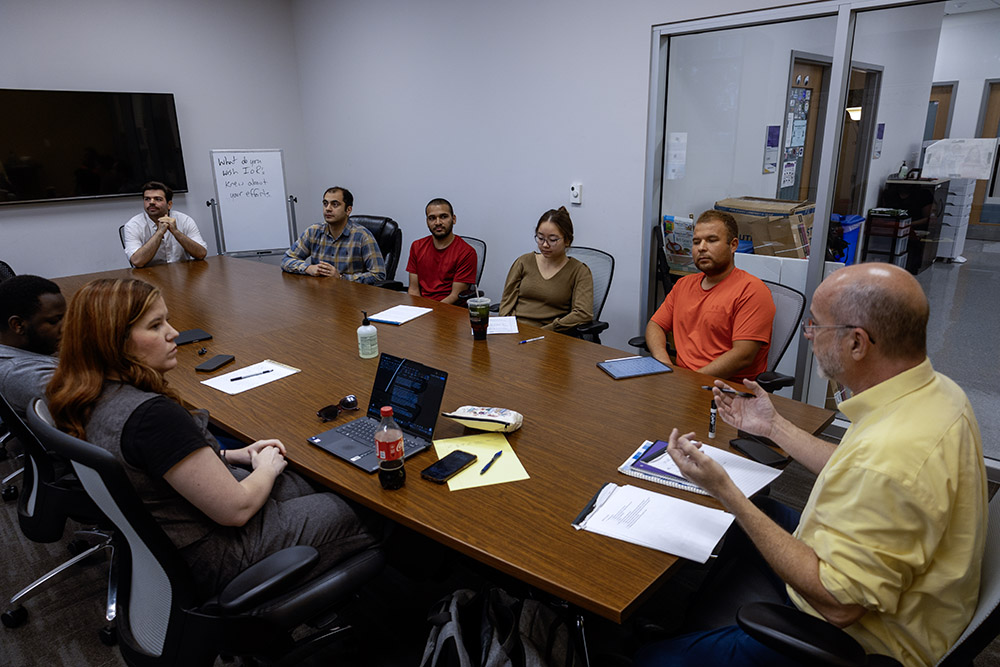
LSU Chevron Center for Engineering Education Director of Student & Faculty Development Boz Bowles leads a review session with mentors, leaders and coaches.
“I could not have moved the needle at all without Jessica and Jamie, who were both K-12 teachers in Louisiana and went through these same changes,” Bowles said. “They went from a largely-lecture model to the hands-on teaching that we are asking our faculty to engage in. They have really been able to home in on what’s necessary and what we’re looking for.”
Bowles this week held an awards ceremony in the Chevron Center for Engineering Education to celebrate the recitation teams. One award recipient was LSU PhD candidate and TA Reza Falsafizadeh, who said it has been an honor to work on the teaching transformation project.
“I wanted to contribute to a program that so clearly strengthens students’ understanding at this critical stage,” Falsafizadeh said. “I have seen students become more confident, more willing to participate, and better prepared for exams and future courses as a result of this continued engagement. Coaching these students has been an excellent professional and personal experience.”
With the fall semester complete, the transformation team will gather data on retention and grades in the retooled courses to gauge success of the effort and keep working to improve student success.
“We know evidence-based teaching practices work,” Bowles said. “We know they’re not always popular, but we know if they’re executed properly in the long-term, they will improve outcomes.”
Like the College of Engineering on Facebook or follow us on LinkedIn, Instagram, Bluesky, and X.