
Seal It Up: LSU IE Grad Student Conducts Research for NASA
December 04, 2025
 Most Americans remember that winter day in 1986 when they watched the Space Shuttle
Challenger ascend into the atmosphere to make history by carrying the first American
woman and first African American astronaut into space. Unfortunately, what made this
space flight infamous was that it exploded 73 seconds into its journey, leaving NASA
and viewers wandering what went so horribly wrong. Fast forward to today, LSU Industrial
Engineering graduate student Olutofunmi Olaoye and a team of LSU Engineering students are working on research to prevent this type
of disaster from happening again.
Most Americans remember that winter day in 1986 when they watched the Space Shuttle
Challenger ascend into the atmosphere to make history by carrying the first American
woman and first African American astronaut into space. Unfortunately, what made this
space flight infamous was that it exploded 73 seconds into its journey, leaving NASA
and viewers wandering what went so horribly wrong. Fast forward to today, LSU Industrial
Engineering graduate student Olutofunmi Olaoye and a team of LSU Engineering students are working on research to prevent this type
of disaster from happening again.
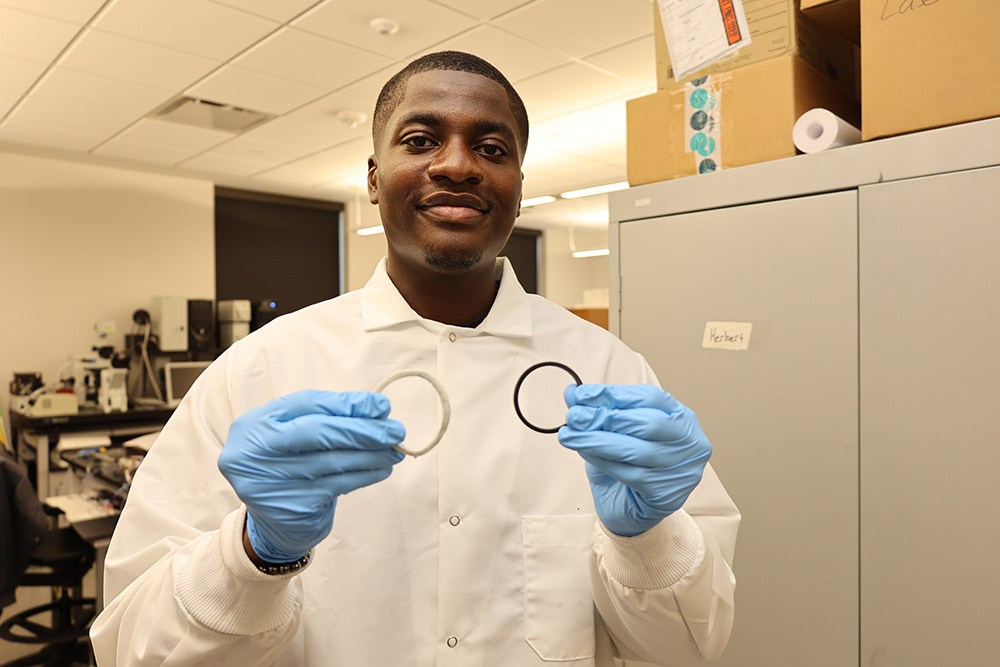
Olaoye, who received his BS in mechanical engineering at LSU, is working with LSU Mechanical and Industrial Engineering Assistant Professor Robert Herbert to develop a space sealant monitoring system that looks at the health of the seals. For instance, the sealant used in the Space Shuttle Challenger failed, causing it to explode. With the proper sealant and a sealant monitoring system in place, perhaps that explosion would have never happened.
“One of the main motivating factors for this research and why there was huge interest stems from the Challenger space crash,” Olaoye said. “You think about that disaster and how something so small could cause the crash. With these seals and this development, there’s huge interest in being able to tell when these systems are starting to degrade and mitigate these disasters.”
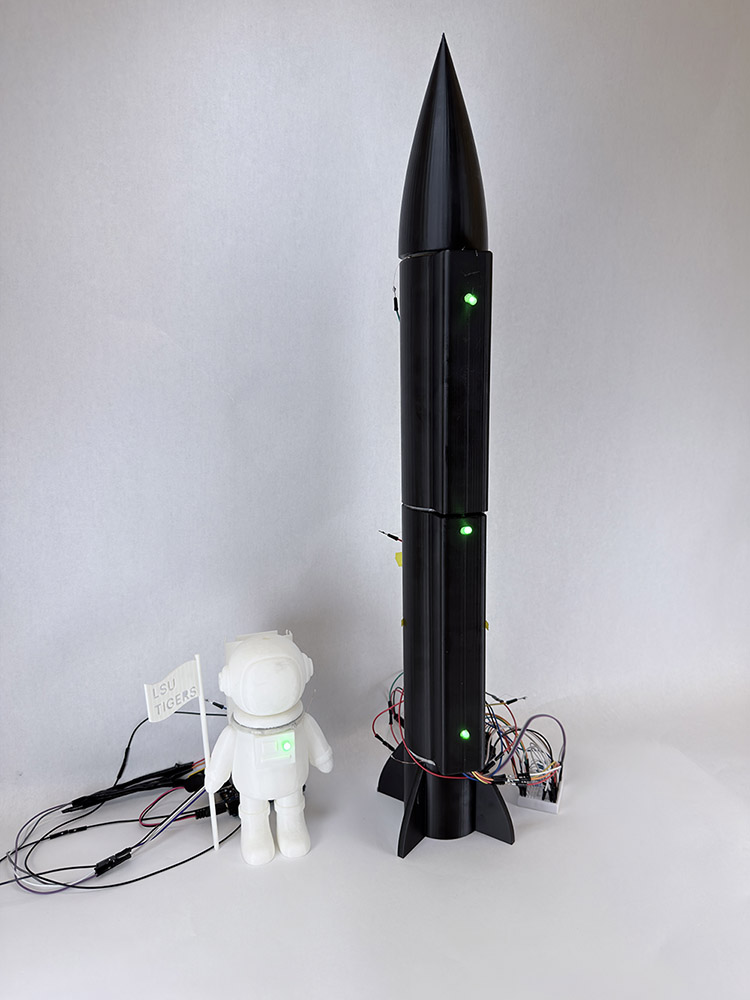
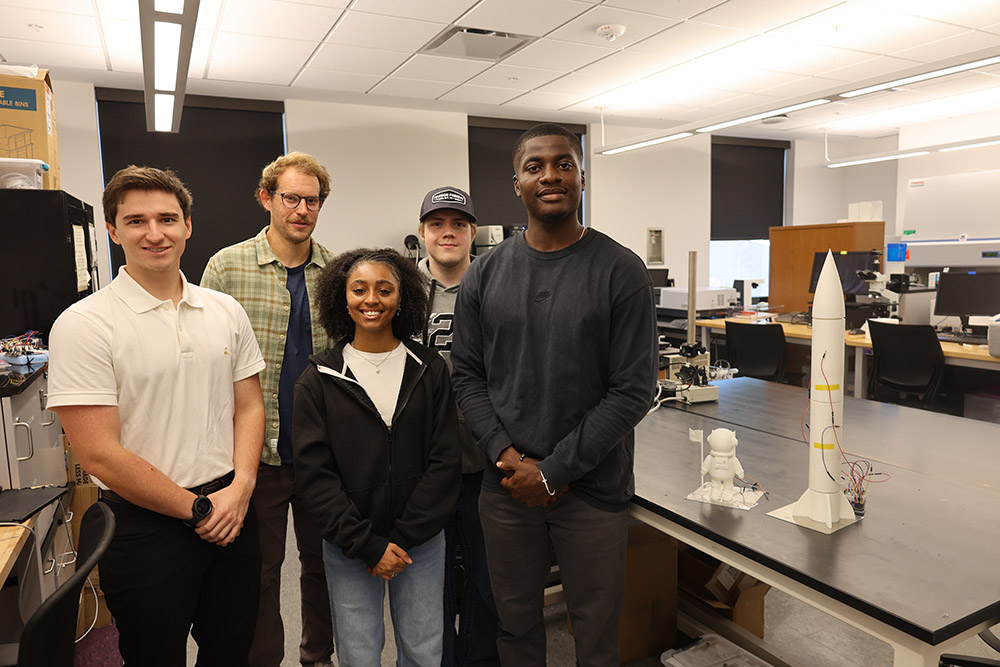
Olaoye and Herbert have been working in the Herbert Lab in Patrick F. Taylor Hall with the help of LSU ME students Michael Ruiz, Matthew McClung, and Caleb Reid, ME seniors from Baton Rouge; Emiliana Grove, an ME sophomore from Tampa, Fla.; Kyle Stack, an ME senior from Aurora, Colo.; and Gabriel Freedman, an ME senior from Madison, Miss. Their research involves applying liquid metal embedded fluoroelastomers for seals and embedding sensors in them. To test their seal sensor system in the lab, Olaoye and his team 3D-printed an astronaut with a sealant between his helmet and body suit with two small lights on the front of the suit. If the sealant is malfunctioning, the light turns red. If it’s ready to go, the light turns green.
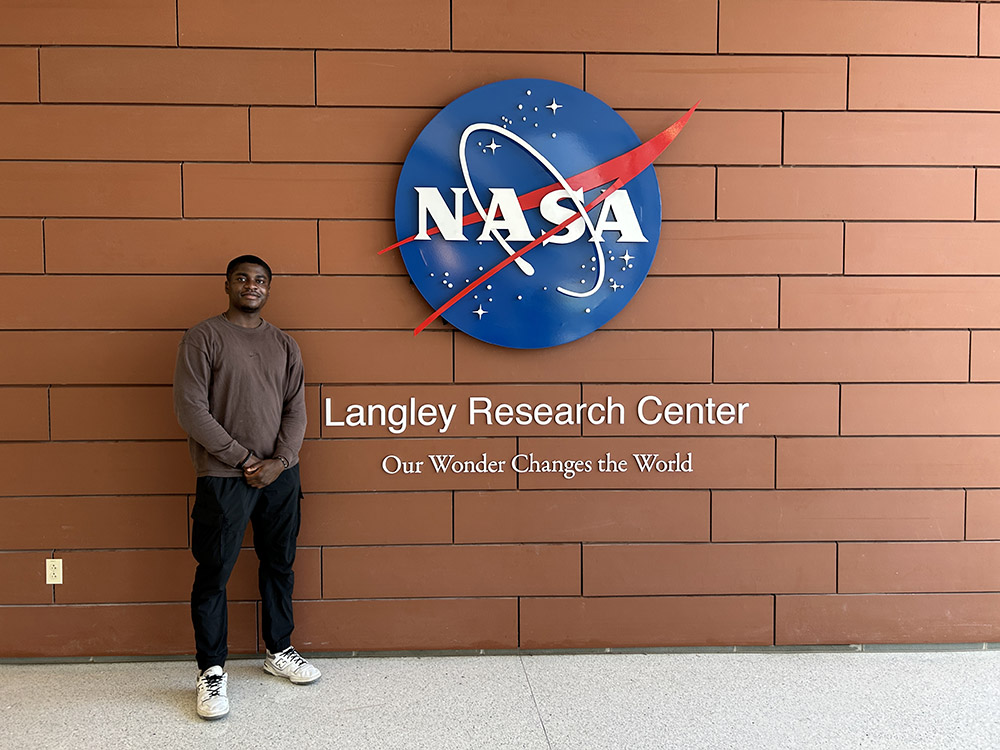
The team’s research, which as been supported by several grants from the LaSPACE program, was able to be tested at NASA Langley Research Center in Virginia.
“We proved that our sensors are functional and can potentially survive harsh space environments,” Olaoye said.
Olaoye, Herbert and their team also attended the LaSPACE conference where they garnered much attention for their research, wrote a conference paper, and will soon see their hard work published in a scientific journal.

“We find this technology can be applied to other areas besides just space, such as in automobiles or oil refineries,” Olaoye said. “Our innovation will be very valuable in all of these sectors.”
For Olaoye, who was born in Rivers state and raised in Abuja, Nigeria, working with NASA is a dream come true.
“When I was growing up, I would always take my toys apart to see how they worked,” he laughed. “I’m a very curious individual. I wondered where I could hone this curiosity working hands-on with things. I was interested in aeronautics but didn’t want to put myself in a box, so mechanical engineering was the perfect fit at the time.”
“ When I was growing up, I would always take my toys apart to see how they worked. I was interested in aeronautics but didn’t want to put myself in a box, so mechanical engineering was the perfect fit at the time. ”
After finishing high school in Nigeria at the age of 16, Olaoye came to LSU in 2019 when he enrolled in the Mechanical Engineering program. During his time at LSU, he interned with NASA, Tesla and Zoox where he began to recognize his passion for manufacturing. At Zoox, an autonomous robo-taxi company based in California, Olaoye worked in manufacturing, product development, and quality engineering and spent most of his time working in their assembly facility where they build the robo-taxi platforms and designed fixtures that aid in assembly of certain vehicle components.
“That’s what drove me to LSU’s Industrial Engineering graduate program,” Olaoye said. “Mechanical engineering gives you the understanding of how all of these systems work while industrial engineering gives you an understanding of how to optimize solutions and existing systems.”
After he graduates in August, Olaoye would like to find a job in manufacturing and developing products. Until then, he is excited about his current research with Professor Herbert and fellow LSU Engineering students.
“It’s been a really big collaborative effort and there’s been a huge sense of pride,” Olaoye said. “It’s work that has shown a lot of potential.”