
LSU BAE Seniors Design Wearable Device to Detect Heat Exhaustion
July 14, 2025
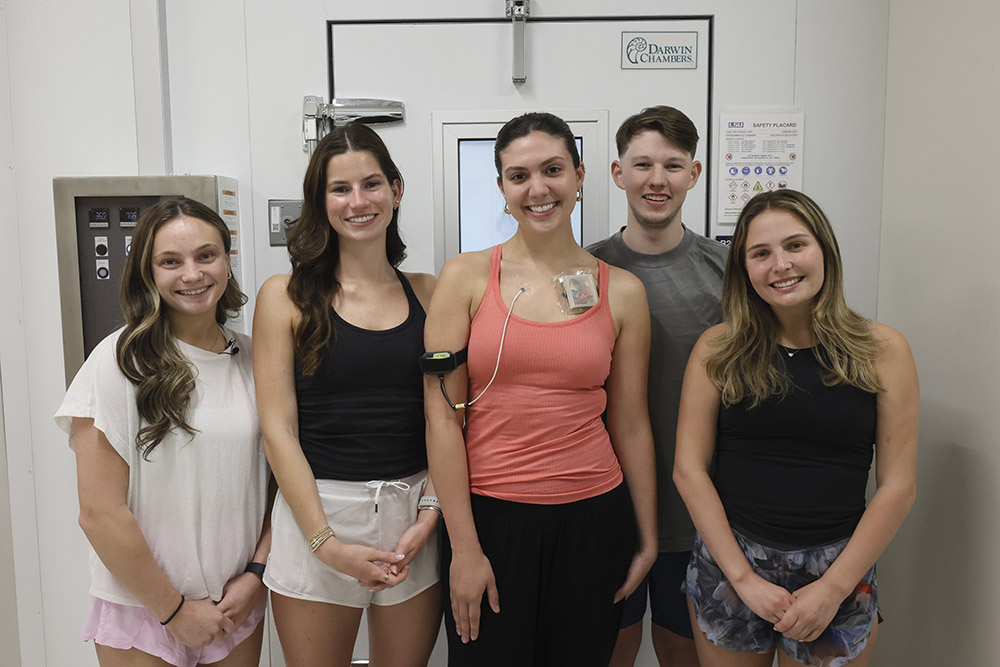 The summer heat in South Louisiana and other states can be unbearable for those who
work outdoors. While some signs of heat exhaustion are obvious, other symptoms such
as cool and moist skin or a fast heart rate can sneak up on someone. In order to prevent
heat exhaustion and heat stroke, five LSU Biological Engineering seniors designed
a wearable device that can detect symptoms of heat exhaustion to prevent heat stroke.
The summer heat in South Louisiana and other states can be unbearable for those who
work outdoors. While some signs of heat exhaustion are obvious, other symptoms such
as cool and moist skin or a fast heart rate can sneak up on someone. In order to prevent
heat exhaustion and heat stroke, five LSU Biological Engineering seniors designed
a wearable device that can detect symptoms of heat exhaustion to prevent heat stroke.
As part of their senior capstone design project, LSU BAE students Mallory Colletta, Lauren Madden, Thomas Rhymes, Charlotte Richardson and Margaret Sides collaborated with the LSU School of Kinesiology, LSU’s Division of Electrical & Computer Engineering, and local industry leader Honeywell to design and test a wearable device to detect heat exhaustion and hydration, and do cognition monitoring and alerting.
“The PPE we made has a heart rate sensor, temperature sensor, and skin conductance sensor, so whoever is wearing the sensor will receive an alert through Bluetooth if they’re reaching heat exhaustion levels and it’s time to take a break, or if they are in the clear and can keep working,” Colletta said.
The students tested the device using the School of Kinesiology’s Environmental Chamber, which is used for research on the effects of sustained heat and humidity on cardiovascular function and performance. The students set the temperature to 95 degrees and the humidity to 70% to simulate the hottest day in Louisiana. Each team member wore the device while walking on a treadmill and lifting weights for about 20 minutes. The device measured their heart rate, skin temperature, and skin resistance to determine sweat amount.
“The more you sweat, the lower the resistance,” Rhymes said. “The monitor gives us an idea of your hydration state. So, we’re trying to quantitatively measure biometrics to then alert you when you’re nearing a critical state of heat exhaustion so you don’t have a heat stroke.”
The team also worked with LSU’s Department of Electrical Engineering who allowed the students to use their Printed Circuit Board (PCB) lab to design and test the wearable device. The team also consulted with Honeywell, a manufacturing and technology company with a facility in Baton Rouge, who were interested in the device for their own workers.
“They said this is clearly a need,” Colletta said. “The foremen and engineers who are outside working are very interested in this.”
With many Louisianans working outside or even working in warehouses that are not air conditioned, the LSU students’ device could save lives.
According to Journals of the American Medical Association (JAMA), there has been a 117% increase in heat-related deaths over the past 24 years with a significant uptick since 2016 due to rising global temperatures. In 2023, there were 2,325 heat-related deaths in the U.S. Of those, 88 were in Louisiana. The Louisiana Department of Health reported 51 heat-related deaths and nearly 4,500 emergency room visits for heat-related illness in 2024.
“With this project, it’s really cool to see that one day, future generations can improve upon this project to help save lives,” Madden said.
“The whole project has been challenging, but it’s also been a lot of fun,” Colletta said. “We’ve grown close over this whole year. Even though we’ve hit some roadblocks, we’ve had fun working together. It’s been a huge learning experience on so many levels.”
Like the College of Engineering on Facebook or follow us on LinkedIn, Instagram, Bluesky, and X.