
LSU Vet Med installs advanced MRI to enhance diagnostic imaging and patient care
May 19, 2026
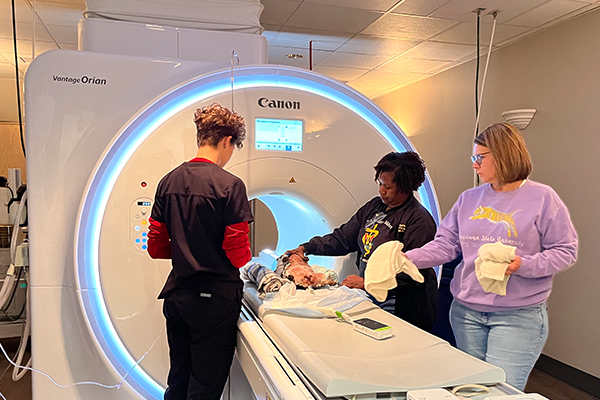
From left, Dr. Rachel Illgen, anesthesia intern, and diagnostic imaging technologists Rouchelle Gage and Ashley Kleinpeter, prepare a patient for the MRI.
The LSU School of Veterinary Medicine has installed a new, state-of-the-art magnetic resonance imaging (MRI) system, advancing the college’s diagnostic capabilities for both small and large animal patients.
The new unit, a Canon Orian 1.5T MRI, replaces LSU Vet Med’s original MRI, which had been in service since 2009. The acquisition marks the final step in a coordinated, multi-year effort to modernize all radiology equipment within the Veterinary Teaching Hospital.
“This MRI represents a major milestone for our Diagnostic Imaging service and for LSU Vet Med as a whole,” said L. Abbigail Granger, DVM, DACVR, professor and service chief for Diagnostic Imaging. “MRI is one of the most complex and powerful tools we have for diagnosing disease. This new system allows us to produce higher-resolution images more efficiently, which ultimately benefits our patients and the clinicians caring for them.”
How an MRI works
MRI (Magnetic Resonance Imaging) uses strong magnetic fields and radiofrequency waves to generate detailed images of internal structures, making it particularly valuable for diagnosing neurologic conditions, musculoskeletal injuries, and soft tissue diseases that cannot be fully evaluated with other imaging modalities.
The Canon Orian 1.5T system features high-performance gradients, enabling faster scan times and improved image resolution—critical factors in veterinary patients where anesthesia time and image quality are both essential considerations.
Implementation of a new MRI system is a complex and ongoing process. For each species, body region, and patient size, imaging specialists must carefully develop and refine protocols to ensure optimal positioning, safety, and image quality. This includes selecting from multiple specialized coils and adjusting technical parameters such as scan sequences, field of view, and slice thickness to achieve the best possible diagnostic images.
Team and Expertise
Diagnostic imaging technologists Rouchelle Gage and Ashley Kleinpeter set up the protocols and have built each of the sequences. They are both formally trained in MRI and gained certifications in human medicine before joining the LSU Vet Med hospital staff. “The physics backgrounds of our staff in this modality are also essential in training our interns and residents and to provide diagnostic quality images for other hospital services and patients,” said Dr. Granger.
Implementation and Collaborative Care
“MRI is extremely sensitive to its environment and requires specialized infrastructure, including shielding and cryogenic management,” Dr. Granger added. “It’s also one of the most challenging imaging modalities to interpret, requiring a deep understanding of the physics behind how images are produced. That’s why it’s often the last modality our residents master during their training.”
At LSU Vet Med, the Diagnostic Imaging team collaborates closely with other hospital services—including neurology and equine surgery—to interpret MRI findings and guide patient care. MRI plays a critical role in diagnosing complex conditions, from spinal and brain disorders to orthopedic issues in both companion animals and horses. In equine patients, for example, MRI is often the only way to evaluate soft tissue structures within the hoof. The new MRI is already being used for clinical cases.
“This technology enhances not only our ability to diagnose and treat patients, but also our ability to train the next generation of veterinarians,” Dr. Granger said. “Our students and residents are gaining hands-on experience with cutting-edge equipment that reflects what they will encounter in leading practices and referral centers.”
The LSU Veterinary Teaching Hospital provides advanced diagnostic and treatment options for animal patients across the region while serving as a critical training ground for veterinary students and residents.
About LSU Vet Med: Bettering lives through education, public service, and discovery
The LSU School of Veterinary Medicine is one of only 33 veterinary schools in the U.S. and the only one in Louisiana. LSU Vet Med is dedicated to improving and protecting the lives of animals and people through superior education, transformational research, and compassionate care. We teach. We heal. We discover. We protect.