
Mathematical Analysis
Mathematical Analysis Program
2026–2027
Mathematical analysis is a meeting ground for problems that look very different at first sight: electronic states in quantum materials, waves moving through heterogeneous media, nonlocal and uncertain material response, and harmonic structure shaped by arithmetic or geometry. Across these problems, researchers ask how spectra encode physical behavior, how oscillation and localization interact, which structures survive perturbation, and how multiscale or geometric organization becomes visible in equations. The 2026-2027 TIAMS program brings these questions together through a portfolio of focused meetings, with analysis serving as a language for extracting mechanisms from complicated systems across several mathematical subfields.
The year-long bridge
The year ranges from operator and spectral theory in quantum materials to nonlocal continuum models and uncertainty in extreme response, while a harmonic-analysis meeting develops connections among arithmetic structure, geometry, frames, and oscillatory phenomena. A separate cross-disciplinary meeting examines how modern computational, search, communication, and collaborative tools can improve the way scientists formulate questions and form research partnerships; its official event title is "ASPIRE: AI Opportunities in Science: Partnerships, Interdisciplinary Research and Education." The scientific thread is the disciplined passage from an object or phenomenon to a mathematical description that can be tested: an effective Hamiltonian, an operator spectrum, a frame, a nonlocal constitutive law, an uncertainty model, or another structure that clarifies what is stable and what remains unresolved.
TIAMS will use the meetings as points of concentration inside a broader year of seminars, visitors, small-group work, and follow-up. Participants will be encouraged to put common examples on the board, compare competing models, isolate assumptions, and leave behind questions precise enough for continued work. Graduate students and postdocs should enter through mini-courses, problem sessions, working discussions, and direct research activity alongside the lectures. The year's value will lie in connections that survive the meetings: sharper mathematical formulations, shared examples, new calculations, open problems, and collaborations linking analysis to materials, geometry, uncertainty, and neighboring sciences.
Program Details
- Which spectral or operator-theoretic structures reliably distinguish localization, propagation, and critical behavior in complex materials?
- How should nonlocality, multiscale structure, and uncertainty be represented when local continuum models no longer capture extreme material response?
- Which harmonic-analytic structures connect arithmetic, geometry, frames, and concrete questions about oscillation or reconstruction?
- How can researchers compare mathematical models across fields while making their assumptions and domains of validity explicit?
- Which problems arising in the year's meetings can be converted into durable working-group questions for students, postdocs, and visiting researchers?
- Spectral and operator theory
- Waves, localization, and propagation
- Quantum-material models
Nonlocality and multiscale response
- Uncertainty and model comparison
- Harmonic analysis, arithmetic, geometry, and frames
- Mathematical translation across scientific fields
Scientific leadership is organized through the four meeting teams listed below. Each team brings expertise matched to the scientific focus of its meeting, while the year-level seminars and working groups create connections across the portfolio.
The program is intended for analysts, spectral theorists, PDE researchers, harmonic analysts, mathematical physicists, applied mathematicians, and scientists whose models raise analytic questions about waves, materials, uncertainty, or multiscale structure. Faculty at all career stages, postdoctoral researchers, and graduate students with appropriate preparation are invited to participate. Researchers from neighboring areas—topology, geometry, numerical analysis, materials theory, engineering, and scientific computation—are especially welcome when they bring a concrete model, mechanism, or mathematical structure that can be examined with the program community. Participants do not need to attend every meeting; the year is designed so that a researcher can enter through one focused event and continue through seminars, visits, or a working group when the scientific connection is productive.
- Attend one or more of the four documented meetings.
- Join TIAMS seminars and working groups between meetings.
- Visit TIAMS for a short targeted collaboration or a longer research stay when space and support permit.
- Participate in mini-courses, problem sessions, or graduate-focused activities attached to individual meetings.
- Use the TIAMS participation form to describe a research question, working-group interest, preferred dates, and support needs.
Junior researchers should expect direct access to the research activity. Mini-courses and tutorials are most useful when they lead immediately to examples under discussion by visitors; working groups should give students and postdocs opportunities to present calculations, test conjectures, and return to a problem over several meetings. TIAMS will encourage participation across LSU and from outside institutions, with the aim of making advanced training part of the research process itself. Junior participants should also have opportunities to give short progress reports, meet visiting researchers in small groups, and help document open problems that remain after each meeting.
Possible outcomes include papers and preprints, refined mathematical models, spectral or analytic calculations, open-problem documents, computational experiments, lecture notes, and collaborations that continue after the meetings. The year should also identify questions mature enough to become later TIAMS working groups or program themes.
Program Activities
Workshops
The year is organized around four documented meetings, supported by TIAMS seminars, visiting-researcher interactions, problem sessions, and follow-up working groups. Meeting records should carry exact schedules, speaker information, registration, and recordings as they become available. Between meetings, TIAMS should use its resident community to continue questions that benefit from repeated blackboard work, computation, model comparison, or translation between mathematical and scientific vocabularies.
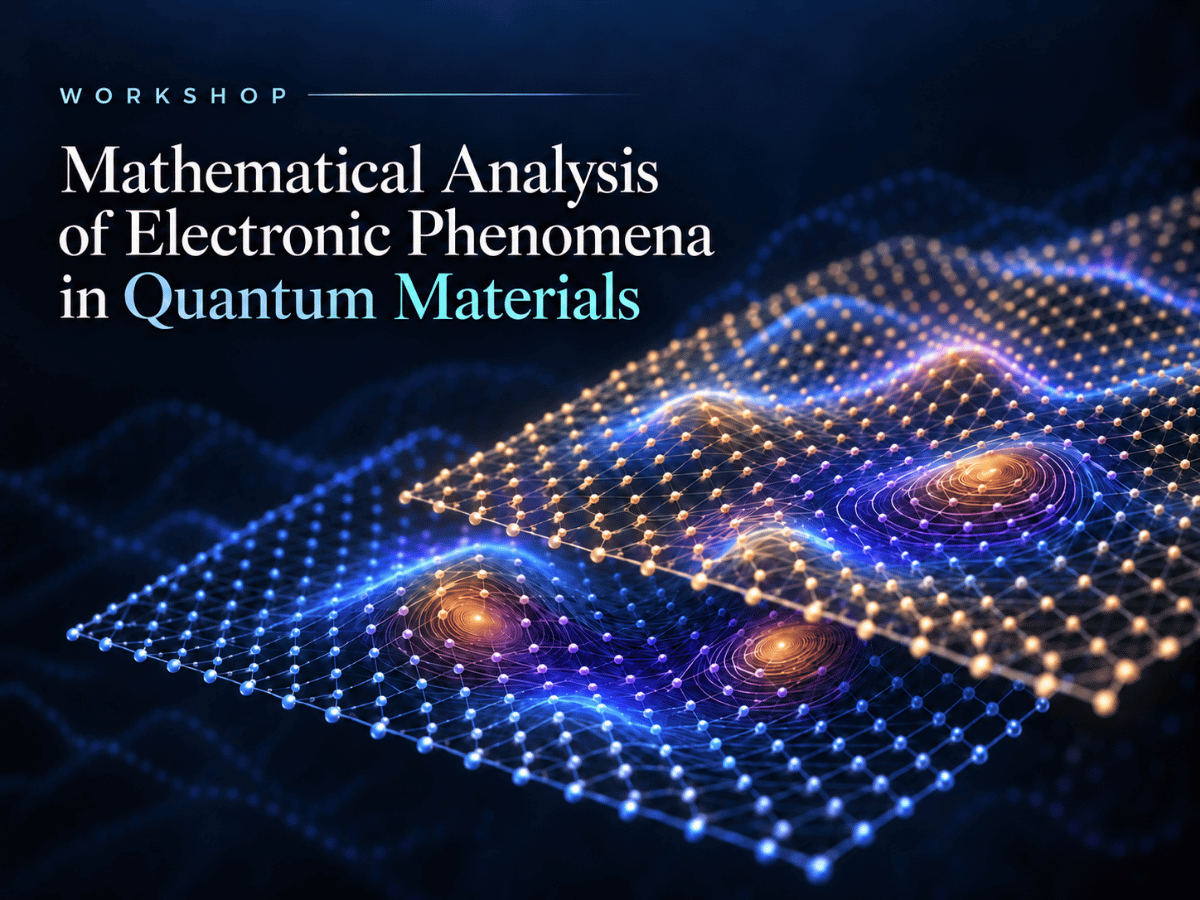
Mathematical Analysis of Electronic Phenomena in Quantum Materials
January 4 - 8, 2027
Organizers: Stephen P. Shipman, Scott J. Baldridge, Justin H. Wilson, Daniel Massatt
A direct bridge from spectral theory, PDE, topology, and mathematical physics to electronic phenomena in layered, incommensurate, and other quantum materials. This meeting also serves as a scientific precursor to the Fall 2027 TIAMS quantum-materials semester.
ASPIRE: AI Opportunities in Science
February 19 - 20, 2027
Organizers: LSU journal-club organizers + TIAMS
A cross-disciplinary meeting on research partnerships, scientific communication, education,
and fast formation of collaborations around difficult problems. The official event
record should provide the detailed scientific sessions and participation information.
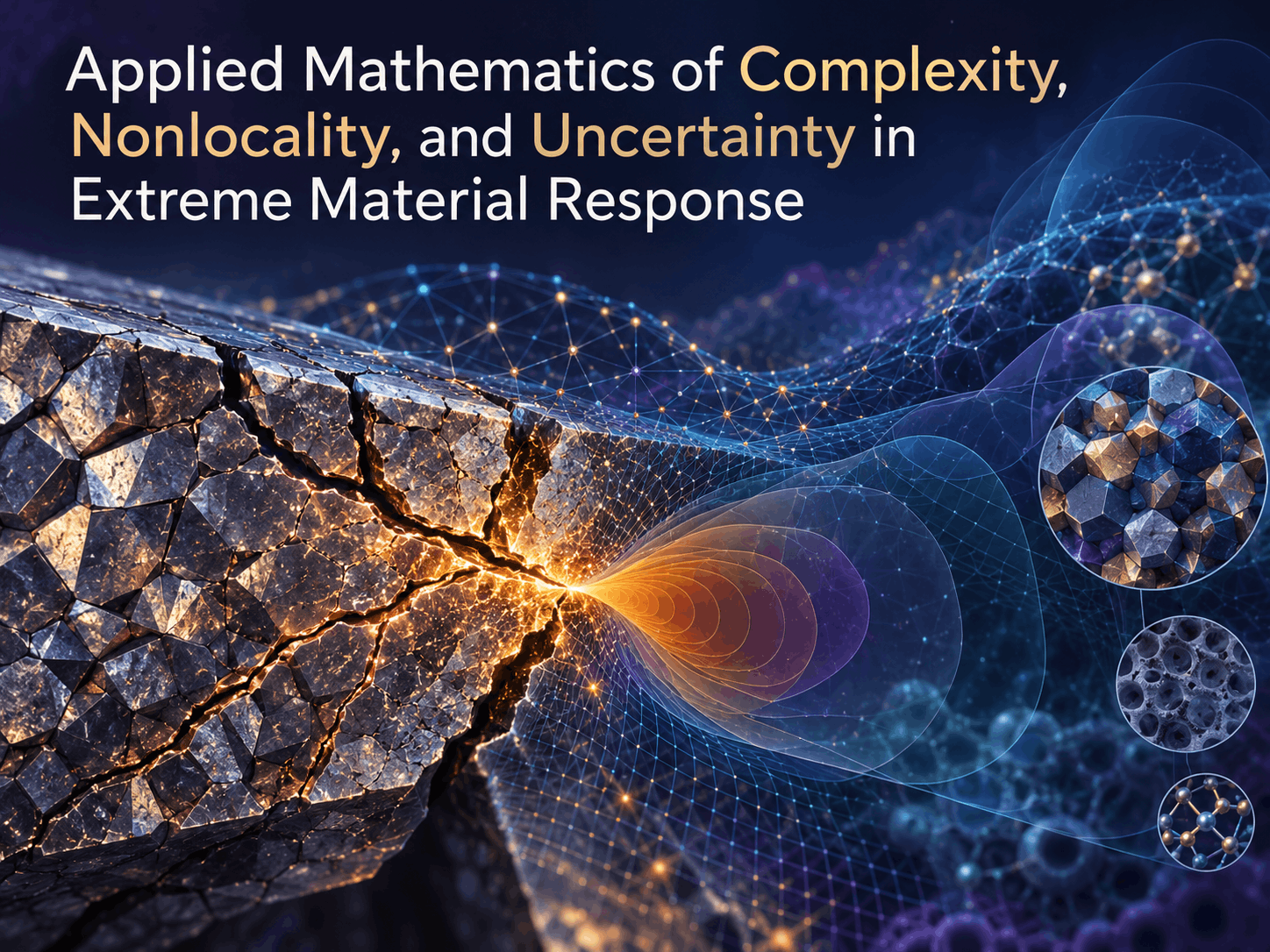
Applied Mathematics of Complexity, Nonlocality, and Uncertainty in Extreme Material Response
March 8 - 12, 2027
Organizers: Robert P. Lipton, Scott J. Baldridge, Kaushik Dayal
A meeting on mathematical models for materials whose response involves multiscale
structure, nonlocal interactions, uncertainty, and extreme regimes where standard
approximations can fail.
Harmonic Analysis at the Interfaces of Arithmetic, Geometry, and Frames
March 11 - 14, 2027
Organizers: Fan Yang, Rui Han, Gestur Olafsson, Naga Manasa Vempati, Scott J. Baldridge
A training-centered harmonic-analysis meeting connecting arithmetic and geometric structure with frames, oscillatory methods, and neighboring areas. Mini-courses and focused research talks will give graduate students and researchers from adjacent areas structured entry points into the meeting.
Seminars and Working Groups
Suggested year-level working groups should form around problems that recur across meetings: spectra and localization, nonlocal and multiscale models, harmonic structure and geometry, and model comparison under uncertainty.
Groups should begin from one or two shared examples, record assumptions and open questions, and use the TIAMS seminar schedule for short progress reports. Group names can change as actual participant interests become clear.