
We Heal: Veterinary Patient Success Stories
September 24, 2026
Discover inspiring patient stories from the LSU Veterinary Teaching Hospital, where expert teams collaborate across specialties to save and improve the lives of animals—from dogs and cats to goats and chickens. Through advanced medicine, innovative treatments, and compassionate care, LSU Vet Med clinicians help patients like Jeaux, Bubbie, Taco, and many others heal and return home to their families.
Henry Einstein
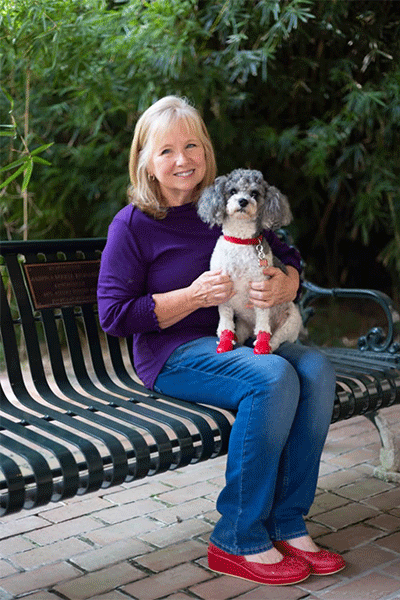
Diane Clay and Henry
Henry Einstein is a longtime LSU Vet Med patient and Diane Clay's beloved companion. The retired nurse has turned to LSU Vet Med's Integrative Medicine service for several of her dogs over the years to help them recover, manage health challenges, and improve their quality of life. Henry began rehabilitation in 2018 after surgery to repair a torn ligament, and Diane credits therapy with significantly improving his recovery. Most recently, Henry received rehabilitation following hip and leg surgery. Diane even shows solidarity with Henry at his therapy appointments by wearing matching red shoes while he sports his non-slip footwear. Before Henry, Diane brought her standard poodle, Kingston, to our Integrative Medicine service for mobility rehabilitation and wound care after a torn tendon. Her dog, Phoebe, received acupuncture and herbal medicine, helping address anxiety and stomach upset. Diane is grateful to see how these therapies have improved her dogs’ health and hopes other pets and their families can experience those same benefits.
Maggie
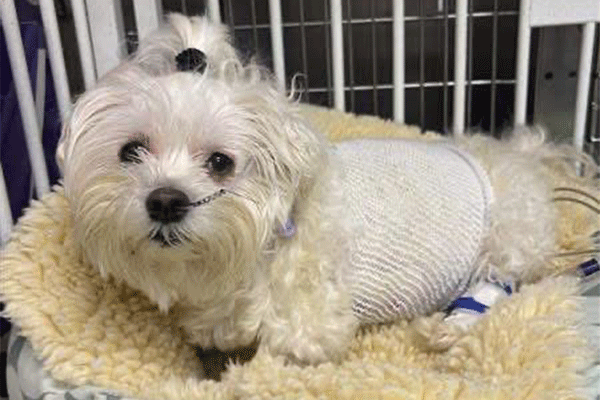
Maggie in the LSU Vet Med ICU
Maggie is an 8-year-old Maltese from Alexandria, La., who arrived at our Veterinary Teaching Hospital critically ill with septic bile peritonitis secondary to a ruptured gallbladder. Maggie underwent an emergency exploratory laparotomy and cholecystectomy, then received around-the-clock monitoring and intensive treatment in ICU. Throughout her hospitalization, specialists from Soft Tissue Surgery, Anesthesia, and Critical Care services worked together to guide every step of her treatment and recovery. This collaborative approach is one of the greatest advantages of receiving care at LSU Vet Med. With multiple specialty services, advanced diagnostic capabilities, and a dedicated intensive care unit all under one roof, our teams can communicate in real time and quickly adjust treatment plans as a patient's condition changes. After several days of intensive care, Maggie recovered well and was able to return home to her family. Complex cases require teamwork, and that's exactly what our Veterinary Teaching Hospital delivers.
Añejo
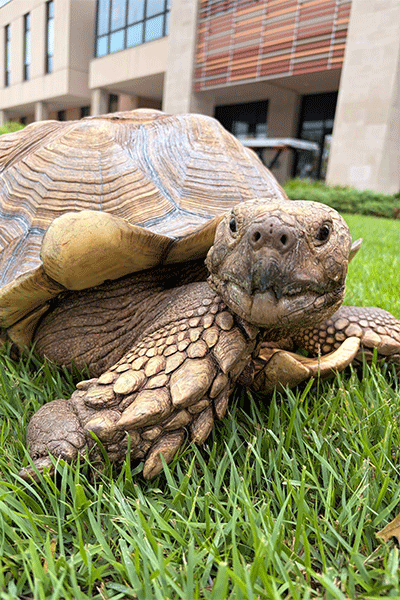
Añejo, a sulcata tortoise, in the yard outside LSU Vet Med
Añejo's owners noticed what looked like a mass on the face of their 45-year-old sulcata tortoise and brought him to LSU Vet Med for answers. Our Zoological Medicine Service discovered that it wasn't a mass; it was a penetrating wound with fly strike, meaning fly larvae had invaded deep into the tissue of his head. After surgically cleaning the wound and treating it with an antibiotic gel, our team placed a feeding tube to provide nutritional support during recovery. Just four days later, Añejo was eating on his own and returned home. Since then, his feeding tube has been removed, and his wounds have healed. While he was under anesthesia, our team also gave his shell a trim. We're thrilled to see Añejo doing so well and are grateful to our Zoological Medicine team for providing the specialized care that helped him make a full recovery.
Dumpster
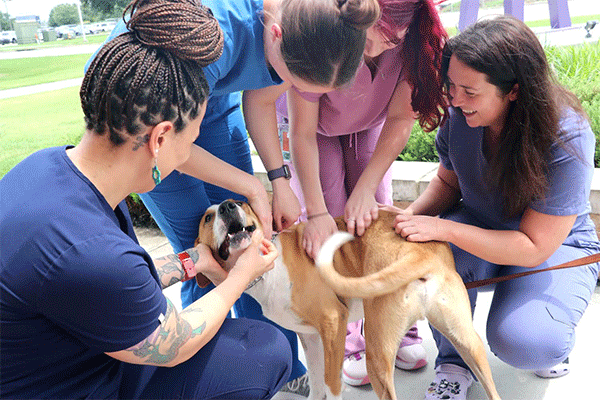
Members of the LSU Vet Med Neurology Service with Dumpster
Dumpster, a 2-year-old hound mix, suffered a life-threatening spinal injury when a 350 lb. piece of metal fell onto him. After advanced imaging and spinal stabilization surgery by LSU Vet Med’s Neurology team led by Dr. Colleen Embersics, Dumpster overcame complications and made a remarkable recovery. Today, he’s back to running, swimming, playing, and chasing Frisbees with his family. “Y’all saved his life. What a wonderful asset LSU Vet Med is to Louisiana,” said owner Adam Cutrer. Dumpster’s full story was featured on the LSU Stories blog. Learn more
Moo
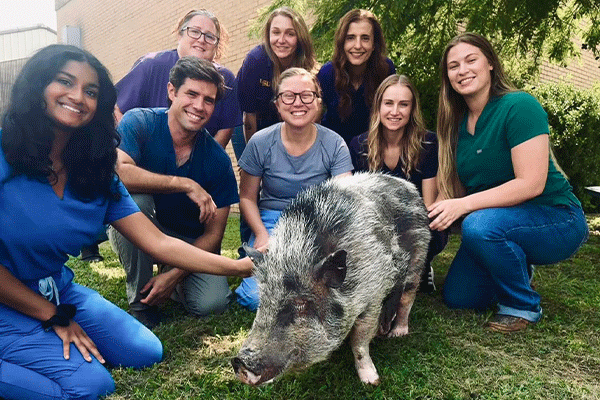
Members of the Food Animal Service team with Moo
Moo, an 8-year-old pig, underwent a high-risk exploratory surgery in June due to an abdominal mass and severe fluid accumulation in her abdomen. Owner Heather Koerin knew that it was highly likely that Moo would not survive the procedure, but she wanted to give Moo the chance. The fluid accumulation made surgery especially challenging and affected Moo's ability to breathe. She underwent a mass removal, splenectomy, and ovariohysterectomy, and surgeons removed nearly 14 gallons of fluid from her abdomen. "We were truly grateful to have the expertise of Dr. Francisco Morales, large animal surgeon, whose skills made this outstanding outcome possible," said team lead, Dr. Clare Scully. During surgery, Moo suffered a life-threatening condition in which blood oxygen levels drop dangerously low. Without adequate oxygen, the body's organs and tissues cannot function properly, leading to severe breathing distress, weakness, collapse, and potentially death if not treated quickly. The anesthesia team applied its expertise to help avert the crisis. Following surgery, Moo had extreme difficulty standing and moving around. However, after several days of hospitalization, monitoring, and supportive care, she is now able to walk and is eating well. "She is a whole new pig," said Geshini Perera, a fourth-year veterinary student who communicated with Moo's owner throughout her hospitalization.
Isabel
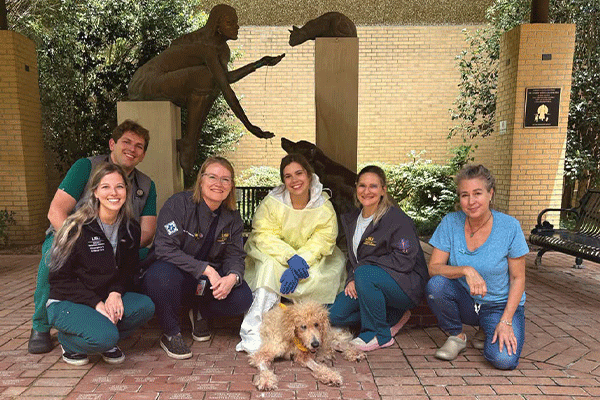
Members of the LSU Vet Med Emergency and Critical Care Service team with Isabel and her owner.
Isabel arrived at LSU Vet Med in septic shock and fighting for her life. The 14.5-year-old Goldendoodle came to our Emergency & Critical Care service suffering from severe complications related to a multidrug-resistant urinary tract infection. She was unresponsive and required immediate lifesaving treatment and intensive care. Teams from Emergency & Critical Care, Internal Medicine, Neurology, and Integrative Medicine worked together to help Isabel recover, and recently, Isabel went home walking, eating, and drinking to continue her recovery with her family.
Duke
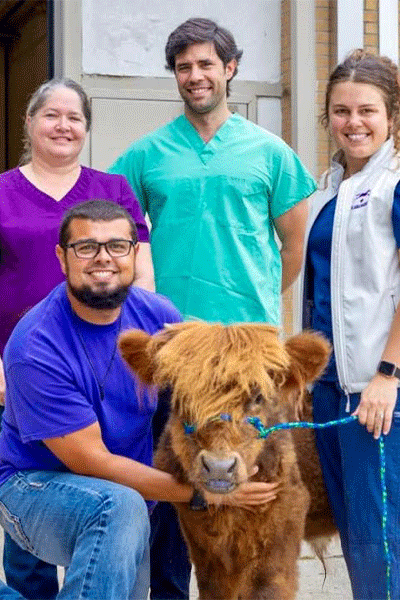
Members of the LSU Vet Med Food Animal Service team with Duke
Duke, the Scottish highland bull, jumped a tall fence and broke out of his pen at 1:30 a.m. and surprised a male donkey who latched onto Duke's back, shoved him into a fence, and fractured his jaw."It took me 20 minutes to get the donkey off of Duke. I've been a firefighter for 16 years, and this was the most traumatic experience I've ever had," said owner Jarred Wrinkles, of Loranger, La. Duke underwent surgery to wire his jaw into place by zig-zagging the wire between his lower teeth. Clinicians made a dental device molded onto his teeth to protect his lips as he healed. The wires and device were removed after six weeks. Duke's jaw has healed and he is well on his way to a normal life. "I have the utmost respect for his clinical team," Jarred said.
Snowy
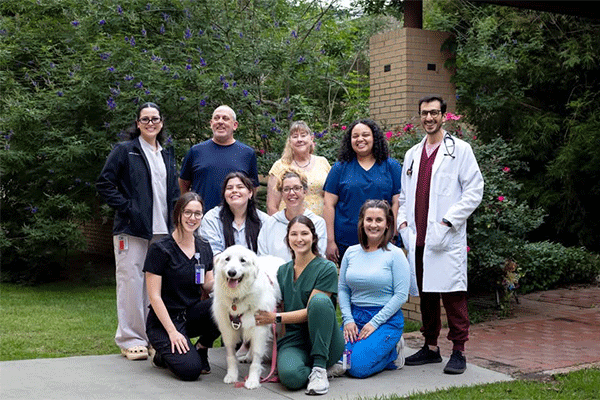
Members of the LSU Vet Med Emergency and Critical Care Service team with Snowy.
Snowy first arrived at LSU Vet Med too weak to walk. The Great Pyrenees was battling severe immune-mediated hemolytic anemia (IMHA), a life-threatening disease where the body destroys its own red blood cells. Despite multiple transfusions before referral, her condition continued to worsen. Snowy immediately received lifesaving transfusions and intensive care through LSU's Emergency & Critical Care and Small Animal Internal Medicine services. Over the following days, she required additional transfusions, constant monitoring, and advanced supportive care. Slowly, Snowy began to regain her strength. When she returned to visit the team that helped save her life, she was happy, bright, and thriving.
Learn about the LSU Veterinary Teaching Hospital
The LSU Veterinary Teaching Hospital is open 24 hours a day, seven days a week, 365 days a year to serve animals. We have the most board-certified specialists under one roof in Louisiana and offer a variety of specialty services, as well as primary care for animals. We have specialists in anesthesiology, cardiology, ophthalmology, zoological medicine, oncology, internal medicine, dermatology, surgery, pathology, diagnostic imaging, and integrative medicine and physical rehabilitation.