LSU Astrophysicists Receive Prestigious European Physical Society Award
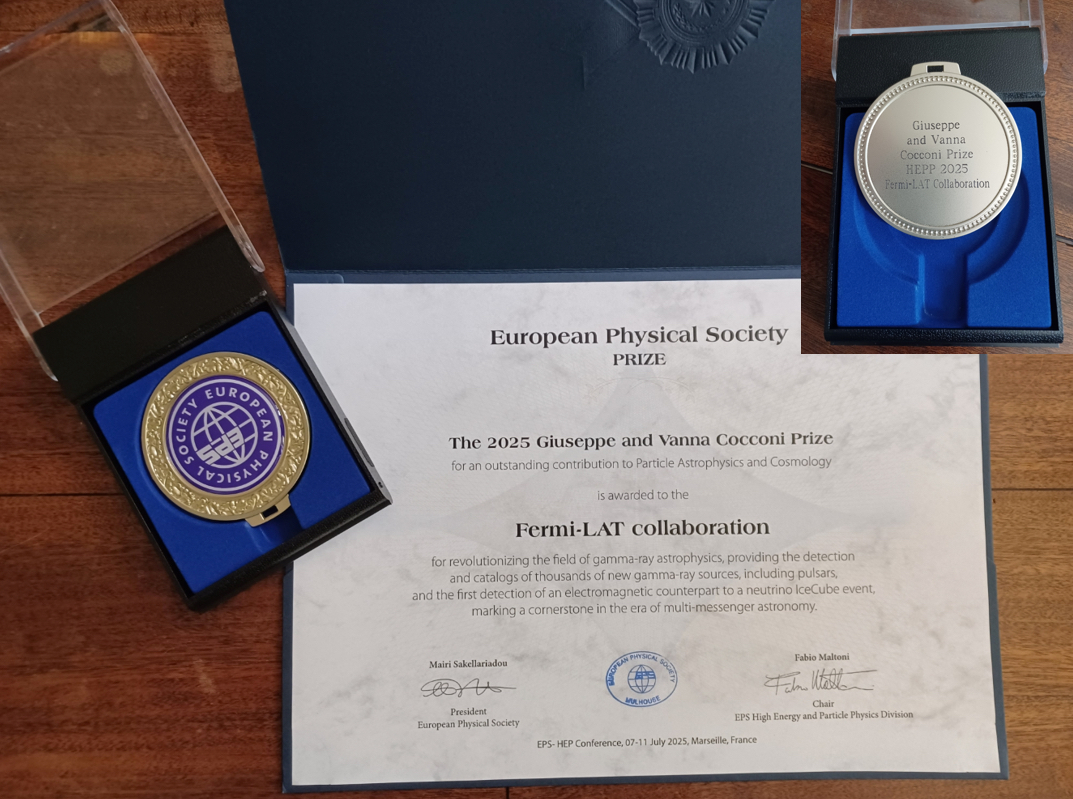
Louisiana State University Astrophysicists Eric Burns and Michela Negro have been awarded a 2025 Giuseppe and Vanna Cocconi Prize by the European Physical Society as part of the Fermi Gamma-ray Burst Monitor (GBM) and Large Area Telescope (LAT) science teams, for revolutionizing the field of gamma-ray astronomy and for laying the foundations of modern multi-messenger astrophysics. This top prize in high-energy physics was formally presented at the European Physical Society Conference on High Energy Physics, held in Marseille, France, last week.
The Fermi Gamma-ray Space Telescope is a powerful space observatory that detects gamma rays, the most energetic form of light, with two main instruments, the GBM and the LAT. Burns and Negro have been active members of the GBM team and the LAT Collaboration, respectively, since the beginning of their careers. Negro currently leads the LAT scientific collaboration.

“Not much of the gamma-ray sky was known before Fermi launched, and now we can talk about “before” and “after” Fermi,” said Negro. “The mission’s pioneering works have not only revolutionized our understanding of the high-energy Universe but also enabled fundamental discoveries that will impact the field for decades to come.”
Since its launch in 2008, the LAT has unveiled a remarkably rich gamma-ray sky, detecting over 5,000 gamma-ray sources, more than twenty times the number known prior to its operation. One example are pulsars. Pulsars are rotating astrophysical sources emitting periodic signal, like cosmic lighthouses. Only a handful of pulsars were known to emit high-energy radiation, Fermi added more than 300 pulsars with precision timing measurements of their pulsation.
“To me the most surprising discovery by the Fermi-LAT, was the detection of two gigantic bubbles, that we named the “Fermi bubbles,” that expand
above and below our Milky Way Galaxy like inflated balloons,” said Negro. “They are as big as our Galaxy itself! It is believed that the supermassive black hole at the center of our Galaxy feasting on matter and shooting powerful jets millions of years ago created these bubbles.”
The Fermi GBM detected over 10,000 transient events, flashes of Gamma-rays coming from all over the cosmos. Fermi-GBM’s most famous discovery was from a partnership with the Laser Interferometer Gravitational-Wave Observatory (LIGO), and Burns co-led the work which measured the speed of gravity
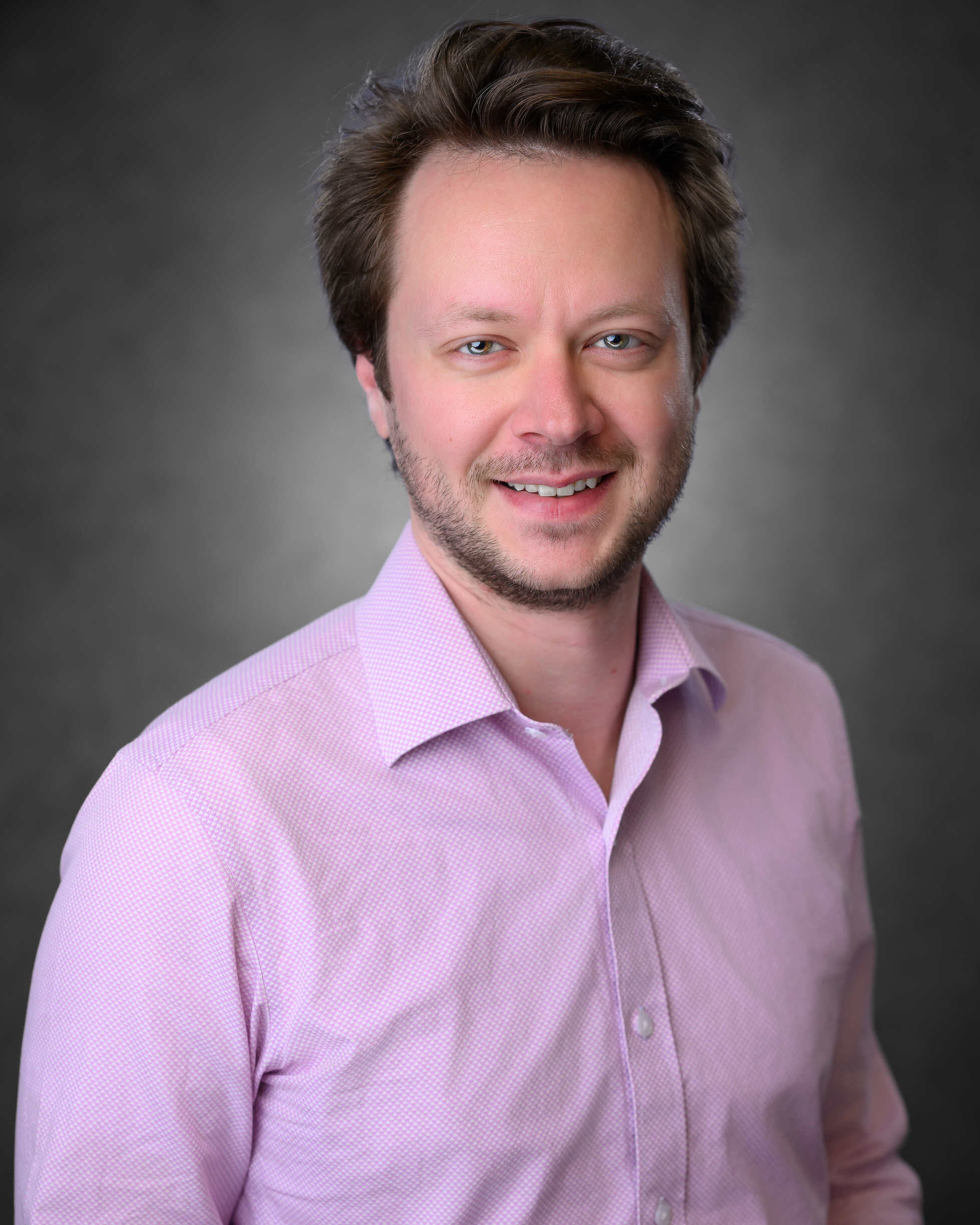
for Fermi GBM, ‘Gravitational Waves and Gamma-Rays from a Binary Neutron Star Merger: GW170817 and GRB 170817A.’ LIGO is a set of instruments designed to detect gravitational waves, which are ripples in the fabric of spacetime itself. The most sensitive of these is in Livingston, Louisiana, 25 milies from LSU's Baton Rouge campus..
“LIGO and GBM separately detected a cosmic collision, LIGO through gravity and GBM through light, which occurred 140 million years ago,” said Burns. “Their signals arrived at Earth only 2 seconds apart, confirming that gravity and light move at the same speed. This was the last major prediction of Einstein’s to be tested, 100 years after it was first described.”
Much of Burns and Negro’s research focuses on gamma-rays. They both have key roles in NASA’s forthcoming Compton Spectrometer and Imager, or COSI, mission which will map out the creation of matter and annihilation of antimatter in the Milky Way.
###
Mimi LaValle
Louisiana State University
Department of Physics & Astronomy
225-439-5633