
Starting STEM Early: ECEI Faculty Present Food-Based Science and Math Learning for Toddlers and Preschoolers at International Conferences
April 01, 2026
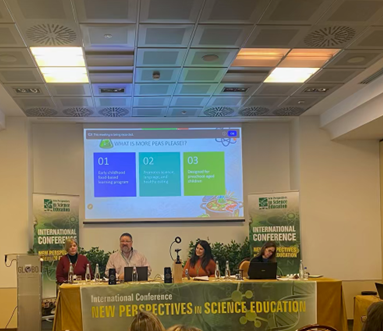
BATON ROUGE, LA — Faculty from the LSU Early Childhood Education Institute (ECEI) recently engaged in international collaboration through presentations in Berlin, Germany, and Florence, Italy. Gene Geist, PhD (Louisiana State University, Early Childhood Education Institute); Cynthia DiCarlo, PhD (Louisiana State University, Early Childhood Education Institute); and Melani Duffrin, PhD (Northern Illinois University) shared their work with faculty and doctoral students, highlighting cross-university partnerships and innovations in early childhood education.
The team presented at the International Academic Conference on Education, Teaching and Learning in Berlin and the International Conference on New Perspectives in Science Education in Florence. Across both venues, their presentations focused on the mission and vision of the LSU Early Childhood Education Institute, the impact of the FoodMASTER program, and ongoing efforts to extend this evidence-based model to serve younger children, including toddlers and preschoolers.
FoodMASTER, originally designed to integrate nutrition education with early learning, is being expanded through grant-funded work to reach children ages two to four. Duffrin has served as the Principal Investigator on several grants supporting this initiative, leading efforts to scale the model across early childhood settings.
“I am thrilled to partner with early childhood faculty to expand the reach of FoodMASTER to younger learners,” Duffrin said. “Scaling this work to toddlers and preschoolers allows us to introduce nutrition, science and math concepts at a critical point in development.”
This work highlights the importance of introducing healthy habits alongside early STEM learning experiences within early care and education environments.
“These international presentations allowed us to elevate an important issue in early childhood education—the need to introduce science and mathematics concepts much earlier in development,” DiCarlo said. “Too often, STEM learning is delayed until later grades, yet young children are capable, through well-planned activities, of practicing math and science skills. Using food as a context creates meaningful opportunities for children to explore these concepts in ways that are engaging and developmentally appropriate.”
“Integrating nutrition with early science and mathematics learning provides a practical and accessible entry point for educators,” Geist said. “By embedding these experiences into everyday classroom activities, teachers can support both healthy habits and early cognitive development in ways that are sustainable and impactful.”
The presentations also emphasized interdisciplinary collaboration, bringing together expertise in early childhood education, nutrition and STEM learning. Discussions with international colleagues explored how the FoodMASTER model can be adapted across different cultural and educational contexts, further strengthening its potential impact.
Through these engagements, ECEI continues to expand its global partnerships, creating opportunities for collaborative research, doctoral student engagement, and the dissemination of innovative practices that support young children from birth through age five.
For more information about the Early Childhood Education Institute, visit lsu.edu/ecei.
About the LSU Early Childhood Education Institute (ECEI)
The LSU Early Childhood Education Institute (ECEI) advances high-quality early childhood
education through research, dissemination, and partnerships that support young children
from birth to age three. Grounded in the belief that Early Childhood Matters, ECEI
works to develop expert practitioners, inform policy, and bridge research to practice
through innovative programming and collaborative initiatives.