
Designing for Child Choice: LSU ECEI Explores Innovative Early Childhood Environments in Bologna, Italy
April 01, 2026
 BATON ROUGE, LA — Faculty from the LSU Early Childhood Education Institute (ECEI) recently engaged in international collaboration through a visit to an innovative
early childhood program in Bologna, Italy. Cynthia DiCarlo, PhD (Louisiana State University, Early Childhood Education Institute) visited the site alongside Marcella Terrusi, PhD (University of Bologna, Early Childhood Education Institute) to examine how environmental design can support child autonomy, engagement and learning.
BATON ROUGE, LA — Faculty from the LSU Early Childhood Education Institute (ECEI) recently engaged in international collaboration through a visit to an innovative
early childhood program in Bologna, Italy. Cynthia DiCarlo, PhD (Louisiana State University, Early Childhood Education Institute) visited the site alongside Marcella Terrusi, PhD (University of Bologna, Early Childhood Education Institute) to examine how environmental design can support child autonomy, engagement and learning.
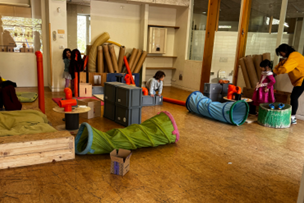
The visit focused on how early childhood environments can be intentionally structured to allow children greater choice throughout the day. The program was organized across two buildings—one serving infants, toddlers, and younger three-year-olds, and another serving children ages three through six. Across both settings, children were provided meaningful opportunities to move freely between spaces, with adults positioned in environments rather than assigned to fixed groups of children.
 In the building serving older children, educators were responsible for specific areas
of the building, and children independently navigated between spaces based on their
interests. In the building serving younger children, children were welcomed into a
central space and then invited by educators to explore different environments, supporting
autonomy while maintaining appropriate guidance.
In the building serving older children, educators were responsible for specific areas
of the building, and children independently navigated between spaces based on their
interests. In the building serving younger children, children were welcomed into a
central space and then invited by educators to explore different environments, supporting
autonomy while maintaining appropriate guidance.
One particularly innovative feature of the program was its approach to mealtime. Rather than a fixed lunch schedule, the school created a restaurant-style dining experience, where the dining space remained open for an extended period and children chose when and with whom they would eat. This structure supported both independence and social interaction, while ensuring all children were served.
“What stood out most was how choice was embedded into the design of the entire environment,” DiCarlo said. “Children were not limited to selecting from pre-defined activities within a classroom—they were navigating spaces, making decisions, and engaging with peers in ways that reflected a high level of trust and intentional planning.”
The visit also highlighted how the environment supported children’s identity and expression, with many children engaged in dramatic play, wearing costumes and moving freely across spaces designed for creativity.
“This collaboration provided an opportunity to examine how early childhood programs can move beyond traditional classroom structures to create environments that truly support child-directed learning,” Terrusi said. “These approaches offer important considerations for how we think about space, time and choice in early education.”
This international exchange reflects ECEI’s ongoing commitment to learning from global models and bringing research-based, innovative practices back to early childhood educators in the United States.
For more information about the Early Childhood Education Institute, visit lsu.edu/ecei.
About the Early Childhood Education Institute (ECEI)
The Early Childhood Education Institute (ECEI) at LSU is an umbrella organization
to promote research and disseminate recommended practices in early childhood care
and education. ECEI focuses on children from birth to age three and works to develop
expert practitioners, advance research, and support high-quality early childhood programming.