
From the classroom to the court: LSU School of Kinesiology Senior Instructor Ari Fisher's Nearly 50 Year Journey at LSU
November 23, 2026
LSU School of Kinesiology senior instructor and alumnus Ari Fisher has been connected to the university for nearly five decades. From childhood, adolescence, and young adulthood, to coaching and teaching, the university has remained a constant over the course of his life.
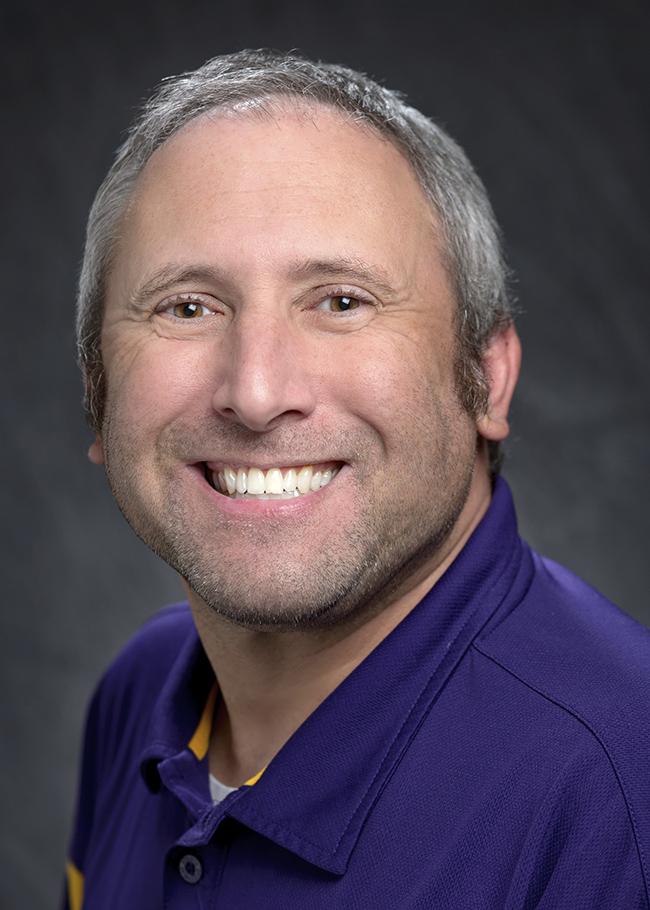
Ari Fisher, senior instructor in the LSU School of Kinesiology.
BATON ROUGE, LA - For Ari Fisher, senior instructor in the LSU School of Kinesiology, LSU was never simply just a place to attend school or establish a career. Long before he ever stepped foot into the classroom as an instructor or onto the court as a coach, it was home. Remaining the most consistent presence in life, aside from his family.
Early Years at LSU
Fisher remembers his first interactions with LSU beginning in the mid 1970s, often accompanying his mother to work and tagging along for weekend activities as a child.
“My mother worked at LSU, testing hearing in the basement of the original Huey P. Long Field House,” Fisher recalled. "On weekends, my mother played intramural volleyball in the old Gym Armory.”
His connection to LSU athletics began just as early when Fisher attended his first LSU football game in 1976, when the Tigers tied Nebraska 6-6. Nebraska was ranked No. 1 in the country at the time. He also remembers attending the Florida State game in 1982, when heavy fog made it difficult to see the field.
During this time, his love for basketball also developed by attending games such as the LSU vs. Kentucky game of 1978.
“I was at the basketball game when LSU defeated Kentucky despite all starters fouling out,” he said.
Those early memories of LSU would eventually become more than childhood experiences.
As he grew older, Fisher found himself becoming more connected to the university.
Only this time, as a student.
Building the Foundation

Ari Fisher, U-High class of 1998, poses for his senior portrait.
He began his educational journey at LSU in 1982 as a middle school student at the University Laboratory School (U-High), where his love for sports, coaching and education would continue to evolve.
Fisher learned the value of relationships at a young age. Though his class was small, with only 64 students per grade, he felt that this close-knit environment, along with the college-prep curriculum, helped lay the foundation for his future.
“I had outstanding teachers at U-High: Al Fabre, Steve Maddox, Barbara Friberg and Steve Delacroix, just to name a few. Jim Fox and Jim Hope were outstanding administrators,” he said. “Mrs. Vivian Hurst, the librarian, was probably the educator that most helped me navigate daily middle and high school life.”
It was during these formative years that inspiration sparked. Though his basketball playing career was what he considered to be mediocre, his interest in coaching was ignited.
“Because of my coaches, [Steve Maddox, Gerald Furr and Willis Stelly], I saw coaching as a noble pursuit,” he said.
After graduating from U-High in 1988, Fisher continued his journey as an LSU student, pursuing two undergraduate degrees in education and history and later pursuing a master of arts in education.
While at LSU he sought opportunities and gained experiences that would have lasting impacts on his life and career.
The Influence of Relationships

Ari Fisher, Rannah Gray, and Joe Dean reunited in 2002 while attending a formal event.
As an undergraduate student, he was a student worker in the LSU athletics department where he worked in marketing and promotions for five years. While there, his supervisor, Rannah Gray, would play an instrumental role in his development; not only motivating him to further his education, but teaching him the vital skill of professionalism.
From those who encouraged him to earn a second undergraduate degree, master’s degree, and apply to be an instructor in the School of Kinesiology, to those who helped him acclimate to college teaching and coaching, Fisher continued to develop relationships that he would later attribute much of his success to.
The Legacy of the Court
While pursuing his master’s degree, Fisher served as graduate assistant and restricted-earnings
assistant coach for LSU Men’s Basketball
from 1994 -1996, during the tenure of head coach Dale Brown, making him one of the
youngest assistants in the history of the program.
He remembers Brown’s ability to make players believe they could be successful no matter their circumstances.
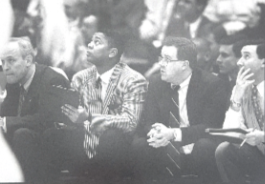
Dale Brown, LSU Men's Basketball head coach; Johnny Jones, Bob Starkey, and Ari Fisher, assistant coach, sit courtside observing a game in the mid 1990's.
“Coach Brown always said the best coaches were the best teachers,” he recalled. “I made mistakes due to youth, but Coach Brown refused to allow me to feel sorry for myself. He made sure I understood an error, how to correct it and reminded me that when someone continues to make the same error, then that is a choice.”
His coaching career was also greatly impacted by former athletic director Joe Dean who supported his decision to pursue coaching, Johnny Jones, who taught him the importance of coaching and correcting while also treating players with decency, and Bob Starkey, who he believes is one of the main reasons he succeeded as a coach.
“When I became a head coach, I do not believe I would have had any success without his mentorship and knowledge,” he said. “I am not hyperbolic when I say he is one of the best coaches in America for any sport.”
In July of 1997, Fisher returned to U-High as the head coach of the U-High boys' basketball team, where he would eventually lead the teams in record-breaking victories.
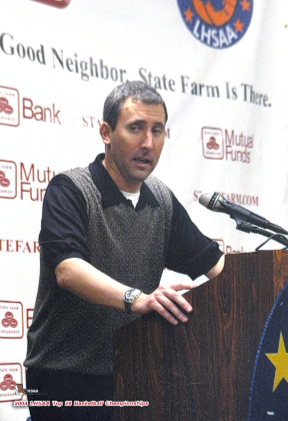
Ari Fisher addresses media at press conference after winning the Louisiana High School Class AA State Championship in 2004.
As the head boys’ basketball coach and associate athletic director at U-High, his teams won two Louisiana High School Class AA State Championships in 2002 and 2004 and became the first athletic team at U-High to be nationally ranked by the end of the season.
“The ‘02 and ‘04 teams represented the school with class,” he said. “Two of those players, [Garrett Temple and Glen Davis], subsequently played in the NBA; one was a football star at Stanford, and one [was a] player for the United States Air Force Academy.”
After retiring in June of 2008, he would return in July as the school’s co-athletic director. He would also continue his coaching career volunteering as the assistant men’s basketball coach for Baton Rouge Community College in 2011 and as the head boys’ basketball coach for middle school at Our Lady of Mercy from 2012-2018.
For Fisher, returning to the school that contributed heavily to his development, now as a coach, was truly a great honor.
From the Student to the Teacher
Inspired by the influence of those to whom he attributed much of his success, including Amelia Lee and Jo Carter, who helped him navigate teaching and professionalism on the college level, the student had become the teacher. Now he would gain the opportunity to shape the lives of the next generation not only on the court, but in the classroom.
He firmly held on to the lessons he learned throughout his journey at LSU as they laid the foundation for his approach to teaching today.
“I learned that the lightbulb turns on at different times for everyone,” he said. “Currently, I keep this in mind with current students and sometimes exhibit the patience of Job with students instead of destroying them.”
As a student, he learned what he considers to be the most important lesson he could have learned: The golden rules of teaching. Preparation was what was instilled in him as a student and now as an instructor is what he emphasizes to students.
Since 1996, Fisher has taught 23 different courses at LSU, spending many of those semesters balancing the demands of leading successful teams. He has found fulfillment in watching students navigate and transition into adult life.
He has also found great esteem in the Harry Rabenhorst Memorial Scholarship. In 2001, after receiving a financial settlement from the NCAA, Fisher donated $10,000 to endow the scholarship. The Harry Rabenhorst Memorial Scholarship continues to award $500 annually to students pursuing careers in kinesiology.
Lessons That Last Beyond the Classroom
Fisher hopes that students carry many lessons with them after leaving his classroom, including the importance of effective communication skills and lifelong learning. Recognized by students as a superior communicator, he often reminds them that these are some of the most important skills they’ll need to successfully navigate life.
“College is where students should consistently improve communication skills,” he said. “If they leave LSU without effective skills for what they say and/or write, then they have wasted time and money.”
He encourages students to make decisions that have the highest possible odds for success because life has no rewind button.
Fisher’s journey at LSU has not been without difficulty or mistakes, but these very mistakes are the fuel that keep him going. It is what allows him to continue to connect with and inspire students semester after semester.
When asked what advice he would give to his college-aged self he said:
“We only control our attitude and effort. Look in the mirror when things don’t go your way.” As he watches students embark on their own journeys, reflecting on his own, he hopes to continue to do his part in equipping students not only in the classroom, but beyond.
About the LSU School of Kinesiology
The LSU School of Kinesiology (SOK) advances the understanding of physical activity, sport, and health to optimize the quality of life for diverse populations through excellence in teaching, learning, discovery, and engagement. SOK offers a BS, MS, Online MS, PhD, and two certificate options. Graduates go on to successful careers in the health and fitness industry, corporate wellness, sport agencies and businesses, athletic administration, and K-12 educational settings. SOK is part of the College of Human Sciences & Education. Visit the School of Kinesiology website.