
Computational Astrophysics
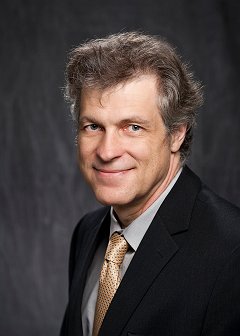
Steve Brandt
Steven R. Brandt is the Assistant Director for Computational Science at the Center for Computation & Technology (CCT) at Louisiana State University.
Brandt earned his Ph.D. in Physics from the University of Illinois at Urbana–Champaign in 1996, where his research focused on rotating black hole spacetimes.
His work centers on high-performance and parallel computing, including parallel programming, computational tools and languages, and science gateways. He has served as Principal Investigator on multiple grants supporting the Einstein Toolkit, a widely used open-source platform for numerical relativity and computational astrophysics.
Peter Diener is an Assistant Professor of Research in the Department of Physics and Astronomy at Louisiana State University, with a joint appointment at the Center for Computation & Technology (CCT).
Diener earned his Ph.D. in Physics from the University of Copenhagen in 1997. He completed postdoctoral fellowships at the University of Texas at Austin, the California Institute of Technology, and the Max Planck Institute for Gravitational Physics before joining LSU.
His research applies high-performance computing to problems in general relativity, including the development of analytical calculations for the radiation reaction problem and numerical studies of binary black hole dynamics.

Peter Diener
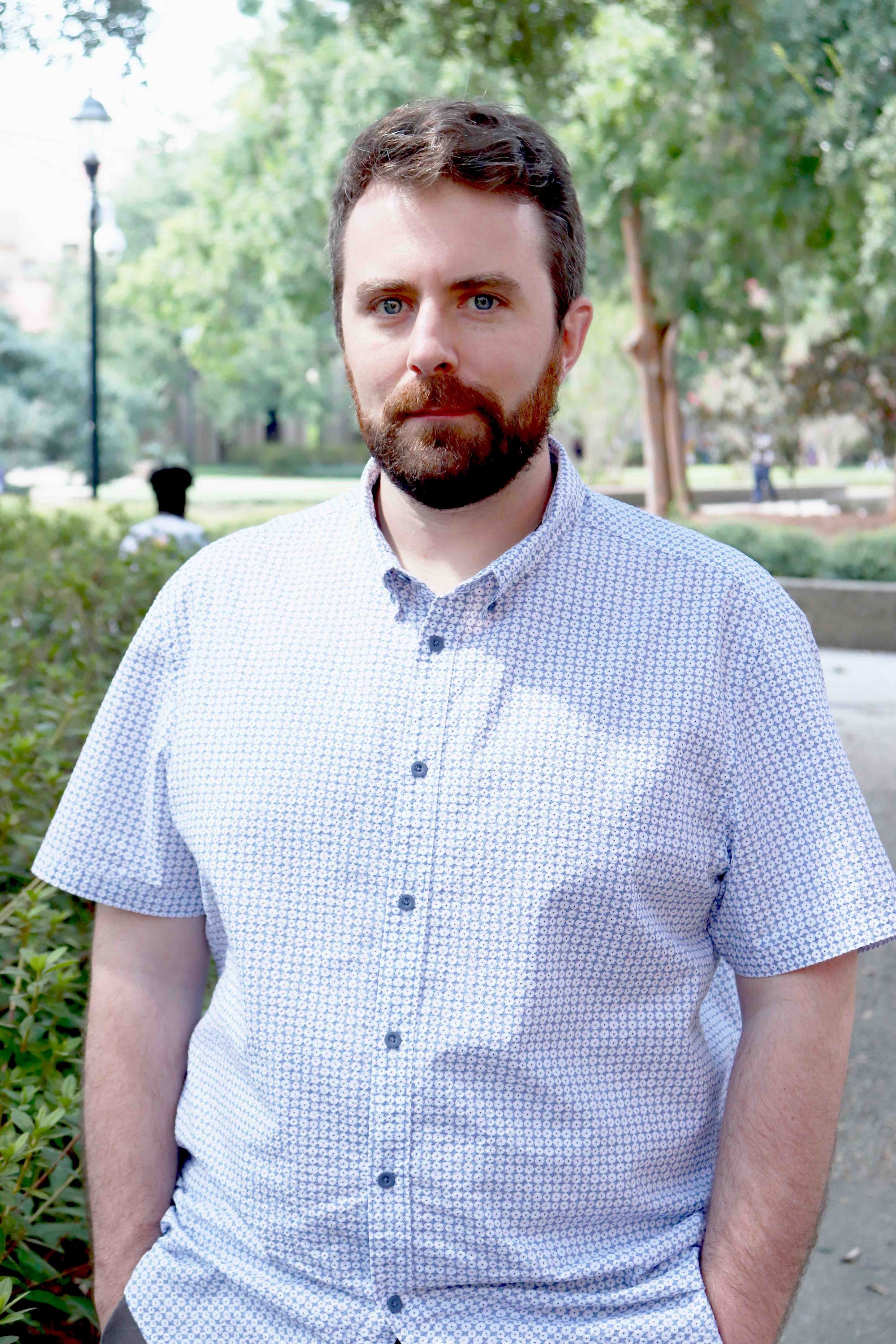
Matthew Penny
Matthew Penny is an Assistant Professor in the Department of Physics and Astronomy at Louisiana State University, with a joint appointment at the Center for Computation & Technology (CCT).
Penny earned his M.Phys. (2008) and Ph.D. (2011) in Physics and Astronomy from the University of Manchester. He held postdoctoral positions at The Ohio State University from 2012 to 2019, including as a NASA Sagan Fellow (2014–2017), before joining LSU in 2019.
His research focuses on exoplanet demographics—understanding the number and properties of planetary systems through large-scale gravitational microlensing and transit surveys. He studies how a star’s location within the Milky Way influences the types of planets that form around it.
Penny is a member of NASA’s Nancy Grace Roman Space Telescope mission (formerly WFIRST). He serves as Principal Investigator of the MISHAPS survey, which searches for transiting hot Jupiters in the Galactic bulge, and contributes to the KELT, UKIRT, CFHT, Euclid, and K2 exoplanet search missions.
Jorge Pullin is the Horace Hearne Chair in Theoretical Physics and Professor in the Department of Physics and Astronomy at Louisiana State University, with a joint appointment at the Center for Computation & Technology (CCT). He also serves as Co-Director of the Horace Hearne Institute for Theoretical Physics and is a former Interim Director of CCT.
Pullin earned his M.Sc. (1986) and Ph.D. (1988) in Physics from the Instituto Balseiro in Argentina. He held postdoctoral positions at Syracuse University and the University of Utah before joining the faculty at Penn State University, where he served from 1993 to 2001.
His research focuses on general relativity and quantum gravity, particularly on the canonical quantization of gravity. Since 1990, he has collaborated closely with Rodolfo Gambini of the University of the Republic in Uruguay, coauthoring the book Loops, Knots, Gauge Theories and Quantum Gravity (1996) and numerous papers on the foundations of quantum spacetime. He has also contributed to the study of black hole collisions and gravitational wave modeling, pioneering methods that use perturbation theory and lattice techniques to solve the Einstein equations with supercomputers.
Pullin’s honors include the Alfred P. Sloan Fellowship (1995), John Simon Guggenheim Fellowship (1998), and Fulbright Fellowship (2001). He is a Fellow of the American Physical Society, the American Association for the Advancement of Science, and the Institute of Physics (UK), which named him a Chartered Physicist in 1999. He is also a Corresponding Member of the Latin American Academy of Sciences, the Mexican Academy of Sciences, and the National Academy of Sciences of Argentina.
At LSU, he was named Distinguished Research Master in 2015. His research has been continuously supported by the National Science Foundation, beginning with an NSF CAREER Award in 1995, as well as by NASA, NATO, and the Foundational Questions Institute (FQXi).
Jorge Pullin

Parampreet Singh
Parampreet Singh is a Professor in the Department of Physics and Astronomy at Louisiana State University and an Adjunct Faculty member at the Center for Computation & Technology (CCT).
Singh earned his Ph.D. in Physics in 2004 from the Inter-University Center for Astronomy & Astrophysics (IUCAA) at Pune. Before joining LSU in 2010, he held postdoctoral position at the Institute for Gravitation and the Cosmos at Penn State University (2004–2007), and served as a Distinguished Research Fellow at the Perimeter Institute for Theoretical Physics in Canada (2007–2010).
His research focuses on the quantum gravitational nature of spacetime in cosmological and black hole settings, using analytical and computational approaches to study singularity resolution, quantum gravity effects in the early universe, potential observational signatures in the cosmic microwave background, and quantum gravitational effects of black holes. A central theme of his work is loop quantum cosmology (LQC), which replaces the classical big bang singularity with a quantum “big bounce.” CCT has been a prominent international player in pioneering the use of high performance computing methods in loop quantum cosmology.
Singh’s honors include the LSU Distinguished Faculty Award (2025), National Science Foundation CAREER Award (2015), the Mid-Career Rainmaker Award (2014), and the College of Science Faculty Research Award from LSU. He has also received the Vainu Bappu Gold Medal, was named one of Greater Baton Rouge Business Report’s 40 Under 40 in 2012, and was featured among 225 Magazine’s People to Watch in 2013.