
Using AI to Protect Louisiana's Coast & Communities
July 15, 2026
Chapter 1: Challenges and Solutions in Progress
I have spent more than two decades working in artificial intelligence. I have published on drug discovery, wildfire prediction, satellite analysis, and machine learning. But the question I get asked most often is a simple one: what is any of this actually for?
It is a fair question. I did not always have a good answer. Early in my career, I thought of AI as a set of mathematical problems worth solving on their own terms. That view changed when I came to LSU. I started paying attention to where I live.
“ The Dead Zone is chemistry, physics, and farm economics at the same time. Cancer disparities here connect to industrial history, poverty, and genetics. You cannot solve any of it by staying in your lane. That is why a team approach matters. And it is why the College of Coast and Environment at LSU is the right place to build one. ”
The Problem Is Bigger Than Any One Lab
Louisiana is losing land faster than almost any place on Earth. A football field of wetlands disappears every hundred minutes. That is not a figure of speech. It is a measured, documented rate of loss.
Every summer, a dead zone the size of Connecticut forms off our coast. Agricultural runoff travels down the Mississippi and chokes the oxygen out of the Gulf's bottom waters. Shrimp and crabs flee or die. Commercial fishers absorb the loss. The communities built around that fishery are being squeezed from two directions: by a retreating shoreline and a depleted sea.
Louisiana also carries a healthcare burden that rarely makes national headlines. Cancer rates in parts of this state run well above the national average. Rural communities can be an hour or more from a specialist. Air quality near petrochemical facilities is a documented, ongoing problem. And because we host one of the world's busiest port systems, we are usually among the first places in the country to see an emerging infectious disease.
None of these problems fits neatly into one discipline. The Dead Zone is chemistry, physics, and farm economics at the same time. Cancer disparities here connect to industrial history, poverty, and genetics. You cannot solve any of it by staying in your lane. That is why a team approach matters. And it is why the College of Coast and Environment at LSU is the right place to build one.
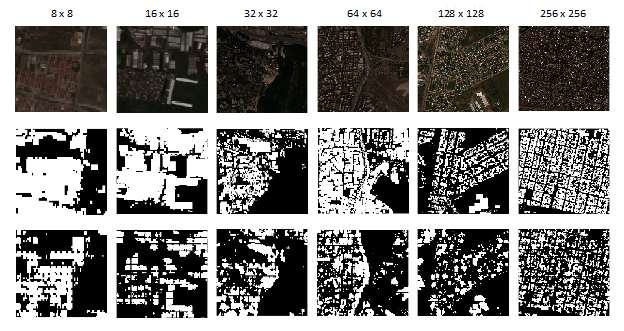
These satellite images of rooftops are used to train artificial intelligence to help in post-disaster damage assessments. This is just one example of how AI can help protect Louisiana's communities.
– Photo Credit: Supratik Mukhopadhyay
Why AI, and Why Now
People ask me whether AI is just a trend. My answer: the problems are not new. The data to tackle them is.
Satellites now photograph the entire Earth every few days. That is more imagery per week than was produced in all the previous decades of the space age. Hospital records contain detailed clinical histories for millions of patients. Genomics databases hold the complete genetic sequences of thousands of bacterial strains, including the ones that are resisting our best antibiotics. Ten years ago, we could not have seriously attempted the questions these datasets allow us to ask. The bottleneck is no longer collecting data. It is reading and understanding it.
That is what AI does. Not magic. It reads large, complex datasets faster and more consistently than any human team can. One of our hypoxia forecasting systems can predict the Dead Zone's daily extent in one second. The physical ocean model it learned from takes half an hour and 518 computer processors to run. One second versus thirty minutes is not a footnote. It is the difference between a tool a fisheries manager can use before dawn and one that sits in a research paper.
Speed matters. So does accuracy. But I have never been interested in black boxes. Every system my team builds is designed to explain its reasoning. If a physician or an emergency manager cannot evaluate why the AI flagged something, they should not trust it. Neither should I.
What This Series Covers
This is the first of four chapters. I am writing for a general audience, so I will
be translating technical work into plain language. I will not sacrifice accuracy to
do it.
Chapter 2 covers the environmental work. How AI reads satellite imagery of Louisiana's coast. How we detect wildfires faster than existing government systems. How we forecast the Dead Zone weeks before it forms. How we track Arctic permafrost thaw, which connects directly to sea level rise here. And how we help identify safe sites for carbon storage as Louisiana pursues its net-zero goals.
Chapter 3 covers health. The DeepDrug platform for AI-driven drug discovery. New antibiotics against drug-resistant infections. Work with LSU Health on head and neck cancer. Our collaboration with the Answer ALS consortium. A COVID-19 drug repurposing program that reached human trials. And two projects aimed directly at rural Louisiana: one that catches dangerous drug reactions in hospitals that lack round-the-clock pharmacy coverage, and one that monitors medically fragile infants who cannot cry out when something goes wrong.
Chapter 4 steps back. It asks why trustworthy AI matters, what makes this program different from peer institutions, and why work built for Louisiana keeps turning out to be useful for the rest of the world.
One thread connects all four chapters. These problems are linked, and so are the solutions. A separate AI system for each domain, developed in isolation, adds up to less than the sum of its parts. What works is putting oceanographers, computer scientists, oncologists, engineers, and policy specialists in the same room. Keeping Louisiana's communities in view the whole time. That is harder than publishing a paper. It is also more worth doing.
About the Author
Dr. Supratik Mukhopadhyay is a professor at Louisiana State University whose research
focuses on artificial intelligence and its applications in healthcare, environmental
science, and advanced data analytics. He has led research programs in drug discovery,
wildfire prediction, satellite image analysis, and AI safety. His work has been recognized
with the runner-up ACM SIGSPATIAL 10-Year Impact Award, and his teams have advanced
to the finals of the XPRIZE Wildfire Competition and the semifinals of the IBM Watson
AI XPRIZE. This four-part series, Using AI to Protect Louisiana's Coast and Communities,
draws on more than two decades of research conducted at LSU's College of Coast and
Environment.