
Measurement Techniques
Louisiana Light Source offers a multitude of measurement techniques for materials research. Our accelerator produces a continuous spectrum of light, from infrared to hard X-rays, allowing for exceptional opportunities for experimental research.

X-ray Absorption Spectroscopy (XAS, XANES, EXAFS)
Each element has its own specific electronic energy levels and they absorb X-rays (XAS) at energies characteristic of those levels. Near the absorption edge, the spectra may contain fine structure (XANES) that reveals the chemical environment of the absorbing atom. Farther from the edge, the spectra (EXAFS) reveals the spacings of neighboring atoms.

Soft X-ray Absorption Spectroscopy (NEXAFS, XANES)
This is part of X-ray absorption spectroscopy, generally, for elements with absorption edges located below 1,000 eV. The spectrum is often called the near-edge X-ray absorption fine structure (NEXAFS). Carbon K-edge, nitrogen K-edge, oxygen K-edge, and the first row of transition-metals’ L-edges are often studied.
X-ray Fluorescence Spectroscopy (XRF)
Each element has characteristic X-ray emission lines. The elemental composition of any material can be determined with X-ray Fluorescence Spectroscopy. The material is excited with an initial energy and all the fluorescence photons, originating from emission lines, are collected with an energy sensitive fluorescence detector. This XRF spectrum gives an overview of the energy and number of all detected photons in the selected energy range. The usual energy range at CAMD is 1-5 keV for low energy XRF, detecting Si, P, S, Cl, K, Ca, Ag etc., and 3-15 keV for high energy XRF, detecting all transition metals, Pb, Au, and others.
X-ray Diffraction (XRD)
X-ray diffraction (XRD) patterns provide interference patterns that allow one to evaluate the atomic structure of crystalline materials, powders, small molecules or larger ordered molecules like protein crystals.
Small Angle X-ray Scattering (SAXS, WAXS, GISAXS)
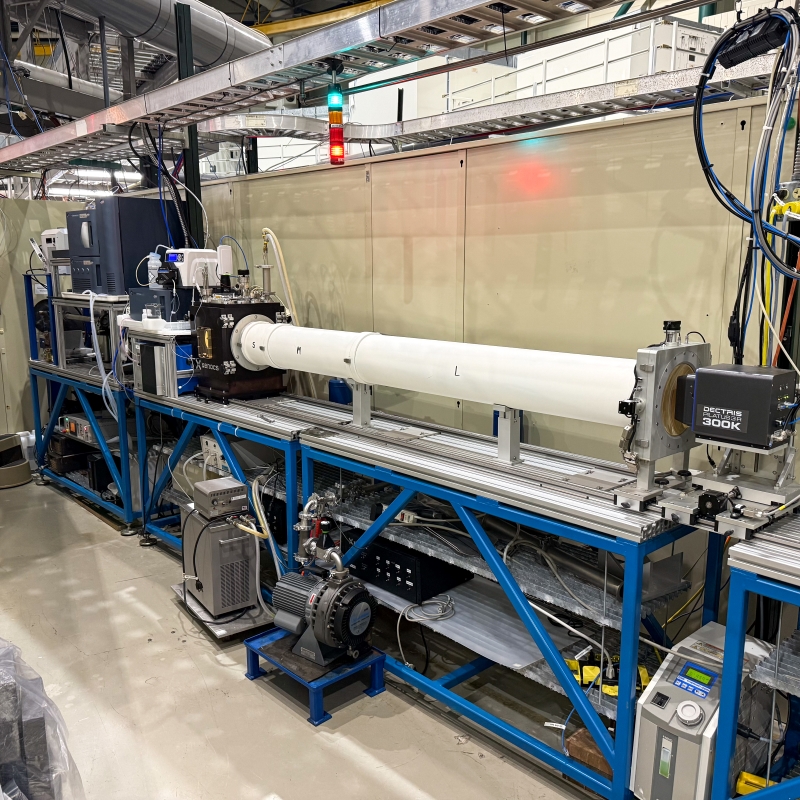
This technique provides structural information and dynamic processes of large molecular assemblies in non-crystalline materials. Many complex materials, such as polymers and colloids, and living organisms can be investigated. WAXS implies wide angle; GISAXS grazing incidence.
Tomography
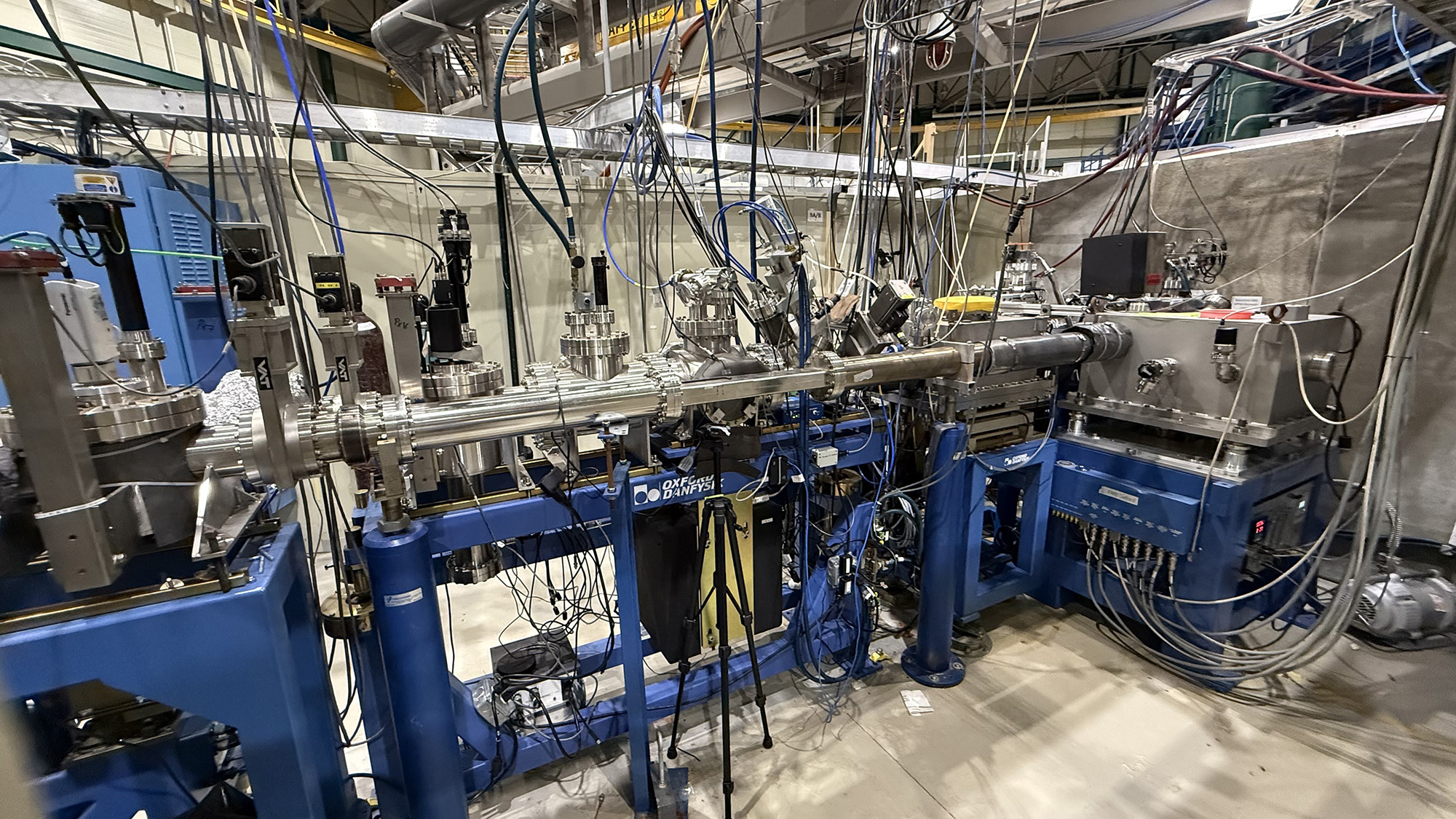
Microtomography is similar to a medical CAT scan but with about 1000 times better spatial resolution, and with synchrotron radiation it is elementally sensitive. It is accomplished by imaging by sections and reconstructing a 3D model of the object under analysis. It can be used in radiology, archaeology, biology, atmospheric science, geophysics, oceanography, plasma physics, materials science, and other sciences.
VUV Photoelectron Spectroscopy (UPS, ARPES, XPS)
The energies and directions of electrons emitted from a sample are studied, providing information on the electronic structure (UPS), chemical adsorbates and reactions, and the electronic band structure (ARPES) as well as providing information on elemental oxidation states (XPS).
Nanofabrication Facility
The NFF provides state-of-the-art instruments for designing, fabricating, characterizing, and testing of complex nano/microscale structures and devices. The NFF is housed within a 2,500 square feet ISO-5 cleanroom with staff available for training, process consultation, and collaboration.