
Small-Angle, Wide-Angle, Grazing-Incidence X-ray Scattering
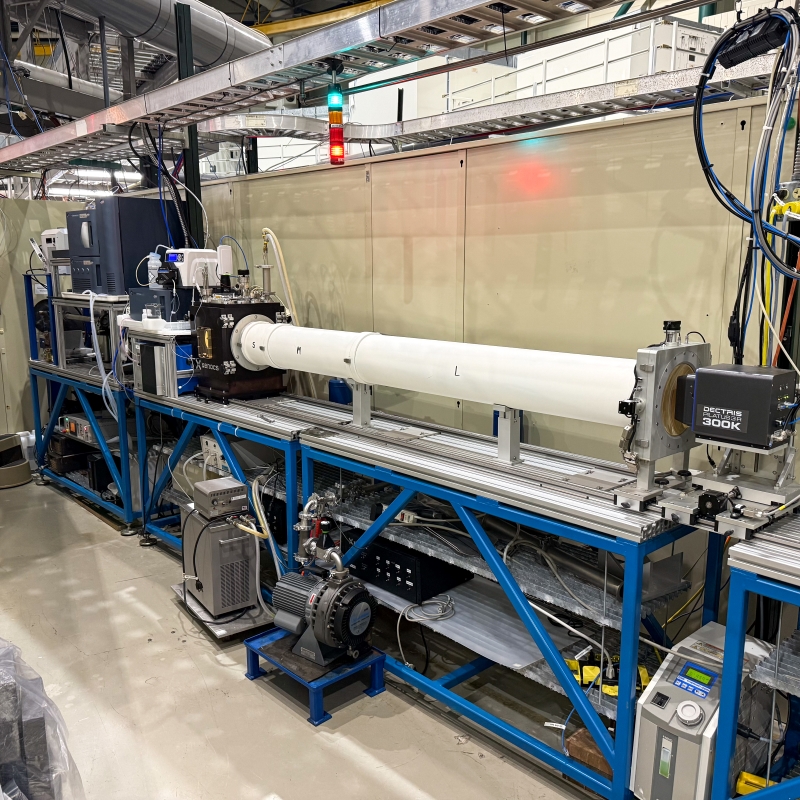
SAXS beamline
SAXS is an experimental technique for determining the structure of non-crystalline materials. While X-ray diffraction (XRD) provides information on the atomic scale location of atoms, SAXS provides information on the structure of larger-scale materials such as proteins, micelles, and polymers. SAXS allows users to observe structures such as nanotubes (1D), layered materials (2D), aggregates, and materials like colloids (3D) and can provide information on any order that exists within the structure. When done in grazing incidence, materials like thin-films or the surfaces of cell membranes can be investigated.
X-ray scattering probes different length scales. WAXS (5-40°) probes structures ~0.1-2 nm, SAXS (0.1-10°) probes 0.5-100 nm while ultra-small SAXS or USAXS (0.01-0.5°) provides information on length scales 20-1000 nm.
Beamline
At LLS, the X-ray scattering beamline is located at port 3A-4, which is illuminated by a 7.0T wavelength-shifter insertion device. The monochromator is a double-multilayer equipped with Ru/B4C multilayers (2d = 5 nm) with the photon energy set at 11.7 keV. Higher energies can be used. Beryllium lenses located in front of the monochromator partially collimate the beam. Combined with a classical pin hole collimation setup, the percentage of monochromatic and collimated light at the sample position is improved.
The sample chamber with the inner dimensions of 356 mm (H) x 270 mm (W) x 265 mm (D)
can be operated in air, helium, and in vacuum. Several feedthroughs allow the installation
of a wide array of sample environments. The sample table allows linear translations
in all dimensions and the tilting required for GISAXS.
The detector in this setup is a Pilatus3 R 300K which has 487 x 619 pixels with a pixel size of 172 x 172 µm2 and an area of 83.8 x 106.5 mm2. The minimal sample-to-detector distance (SDD) is 295 mm with a maximum of 2449 mm, covering the q-range between q = 0.0025 Å-1– q = 0.83 Å-1at 11.7 keV.
Important Q-range settings:
| Flight tube | Sample to detector distance | Q-range |
| none | 263.4. mm | 0.023 - 1.12 A-1 |
| S | 463.4 mm | 0.014 - 0.65 A-1 |
| L | 1563.4 mm | 0.004 - 0.18 A-1 |
| S + M + L | 2417.4 mm | 0.003 - 0.12 A-1 |
STANDARD SAMPLE PLATE
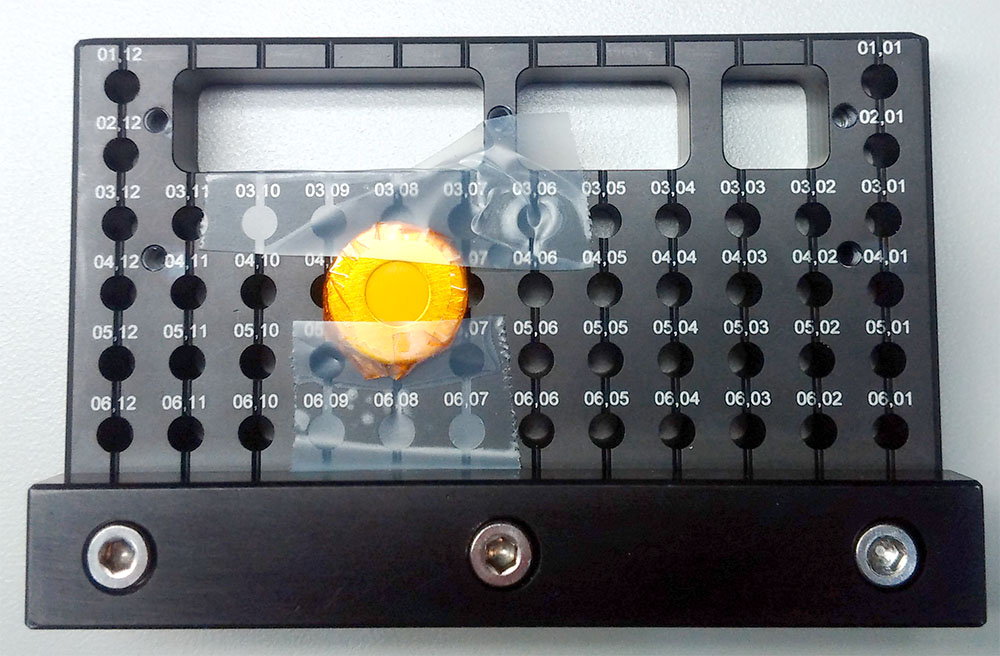
- 52 holes (diameter 4mm, 4mm apart from each other)
GISAXS SAMPLE HOLDER
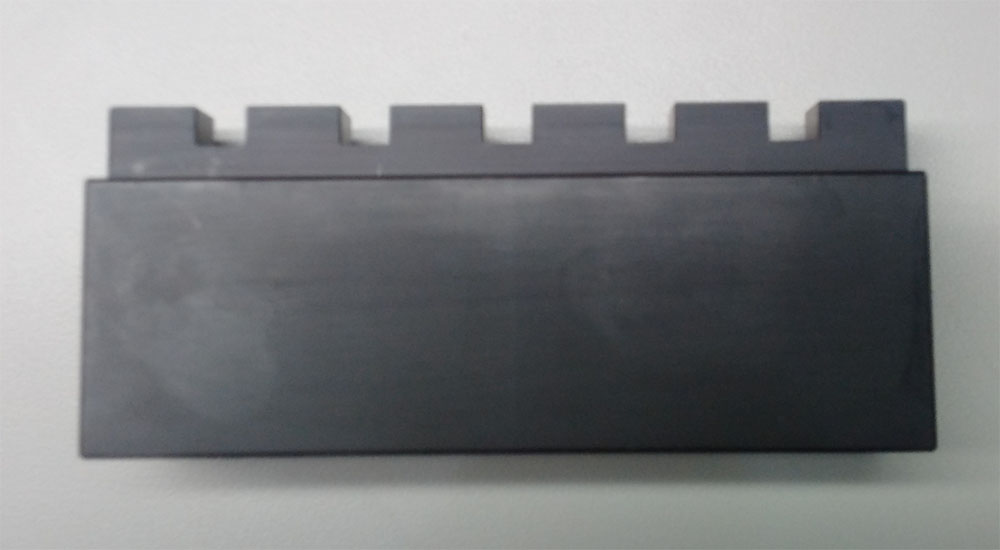
- 5 sample locations, each 10mm x 12mm
INSTEC TEMPERATURE CELL
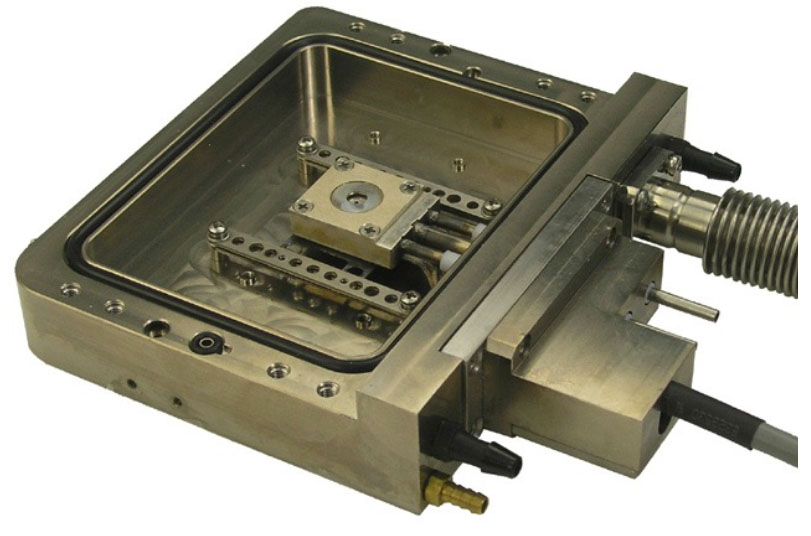
- Temperature range: -190°C to 600°C
- Sample holder for liquids: place for a capillary with a diameter of 2mm and a length of 13.5mm
- Sample holders for solids:
- thickness: 1.0 mm, 2.0 mm, 2.5mm
- diameter: 5 mm, 10 mm, 20 mm
FLOW-THROUGH CELL
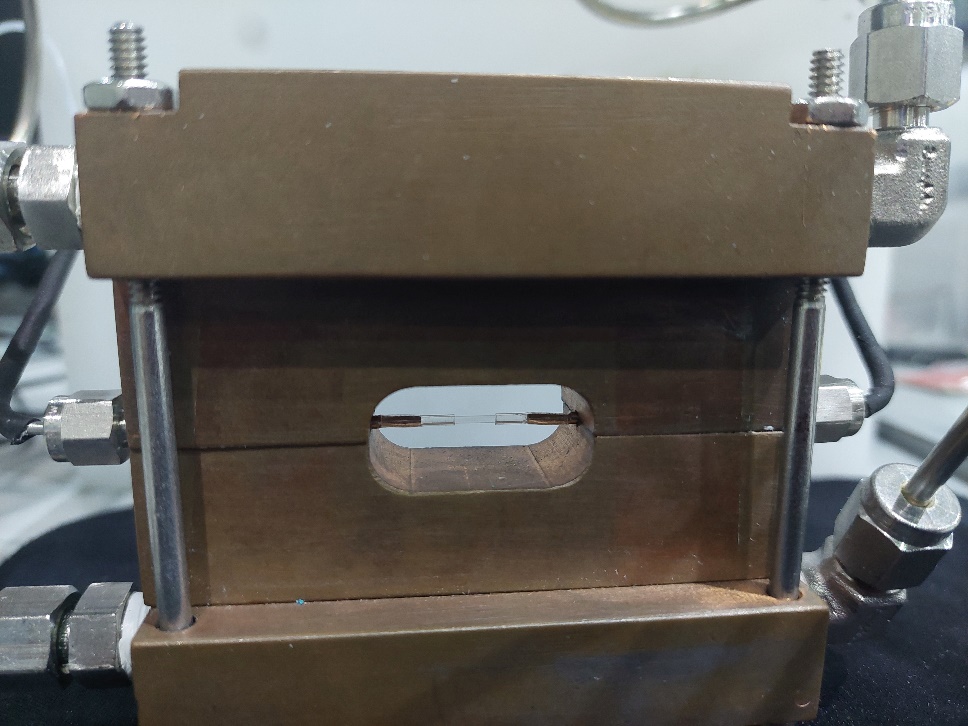
- 1mm diameter borosilicae capillary
- Not only for aqueous, but also for organic solvents
- Flow path: per-fluorinated polymers, steel, and glass
- Volume: 0.1 mL—when measuring at multiple distances, a volume of 0.2 mL is needed
- Temperature can be controlled by a chiller
SANDWICH CELL
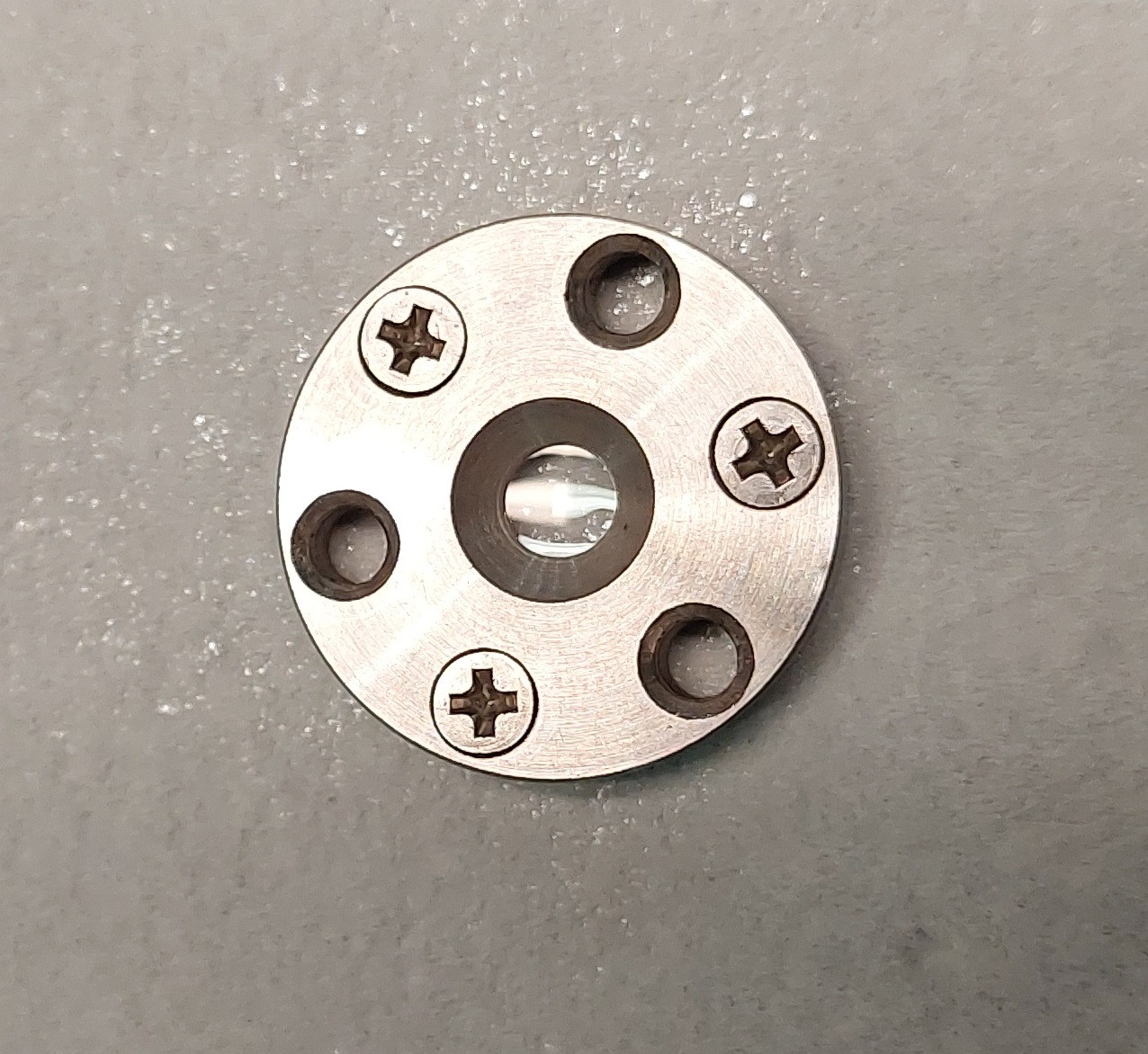
- Can be used for high-viscosity samples, such as gels or polymer melts
- Cell made of steel and mica sheets (5-7 micrometers in thickness) as one-time use window material
- Can be attached to the Instec cell
- Volume 0.05 mL