
Mapping Science Through Art
September 08, 2026
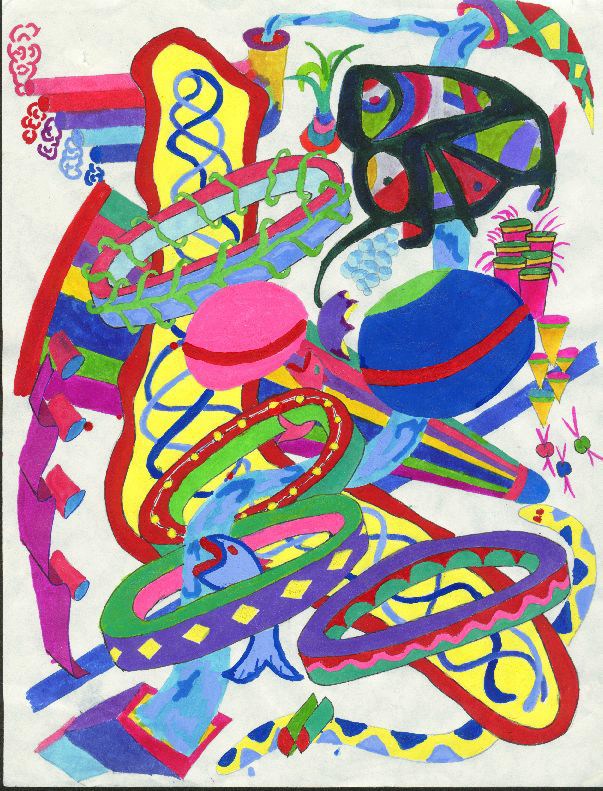
Day, a professor of Oceanography & Coastal Sciences, began drawing more than 50 years ago.
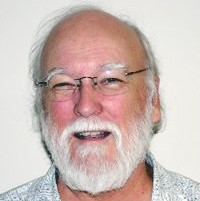
Dr. John Day
BATON ROUGE - For more than five decades, Dr. John W. Day, Jr. has helped shape our understanding of coastal wetlands, mentoring generations of scientists while producing an extensive body of research on the Mississippi River Delta and coastal ecosystems around the world. But, there is another side to Day’s work, one that brings art and science together.
Beginning in the 1970’s, Day began doodling during faculty meetings, graduate examinations, agency meetings, and scientific conferences. "A doodle is a casual or aimless drawing made while a person's attention is otherwise occupied," Day notes. Over the decades, these doodles evolved from simple pen-and-pencil sketches into painted works created using a variety of media. The final composition was assembled in 2021 and 2022 for Celebrating Our Journey, the 50th anniversary of LSU’s Department of Oceanography academic programs.
From September 13, 2025, until January 2, 2027, visitors can see Day’s “Doctor Dazed Doodle Delta” exhibit showcased at the LSU Museum of Art.
The artwork incorporates imagery from three landmark scientific studies documenting the evolution of the Mississippi River and Delta. These include Harold Fisk's influential 1944 maps of the river's Holocene meander belt, the wetland habitat change maps produced by Britsch and Dunbar in 1993, and the comprehensive wetland change analysis published by Couvillion and colleagues in 2017.
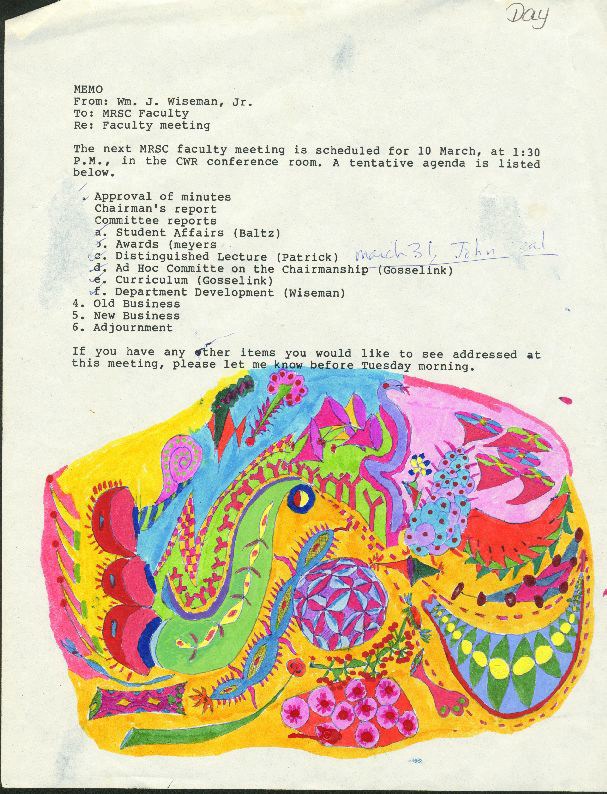
Day doodled in faculty meetings, graduate examinations, agency meetings, and scientific conferences.
Layered across these scientific images are whimsical doodles, sketches, and figures that Day began drawing more than 50 years ago. Together, they tell the perspective of a scientist whose curiosity extended beyond the laboratory and into the creative process itself, illustrating how both art and science rely on observation, interpretation, and a desire to better understand the world around us.
The result is a visual record of a career spanning science, education, and creativity. While the maps document environmental change, the doodles capture a more personal side of a lifetime spent thinking, teaching, and discovering.
The exhibit also reflects the collaborative spirit that has characterized Day's career. He acknowledges the use of imagery from paintings by artists Melissa Sarat, Allison Stewart, George Dugan, Jane Hallmark, and Bruce Carter, as well as the production expertise of Garrett Roberson and Alex Ruch of Vivid Ink in Baton Rouge.
Day joined LSU in 1971 and retired in 2005, but his influence on the university continues. During his career, he published an average of approximately eight peer-reviewed journal articles, book chapters, or books each year and mentored, advised, or co-advised 70 master's and doctoral students who have gone on to careers in acade