
This LSU Scientist Works in Some of Earth's Deepest Waters. She May Change the Way We Look at the Ocean.
September 28, 2026
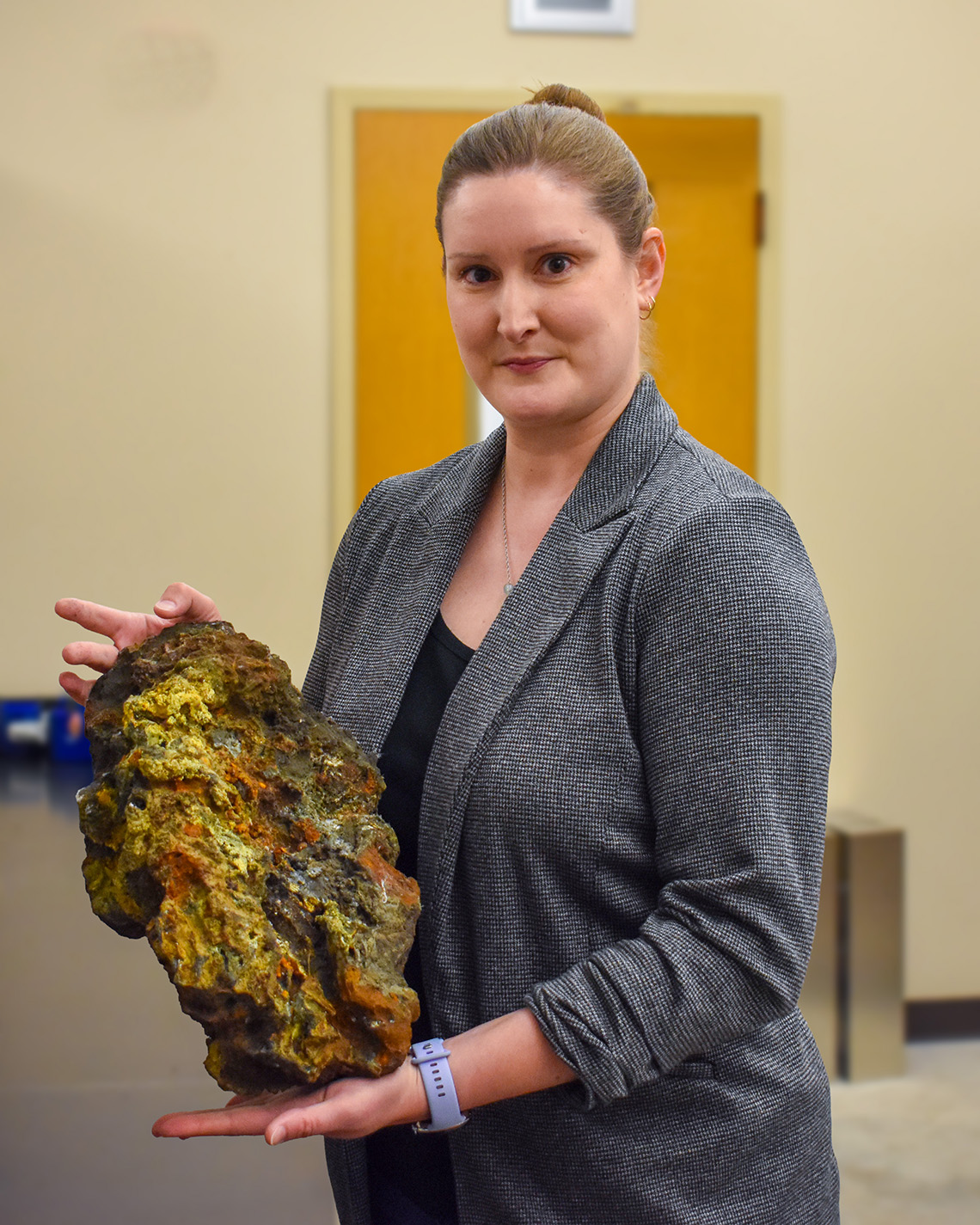
Assistant Professor Amanda Achberger holds a rock collected from the sea floor during her sampling.
Oceanography & Coastal Sciences Assistant Professor Amanda Achberger is going where almost no one has gone before: the deepest depths of the ocean, where she works to understand some of the least-understood creatures on the planet.
Achberger studies the micro-organisms that live in the crevices of hydrothermal vents –underwater hot springs that spew magma-heated ocean water – once the vents have become inactive.
What she’s learning may change the way we look at the ocean.
We chatted with Achberger about where she goes, what she’s learning, and why it matters.
So, tell us about your research: At the most basic level, I'm interested in understanding what microorganisms are in an environment and how their interactions with other microorganisms, other organisms in general, and the environment itself are impacting how ecosystems function, how nutrients flow through an ecosystem, how that contributes to health and stability of environments.
Throughout my career, I've sort of looked at these interactions in a variety of environments. I've done work in polar environments in Antarctica. I've done work in surface seawater impacted by oil spills, and now a lot of my work is examining the seafloor environment.
What took you to the seafloor?
I've always been fascinated by environments that are driven by chemical energy sources, so environments that are outside of the sunlit zone. That fueled some of my early interest in polar microbiology. And when I had the opportunity to do seafloor work, I jumped on it.
What is the major research question you're trying to answer right now?
In our ongoing work with seafloor microbial communities we’re particularly focused on hydrothermal vent mineral deposits, which are mineral deposits left over once hydrothermal venting ceases.
These are very metal-rich, chemical-rich, rock deposits. We have found there are microorganisms that are very happy to be living there, and they are contributing potentially significantly to carbon cycling in the deep sea, and that is having implications for higher trophic level organisms.
We know that these features are globally distributed, but they, for the most part, have been treated as biologically insignificant in the grand scheme of things. Our findings are showing that that is definitely not the case. We're just trying to understand how that particular ecosystem functions from the bottom up.
We're starting to find that there might be a unique, potentially endemic animal population in these sites that are being supported by this microbial community.
How deep down are you talking about?
The sites that we're looking at are 2500 meters below the surface of the water.
Can you tell us a little bit about how you sample?
We have to rely on ROVs or submersibles that are capable of going down that deep… The site we focus most heavily on is about a seven-day steam from San Diego, California. We’re there for… usually four or five weeks every time we go out.
We bring chunks of rock back to the surface, take samples from different parts to try and understand what microorganisms are there, what's the chemical composition of the rocks, and then we do experiments on the microorganisms to try and understand what they're doing.
What do you want people to know about these microorganisms and the deep sea environment?
What I love about microorganisms in general is just how extensively they are impacting so much of our lives. We're only now really beginning to appreciate how microorganisms are affecting our human body, such as the gut microbiome. But the same thing is happening in the environment. We're only really now starting to appreciate the diversity of microorganisms and all the things that they are involved in doing in environments and how that is enabling us to live.